Jeroen Brinkman

What It Actually Does
An alien fleet travels through an elongated wormhole toward your base. The enemies appear one by one from the far end of the LED strip, marching steadily toward you. Your job is to shoot them with the right colour laser before they reach the end.
You have three laser buttons: red, green and blue. The trick is that combinations work too. Press red and green simultaneously and you fire yellow. Green and blue gives cyan, red and blue gives magenta, all three gives white. No controller with forty buttons. Three buttons, seven colours, one increasingly panicking player.
The Enemies
Asteroids are single pixels in a primary colour — red, green or blue. One button, one shot, one point. Perfect for a four-year-old. They will feel like a hero.
Planets are single pixels in mixed colours — yellow, cyan or magenta. Now you need to press two buttons at the same time. This is where younger siblings start losing to older siblings and nobody is happy about it.
Stars are white pixels that always appear last in a wave. All three buttons simultaneously. Three points. The button LEDs flash as a victory celebration, which is objectively the best part of the game.
Meteors are four consecutive pixels of the same colour, noticeably dimmer than single invaders — and they get dimmer the more damage they take. Each pixel has 2 HP and you must work from the front pixel backward. Eight hits to destroy, four points maximum. Missing a shot on a meteor does not just waste your time: the wrong-colour bullet joins the front of the wave, making the problem longer. Consequently, the family member who keeps missing the meteor becomes very popular.
The Bosses
Three boss types appear at higher levels, after the wave is cleared. Bosses advance from the far end of the strip and fire back. Miss one incoming projectile and it is immediately game over.
The Rampart crawls slowly toward you, fires projectiles in colours that often don't match its front segment (rude), and enters rage mode if you hit it with the wrong colour three times in a row — unleashing a rapid burst that has ended more than one promising run.
The Sentinel stops at three fixed positions, charges up with a pulsing warning, then fires a barrage of projectiles. After the barrage, its segments become vulnerable for a limited time. The segments you don't destroy in time make the next barrage longer. It is the closest a strip of LEDs can get to being passive-aggressive.
The Prism has fifteen segments in random mixed colours and never stops moving. Twice during the fight all segments turn white and it becomes briefly invulnerable — then recolours randomly and immediately fires a burst in mixed colours. This is the hard boss. Children who reach the Prism should be treated with respect.
What Makes This Different
It fits in a living room. The strip is two metres long and hangs on a wall, lies on a table or drapes over a shelf. No dedicated game room required.
No noise. No speakers, no sound effects, no eight-bit music loop that lodges in your brain for three days. A normal conversation remains entirely possible. You might even enjoy it.
No apps, no WiFi, no Bluetooth, no 3D-printed parts. Plug it in, play it. The entire interface is three coloured buttons with built-in LEDs, one black confirm button and a six-digit display. Anyone who has ever pressed a button can figure it out within thirty seconds.
Selectable level range. You choose a start level and a stop level before each game. For the youngest children: levels 1 to 2, primary colours only, no shooting back. For older kids: 3 to 5, mixed colours, meteors, one boss. For the household's self-proclaimed gaming expert: 6 to 9, fast waves, complex meteors, all three bosses. Or play all nine levels in one sitting if everyone has time and nobody needs to go to bed.
Nine Levels, Fully Configurable
Each level is defined by a ten-column table in the firmware: gap between waves, number of waves, asteroid count,...
Read more »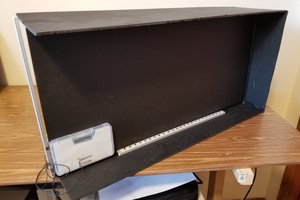
 Bob Baddeley
 dacshayan
 mircemk