 ElectroBoy

If you have seen my previous audio projects, the tone processors, my preamps and amplifier boards you already know one thing. Almost every single one of them needed potentiometers. Bass, treble, mid, volume, balance, gain. Knobs, knobs, knobs everywhere. Every time I designed a new board, I had to add those same pots all over again. Buy them again, solder them again, find footprint space for them again. These are big, bulky through-hole parts, and they make a mess of an otherwise clean SMD layout.
They take up half the board, they stick up tall, and the moment the project is done they are stuck on that PCB forever. I cannot reuse them. I cannot pull six soldered pots off a finished board and move them to the next one without wrecking everything. So I sat at my workbench, looked at a drawer full of loose pots and three boards all carrying the same volume/bass/treble trio, and thought - enough of this. Enough of pots on every board. Let me make the pots once, as a separate plug-and-play module, and just reuse that forever. That is exactly what this little project is. Let's see how it works.
Why Onboard Pots Are Such a Pain:
Let me be honest about why I dislike putting pots directly on the main PCB. There are real practical reasons like:
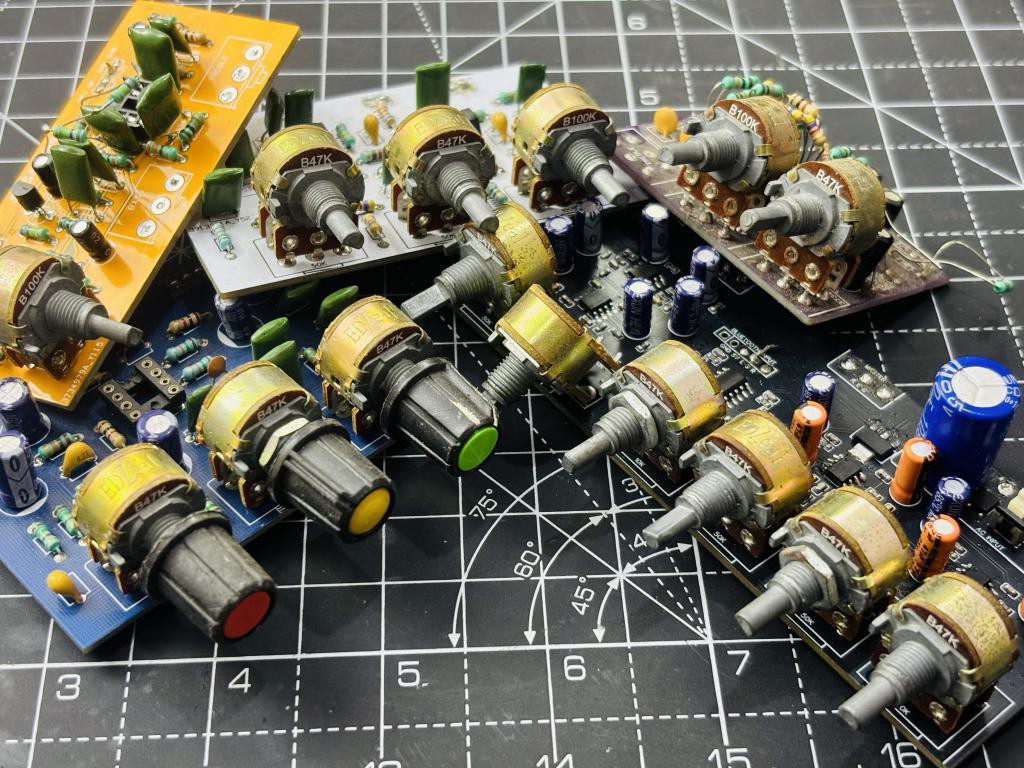
- They eat board space. A standard 16mm pot footprint is huge compared to an SMD IC. Three or six of them and your nice compact board is suddenly twice the size.
- They are tall, through-hole, and mechanical. They do not fit the spirit of a small SMD board, and they put mechanical stress on the PCB every time you turn a knob.
- They are not reusable. Once soldered, they belong to that board. Desoldering six pots cleanly is a nightmare and you usually kill the pads.
- You keep re-buying them. Every new build is another order of the same six pots. I have probably bought the same 100K pot fifty times by now.
- They clutter routing. Six pots means eighteen terminals to route across the board, right through the area where your sensitive analog signal lives.
I want to keep my main boards minimal. Clean signal path, small footprint, easy to lay out. The pots are fighting that goal on every project.
Make the Pots a Module Once, Reuse Forever:
The concept is dead simple, and that is exactly why I like it. Instead of placing pots on every project board, I made one small dedicated PCB that holds all the pots, and I break every terminal out to a header. Then on any future project, I just place a matching header and plug this module in with a connector or some wires. Plug and play.
Wire to wireless just needed a Bluetooth module? Same idea here, onboard to modular just needs a header. Yah! That is the whole trick. The pots become a reusable building block, like a sensor module or a breakout board. Design it well once, and every preamp, tone control, or amplifier board I make from now on gets cleaner and smaller, because the bulky stuff lives off-board on a part I already own.
Choosing the Pot Values:
This was the one part that actually needed a little thought. I did not want a random pile of pots — I wanted the values that cover the most common audio preamp and tone-control needs, so this single board fits the maximum number of projects without changes.
In my experience building audio gear, two values show up again and again:
- 100K: This is the classic value for volume controls and for high-impedance preamp inputs. Most volume pots in line-level audio sit around 50K–100K and it is also common in passive tone stacks and balance controls.
- 47K: This is everywhere in tone and EQ networks. Bass and treble cut/boost networks, mid controls, and a lot of op-amp based filters are designed around 47K.
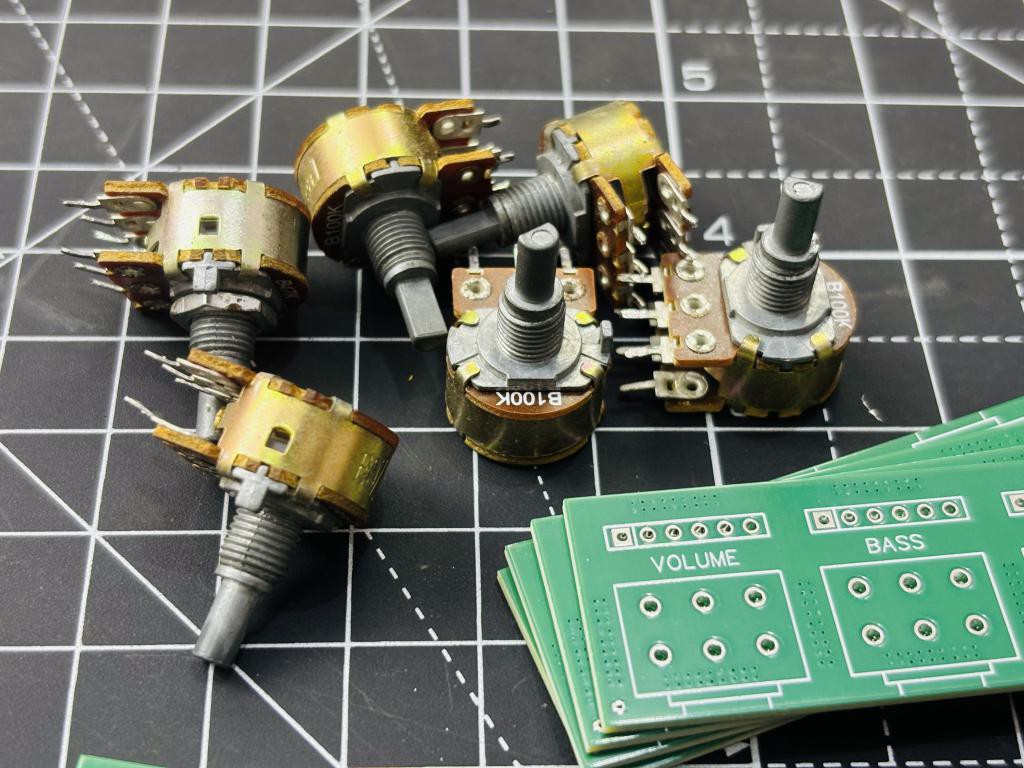
So I put three of each 3x 100K and 3x 47K. Six pots total. That covers the typical bass / treble / mid / volume / balance / gain set that most of my preamp projects need. If a project only needs four, I just leave two unused. I built this board with linear pots because they are what I had on hand and they...
Read more »