Elehobica

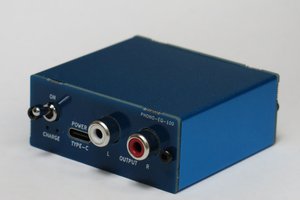
An MC cartridge puts out roughly a tenth of what an MM cartridge does, so an MM phono stage needs something ahead of it. This is that something, and we wanted it to keep the two things that define the EQ-100. Small, and battery powered.
Battery operation is what shapes the rest. A boost converter would let us run a higher-voltage op-amp, but a switching converter sitting next to a stage that amplifies a few hundred microvolts is a noise problem you then have to spend the rest of the project solving. So there is no converter and no regulator. The circuit runs on whatever the cell actually delivers, anywhere from 2.9 V to 4.2 V, and the operating point holds across that whole range.
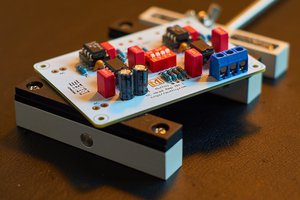
That rules out most low-noise op-amps, which is fine, because a discrete stage is a better fit here anyway. The amplifier is a single common-emitter bipolar stage per channel, biased by collector-to-base feedback, using two transistors in parallel. Paralleling lowers the effective base resistance, which is what sets the noise floor at the low source impedance an MC cartridge presents.
Evaluation started with KSC1815YTA in TO-92, an easy part to socket and swap while the operating point and the loading network were still moving. Once those were settled, the whole evaluation was repeated with MMBT5551 in SOT-23, since the production board has to be surface mount. Not one circuit value had to change, and the measured white noise came out slightly lower than with the TO-92 part.
 Florian Wilhelm Dirnberger
 Craig D