 Akshay Jain

What is the nRF24L01+?
The nRF24L01+ is a low-cost 2.4 GHz wireless transceiver that can both transmit and receive data. The module operates from 1.9 V to 3.6 V and is normally powered from a 3.3 V supply. It supports data rates of 250 Kbps, 1 Mbps, and 2 Mbps, while the SPI interface can operate at speeds up to 8 Mbps.
The standard PCB-antenna version can typically achieve around 50–100 meters in open space, although the actual range depends heavily on the environment, antenna orientation, interference, and data rate. For longer-range applications, versions with a PA, LNA, and external antenna are available and can reach distances of up to around 1 km under suitable open-space conditions.
The module is also designed with low-power operation in mind. It consumes roughly 11.3 mA while transmitting and about 13.5 mA while receiving. Standby and power-down modes reduce consumption significantly, making the device useful for battery-powered wireless projects.
How the nRF24L01+ Works
The nRF24L01+ operates in the 2.4 GHz ISM band, covering frequencies from 2.400 GHz to 2.525 GHz. The available spectrum is divided into 126 selectable RF channels. For two modules to communicate, both devices need to be configured to use the same RF channel and compatible communication settings.
For example, if the transmitter is configured for channel 100, corresponding to 2500 MHz, the receiving module must also be configured for the same channel. Using different channels prevents the modules from receiving each other's packets. This channel-based approach also makes it possible to operate different wireless networks in the same general area.
One particularly useful feature is the nRF24L01+'s Multiceiver capability. A single receiver can communicate with up to six different transmitters using separate data pipes and addresses while operating on the same RF channel. Although six pipes can be configured, only one packet is actually received at a time.
Another important feature is Enhanced ShockBurst. Much of the packet-handling work is performed inside the nRF24L01+ itself. The module handles packet construction, addressing, CRC checking, acknowledgments, and automatic retransmission. If the receiver successfully receives a packet, it can automatically return an acknowledgment. If the transmitter does not receive the expected acknowledgment, the packet can be retransmitted. This makes communication more reliable while reducing the amount of communication-management code required on the Arduino.
nRF24L01+ Module Variants
There are several common physical versions of the nRF24L01+, although they use the same basic transceiver technology. The compact version uses a PCB trace antenna and is generally the most convenient choice for short-range Arduino projects. Its range can reach around 100 meters in open space, but walls and other obstacles can reduce this considerably.
A second version uses an SMA connector with an external antenna. The external antenna can improve signal strength and communication stability, especially where the environment contains obstacles or interference.
The third common version combines an external antenna with a Power Amplifier and Low-Noise Amplifier. The PA increases the strength of the transmitted signal, while the LNA improves the receiver's ability to work with weak incoming signals. These modules are intended for longer-range communication and can reach up to around 1000 meters in suitable open-space conditions.
The different module versions can generally communicate with each other, so an application can use a standard PCB-antenna module on one side and a PA/LNA version on the other when the additional range is useful.
nRF24L01+ Pinout

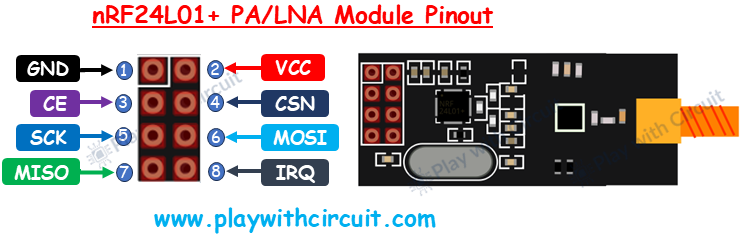
The nRF24L01+ uses an 8-pin interface. GND is the ground connection, while VCC supplies the module with power. The recommended supply voltage is 3.3 V. CE, or Chip Enable, controls the module's active transmit and receive operation. CSN, or Chip Select Not, is the active-low...
Read more »