Close
0%
0%

RotaryCell

A reversible ESP32/LTE conversion that lets a classic rotary telephone make and receive cellular calls.

Public Chat
Similar projects worth following
0 followers
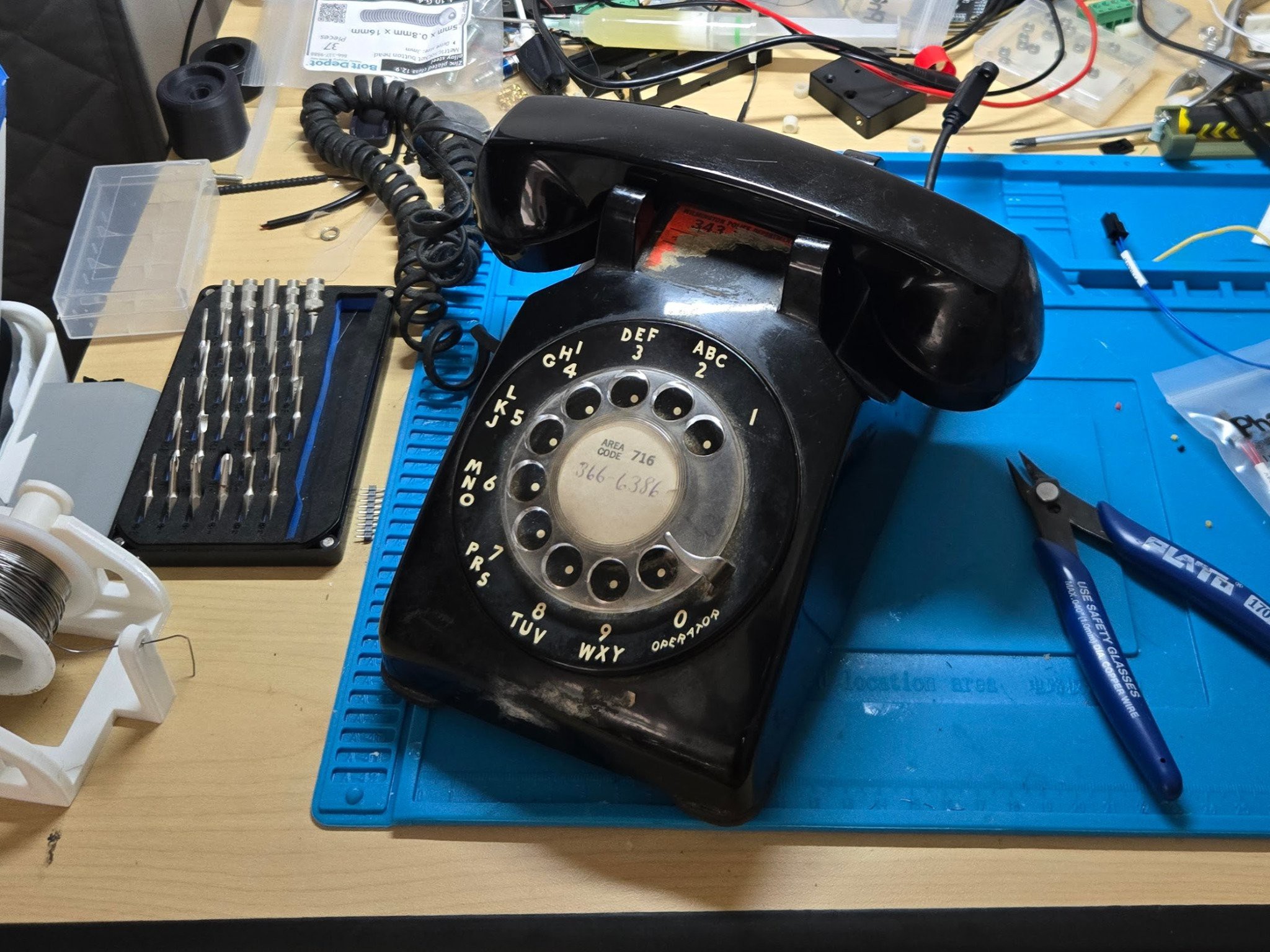
RotaryCell converts a Western Electric 500-series rotary telephone into a self-contained cellular phone while retaining its original dial, handset, switchhook, mechanical bells, network block, wiring, and case.

A LilyGO ESP32/LTE board handles cellular service and a Silvertel AG1171 interfaces with the telephone’s original analog circuitry. Two custom PCBs provide audio conditioning, control, and hardware modem reset. The conversion runs from a rechargeable 21700 cell, charges through USB-C, and requires no drilling or cutting of the telephone.

The firmware, PCB files, printable mounts, wiring diagrams, bill of materials, and complete illustrated build guide are all publicly available.


What is RotaryCell?


RotaryCell is a reversible internal conversion that gives a traditional rotary telephone its own cellular connection. The finished phone operates much like it originally did: lift the handset for a dial tone, dial with the rotary wheel, and answer incoming calls when the original mechanical bells ring.

The design preserves the original dial, handset, switchhook, network block, ringer, wiring, and case. The added hardware fits inside a Western Electric 500-series telephone without drilling or cutting it.


System architecture

A LilyGO T-SIM7670G-S3 combines an ESP32-S3 controller with an A7670G LTE modem. The ESP32 reads the switchhook and rotary dial, generates telephone tones, controls cellular calls, and manages the other phone functions.

A Silvertel AG1171 subscriber-line interface connects the modern electronics to the telephone’s original analog circuitry. It provides the line voltage, supervises the switchhook, carries handset audio, and supplies the ringing signal for the mechanical bells.

Two custom circuit boards complete the interface:

  • The AG1171 carrier connects the line-interface module to the telephone, controller, and power system.
  • The Audio/Reset A4 board conditions microphone and speaker audio and provides a hardware power-cycle circuit for recovering the cellular modem.


Power and packaging

The phone runs from a rechargeable Samsung 58E 21700 lithium-ion cell. A USB-C connector installed in the telephone’s original rear opening supplies charging power. Custom printed carriers secure the LilyGO board, custom PCBs, and rear connector inside the housing.

A typical charge provides roughly two days of operation, depending on signal conditions and use.


Firmware

The firmware handles:

  • Rotary pulse decoding
  • Switchhook detection
  • Incoming and outgoing cellular calls
  • Dial, reorder, and receiver-off-hook tones
  • Mechanical bell ringing
  • Battery monitoring
  • Persistent event logging
  • Browser-based maintenance and diagnostics
  • Web firmware updates
  • Manual hardware modem recovery


Building one

The project is fully documented. The illustrated guide covers sourcing the major components, ordering the custom PCBs, printing the mounts, preparing the LilyGO board, assembling the wiring, installing everything in the telephone, loading the firmware, adjusting the audio, and testing the completed phone.

Illustrated build guide:
https://evilroot.net/RotaryCell/

Firmware, PCB files, printable parts, and engineering documentation:**  
https://github.com/fregacmols/RotaryCell


Demonstration video:
ag1171.stl

Standard Tesselated Geometry - 35.79 kB - 09/26/2026 at 00:37

Download

audio.stl

Standard Tesselated Geometry - 31.80 kB - 09/26/2026 at 00:37

Download

LilyGO_Dial_Support_Carrier.stl

Standard Tesselated Geometry - 292.53 kB - 09/26/2026 at 00:37

Download

ESP-RotaryCell_v0.11.1-dev-source.zip

x-zip-compressed - 42.92 kB - 09/26/2026 at 00:37

Download

ESP-RotaryCell_AG1171-Carrier_Through-Hole_2026-08-28_Gerbers.zip

x-zip-compressed - 13.33 kB - 09/26/2026 at 00:36

Download

View all 7 files

  • 1 × Western Electric 500-series telephone Donor rotary telephone retaining its original dial, handset, switchhook, network block, mechanical ringer, wiring, and case.
  • 1 × LilyGO T-SIM7670G-S3 Standard ESP32-S3 controller and A7670G LTE voice modem.
  • 1 × Silvertel AG1171 Subscriber-line interface that operates the telephone’s original analog circuitry and mechanical ringer.
  • 1 × RotaryCell Audio/Reset A4 PCB Custom PCB providing adjustable audio conditioning and hardware modem power-cycle control.
  • 1 × RotaryCell AG1171 carrier PCB Custom carrier connecting the AG1171 to the controller, telephone network block, and power system.

View all 10 components

  • From hand-wired prototype to documented PCB build

    Carl F. • 2 hours ago • 0 comments

    RotaryCell began as a hand-wired, one-off conversion. That prototype proved the core idea: an ESP32 and cellular modem could read the original rotary dial, place and receive calls, operate the handset, and ring the telephone’s mechanical bells through a Silvertel AG1171 line interface.

    Getting it to work once was only the beginning. The loose wiring made the prototype difficult to reproduce, inspect, or repair. It also left little room for additions such as reliable modem recovery and controlled power saving.

    The current version replaces most of that point-to-point assembly with two purpose-built circuit boards. The AG1171 carrier handles the telephone interface and its through-hole components. The Audio/Reset A4 board handles adjustable audio conditioning and includes a hardware power-cycle circuit that the ESP32 can trigger if the cellular modem becomes unresponsive. Custom printed carriers secure the electronics inside the phone without drilling or cutting its case.

    Several complete PCB-based conversions are now operating. The current firmware supports the new hardware, including modem reset, AG1171 power control, maintenance Wi-Fi, browser-based diagnostics, event logging, and web firmware updates. A 5330 mAh 21700 cell provides roughly two days of typical operation.

    The other major task was turning my notes and development photos into instructions someone else could actually follow. The resulting guide now covers sourcing, PCB ordering, printed parts, wiring, firmware, installation, adjustment, and final testing.

    Illustrated build guide: https://evilroot.net/RotaryCell/

    GitHub repository: https://github.com/fregacmols/RotaryCell

View project log

View all 8 instructions

Enjoy this project?

Share

Discussions

Does this project spark your interest?

Become a member to follow this project and never miss any updates