 Petoi
Petoi

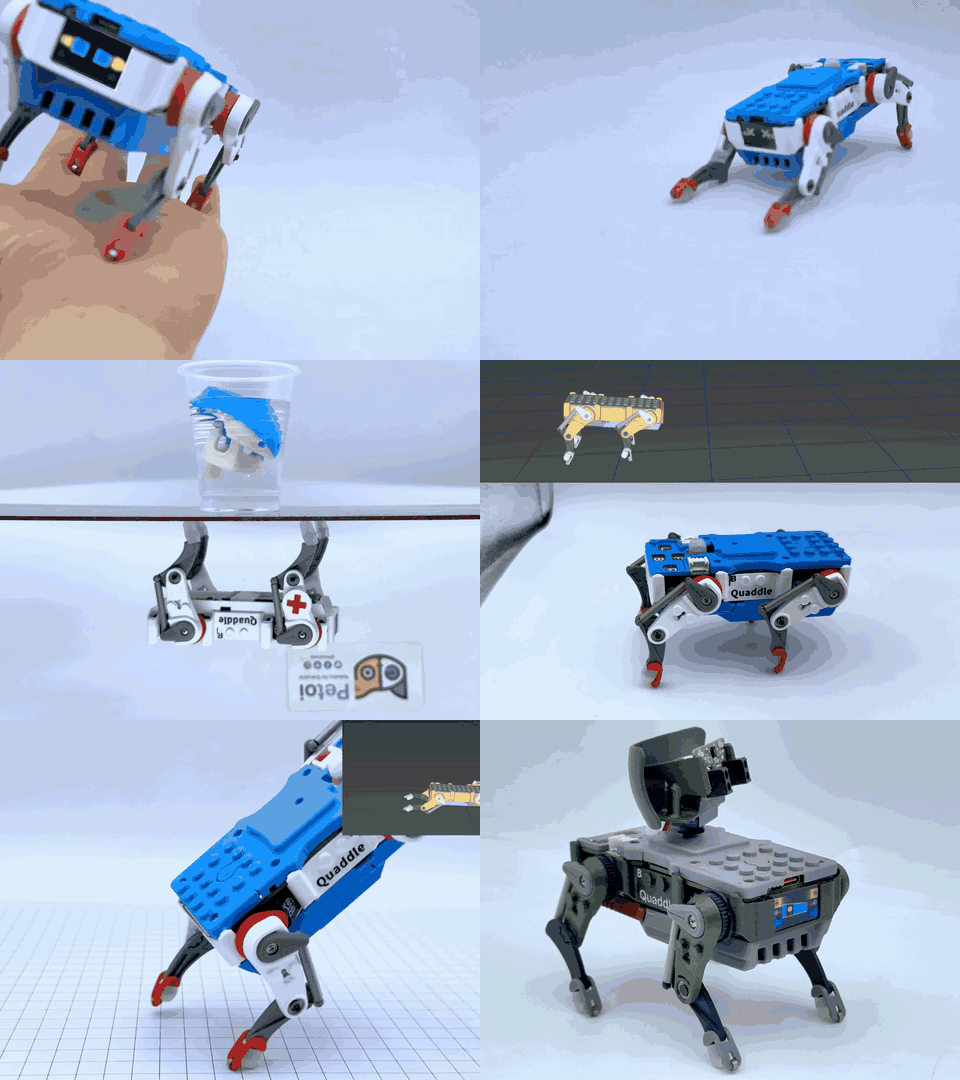
Trading Servos for Structure
Ten years ago, only Boston Dynamics and a few companies and laboratories could make quadrupeds walk convincingly. I started OpenCat as a cheaper route. With hobby servos and an open motion framework, I put a walking quadruped on a maker's desk.
That problem has changed. Robot dogs can now walk, run, jump, recover, and perform remarkably complete motion repertoires. The harder question is no longer whether a quadruped can walk, but who needs one and what they will actually do with it.
Researchers and makers will always find highly articulated robots fascinating. The general public—and even many educators—cannot easily picture how multiple joints coordinate. Most people simply call high-level commands such as walk or turn, much as they control a wheeled robot. The locomotion stack hides most of the knee motors' capability. Most users see and value the lifelike result. They hesitate to pay for the motors, batteries, calibration, maintenance, and support behind it.
That observation came from delivering and supporting more than 30,000 OpenCat robots across the 11-DoF Nybble and 9-DoF Bittle families. It led to a different design brief: preserve the sense of life, but compress its cost at the architectural level.

Many research quadrupeds use three active joints per leg. At the other extreme, cheap single-motor linkage toys offer only one fixed gait. Quaddle, Petoi's new quadruped following Bittle, is now crowdfunding. It sits between those two extremes. One shoulder servo drives each leg, for four active degrees of freedom in total. Geometry, elasticity, and directional friction let the lower leg do work that would normally require more motors.
The question was not “How can I remove eight servos?” It was:
Which parts of locomotion need independent real-time control, and which parts can the body handle?
Petoi Bittle was released in 2020. Watch it in slow motion—what do you notice?
The Mechanical Problem
Walking turns a leg's back-and-forth movement into continuous body motion. The shoulder provides the main drive and rhythm. A knee, or an equivalent mechanism, supports the body and shortens the leg during swing.
When only the shoulder drives a rigid leg, the leg sweeps an arc. The toe tends to drag as it crosses beneath the shoulder. Simple quadrupeds often avoid that collision by keeping the leg in one half of the arc. This creates a fan-shaped dead zone beneath the shoulder. The robot can shuffle, but its stride remains short and stiff.
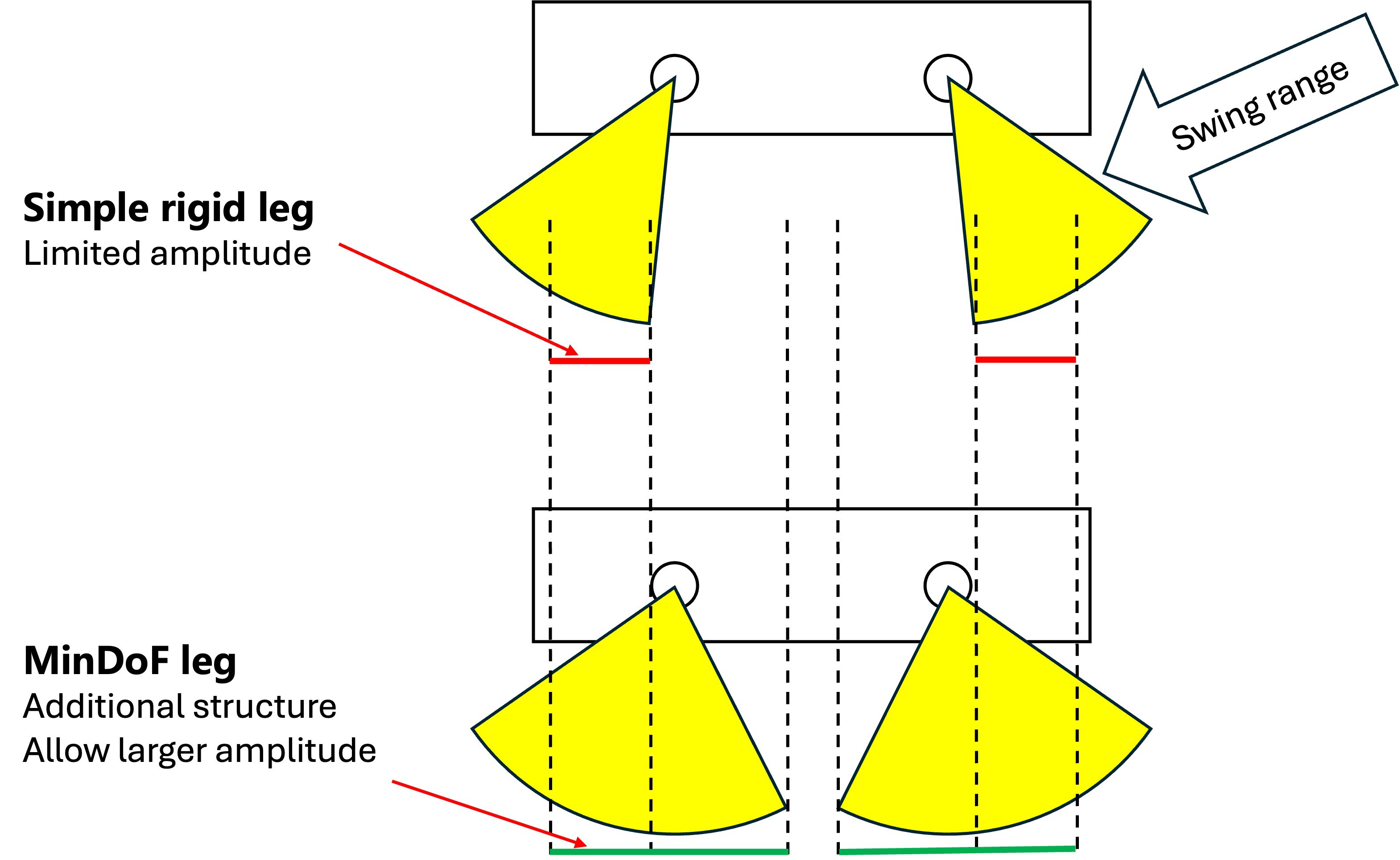
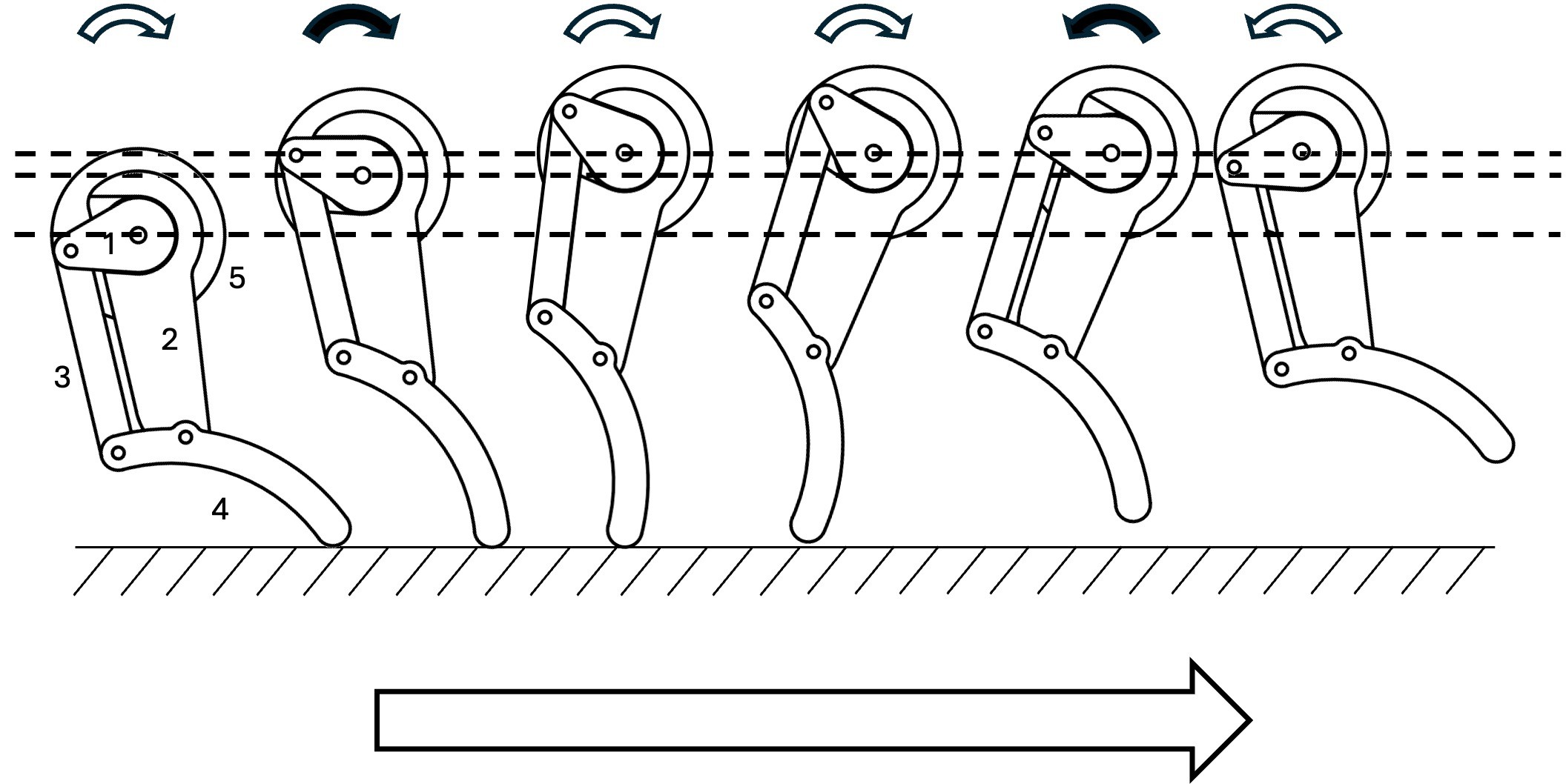
To cross that zone, the robot must change the leg's effective length. It retracts the unloaded leg, passes it beneath the shoulder, and then extends it to accept load. A conventional quadruped gives that sequence to a knee servo. Quaddle's MinDoF (Minimal DoF) leg derives it from the shoulder motion itself.
When the shoulder reverses, geometry, elasticity, and loading change the leg's response. The shoulder-to-toe length shortens during swing and extends again before support. Quaddle needs no separate phase sensor here. The mechanism reacts directly to direction and force.
Each leg still has its own shoulder servo. Quaddle is not a one-motor toy with four legs locked to a crank. Firmware can vary each leg's phase, direction, amplitude, and timing. MinDoF removes the second commanded joint from each leg, but keeps the four legs independent.
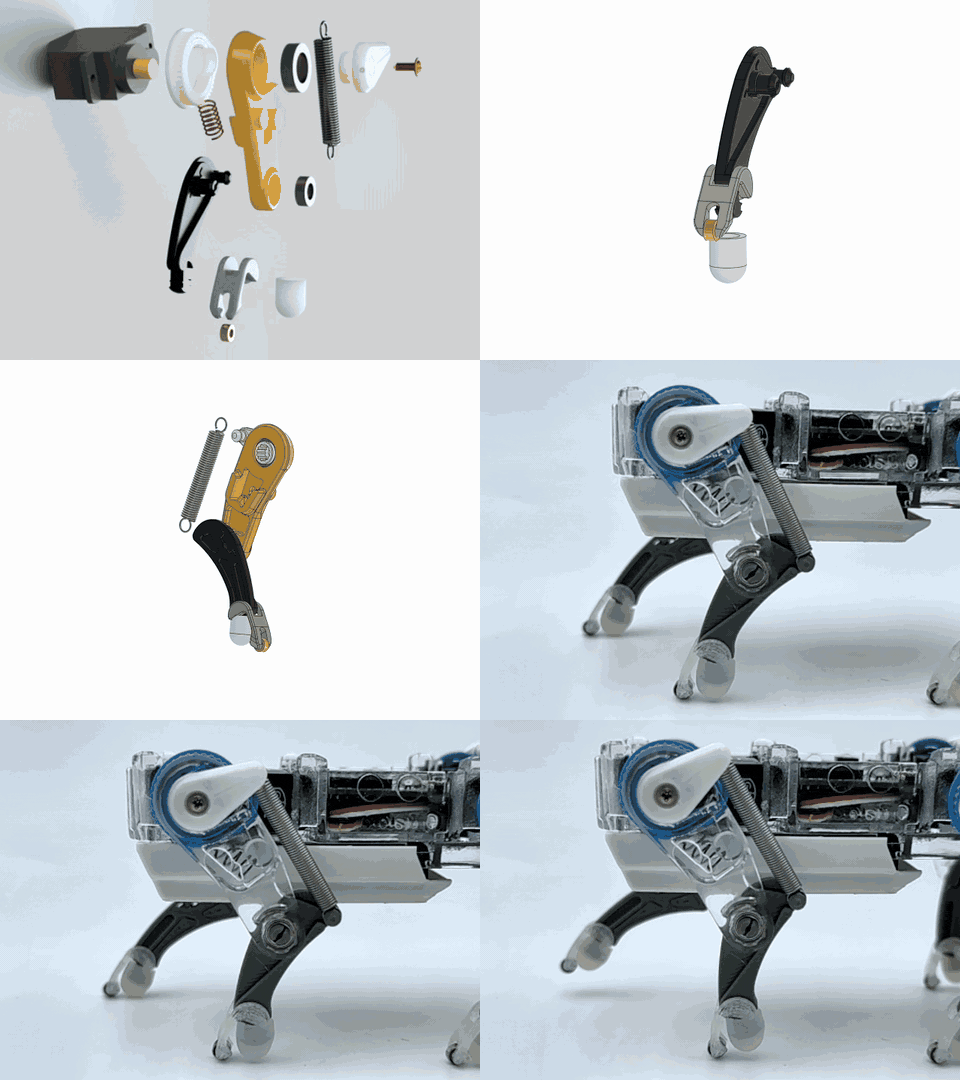 This is motion reuse. One servo sweeps the leg forward and back. The structure derives a second, phase-dependent change in leg length from the same motion. The resulting foot path covers more useful space than a rigid arc. The controller cannot place the foot anywhere in Cartesian space, but it recovers a useful subset of the gaits that usually require more active joints.
The Toe Is Part Foot, Part Wheel
The foot needs different friction at different moments. It needs traction during support. During swing, an accidental touch should not stop the leg or tip the body. Quaddle's...
Read more »