Petoi
Petoi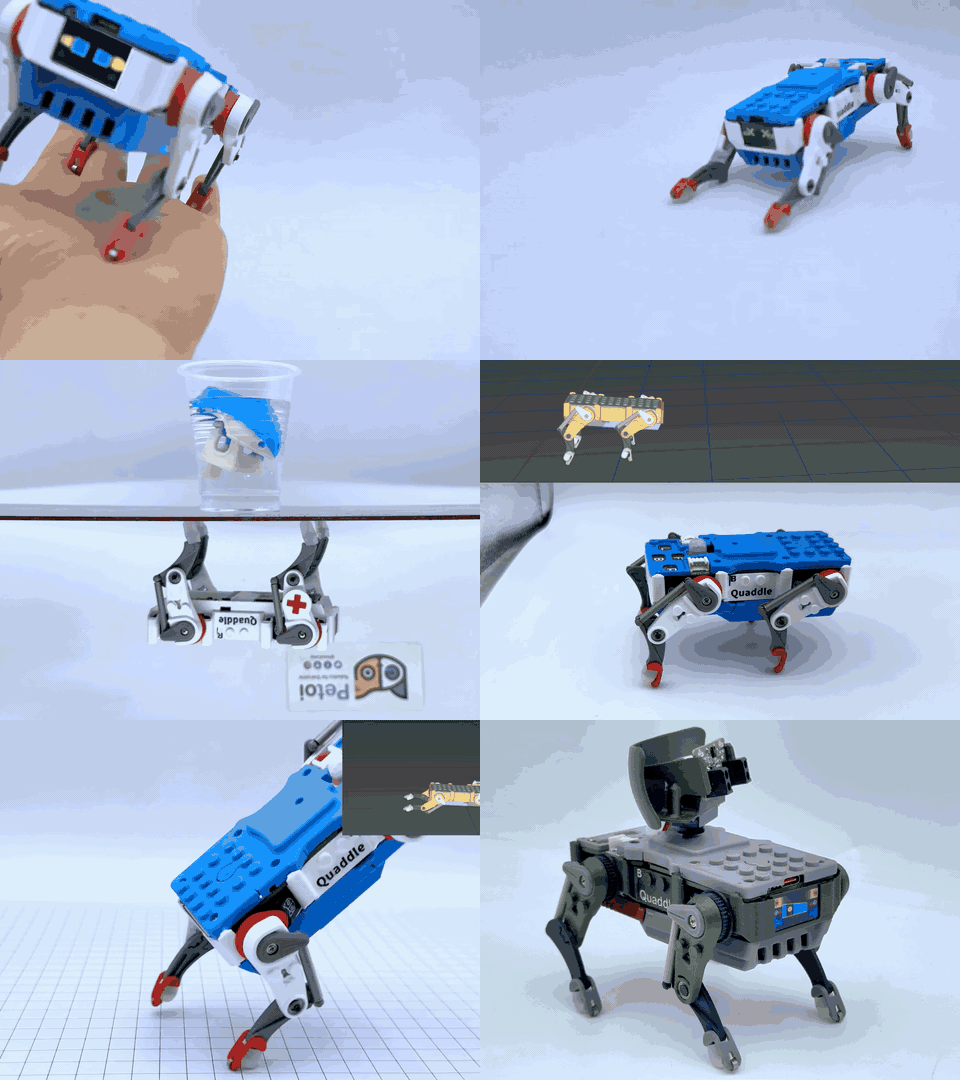
Trading Servos for Structure
Ten years ago, only Boston Dynamics and a few companies and laboratories could make quadrupeds walk convincingly. I started OpenCat as a cheaper route. With hobby servos and an open motion framework, I put a walking quadruped on a maker's desk.
That problem has changed. Robot dogs can now walk, run, jump, recover, and perform remarkably complete motion repertoires. The harder question is no longer whether a quadruped can walk, but who needs one and what they will actually do with it.
Researchers and makers will always find highly articulated robots fascinating. The general public—and even many educators—cannot easily picture how multiple joints coordinate. Most people simply call high-level commands such as walk or turn, much as they control a wheeled robot. The locomotion stack hides most of the knee motors' capability. Most users see and value the lifelike result. They hesitate to pay for the motors, batteries, calibration, maintenance, and support behind it.
That observation came from delivering and supporting more than 30,000 OpenCat robots across the 11-DoF Nybble and 9-DoF Bittle families. It led to a different design brief: preserve the sense of life, but compress its cost at the architectural level.

Many research quadrupeds use three active joints per leg. At the other extreme, cheap single-motor linkage toys offer only one fixed gait. Quaddle, Petoi's new quadruped following Bittle, is now crowdfunding. It sits between those two extremes. One shoulder servo drives each leg, for four active degrees of freedom in total. Geometry, elasticity, and directional friction let the lower leg do work that would normally require more motors.
The question was not “How can I remove eight servos?” It was:
Which parts of locomotion need independent real-time control, and which parts can the body handle?
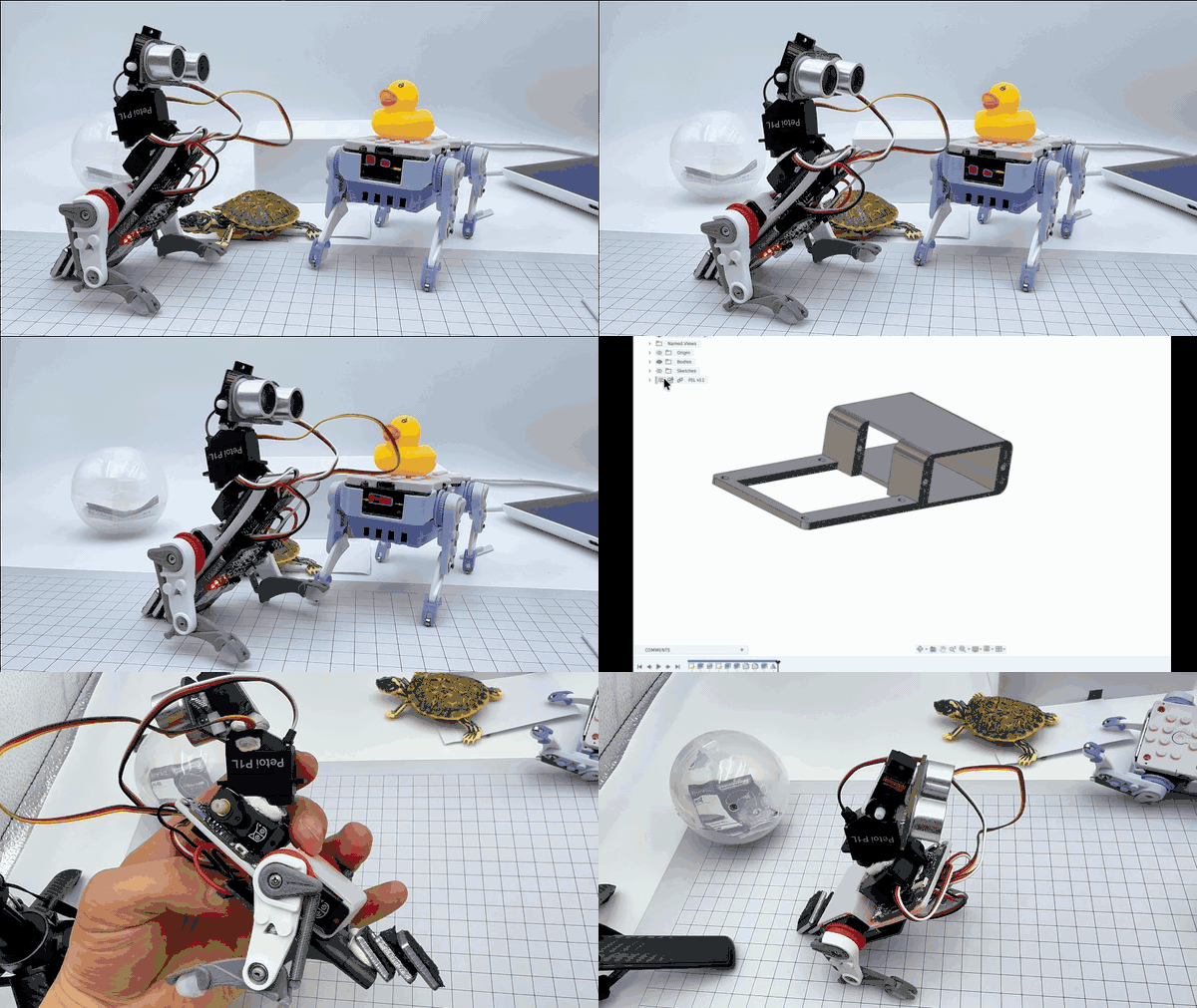
Petoi Bittle was released in 2020. Watch it in slow motion—what do you notice?
The Mechanical Problem
Walking turns a leg's back-and-forth movement into continuous body motion. The shoulder provides the main drive and rhythm. A knee, or an equivalent mechanism, supports the body and shortens the leg during swing.
When only the shoulder drives a rigid leg, the leg sweeps an arc. The toe tends to drag as it crosses beneath the shoulder. Simple quadrupeds often avoid that collision by keeping the leg in one half of the arc. This creates a fan-shaped dead zone beneath the shoulder. The robot can shuffle, but its stride remains short and stiff.
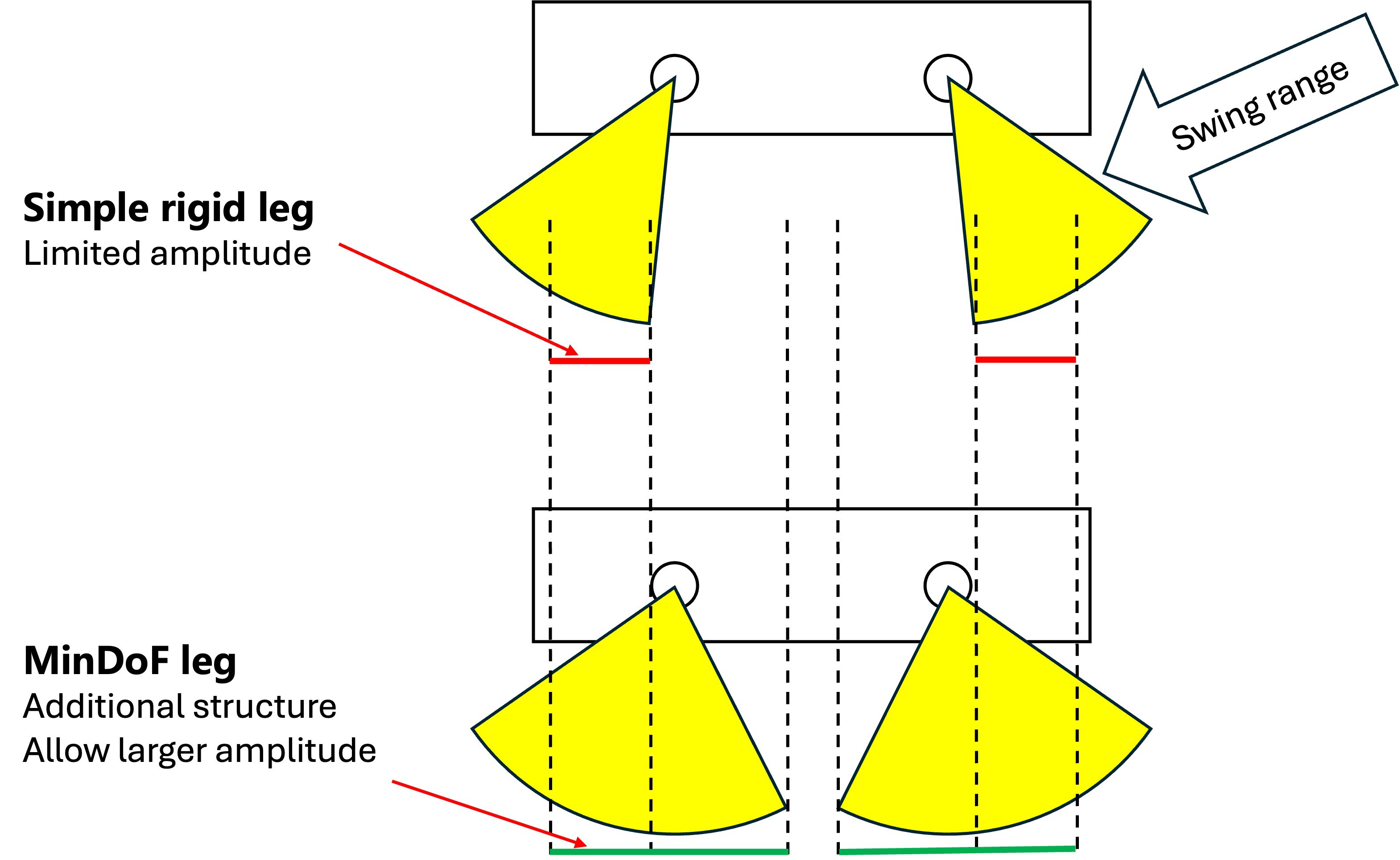
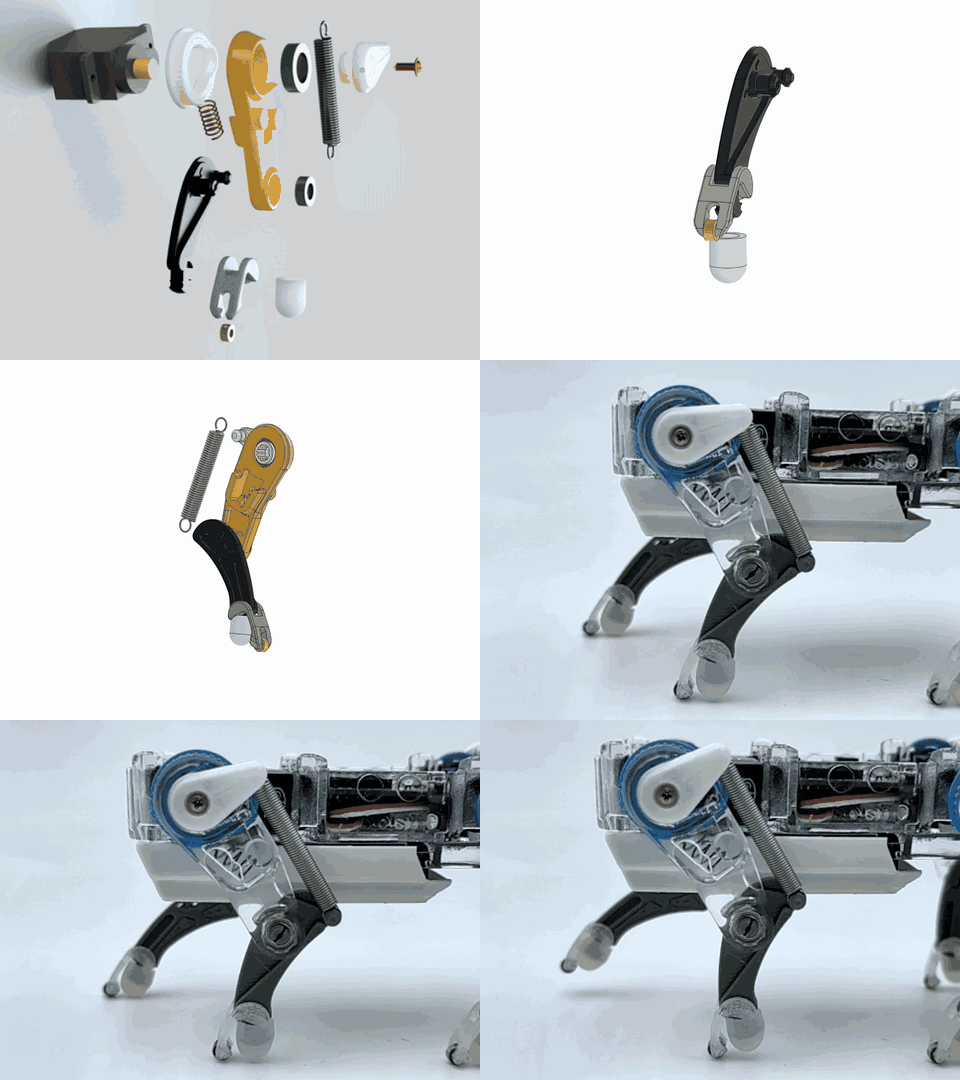
To cross that zone, the robot must change the leg's effective length. It retracts the unloaded leg, passes it beneath the shoulder, and then extends it to accept load. A conventional quadruped gives that sequence to a knee servo. Quaddle's MinDoF (Minimal DoF) leg derives it from the shoulder motion itself.
When the shoulder reverses, geometry, elasticity, and loading change the leg's response. The shoulder-to-toe length shortens during swing and extends again before support. Quaddle needs no separate phase sensor here. The mechanism reacts directly to direction and force.
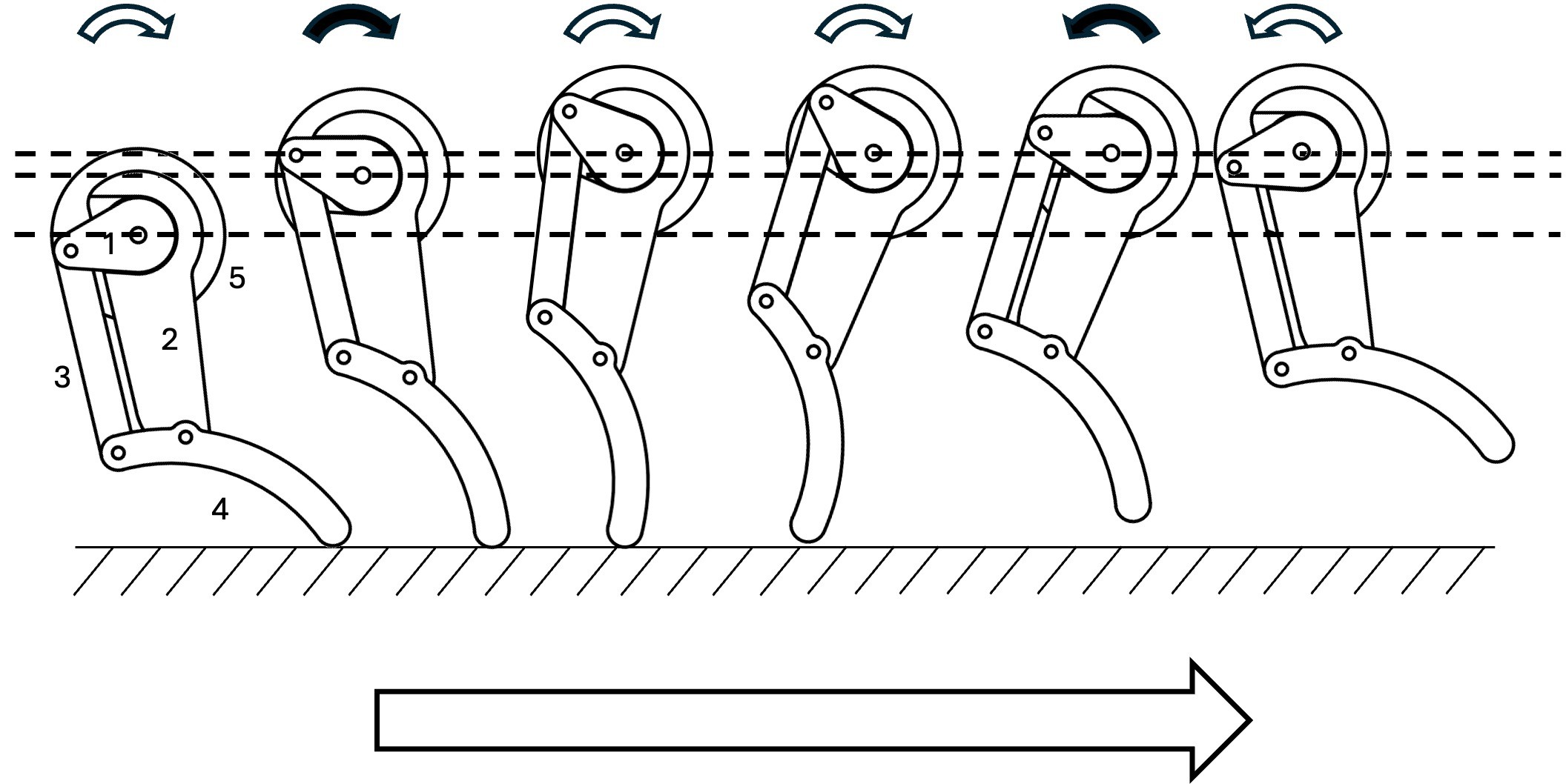
Each leg still has its own shoulder servo. Quaddle is not a one-motor toy with four legs locked to a crank. Firmware can vary each leg's phase, direction, amplitude, and timing. MinDoF removes the second commanded joint from each leg, but keeps the four legs independent.
This is motion reuse. One servo sweeps the leg forward and back. The structure derives a second, phase-dependent change in leg length from the same motion. The resulting foot path covers more useful space than a rigid arc. The controller cannot place the foot anywhere in Cartesian space, but it recovers a useful subset of the gaits that usually require more active joints.
The Toe Is Part Foot, Part Wheel
The foot needs different friction at different moments. It needs traction during support. During swing, an accidental touch should not stop the leg or tip the body. Quaddle's toe combines an elastic element, a small roller, and asymmetric friction. It favors grip under load and rolls more freely during glancing contact.
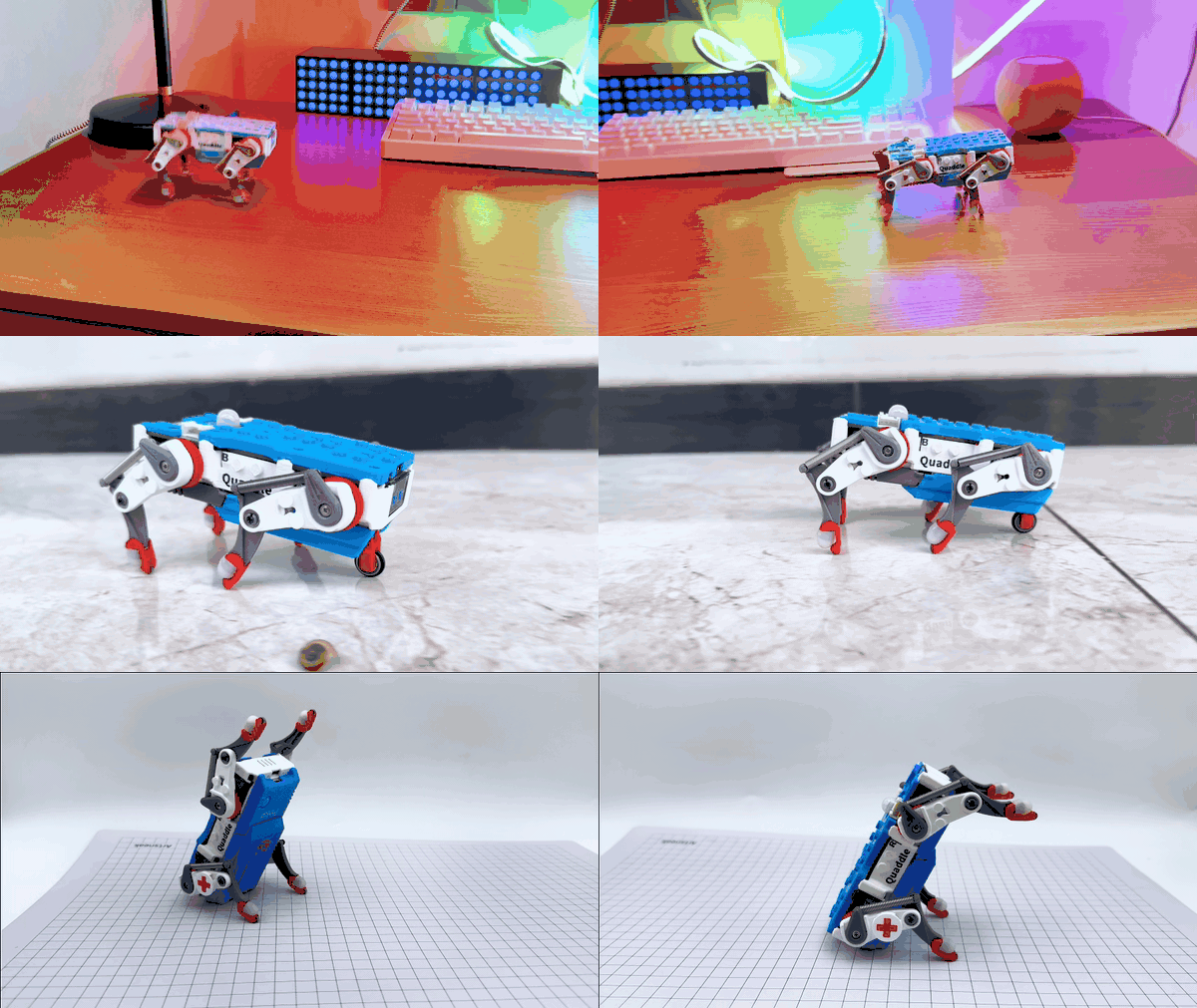
The roller also opens another motion mode. Different gait timing can produce several forms of gliding, including continuous contact on all four toe wheels. On a suitable smooth surface, a prototype reached 3 body lengths per second this way. The result depends on the surface, but it avoids some of the repeated lifting and impact of walking.
The wheel does not simply turn Quaddle into a wheeled robot. The shoulder still decides when and where each leg pushes. The toe changes whether that contact behaves more like a foot or a wheel. In this way, one active DoF serves several functions.
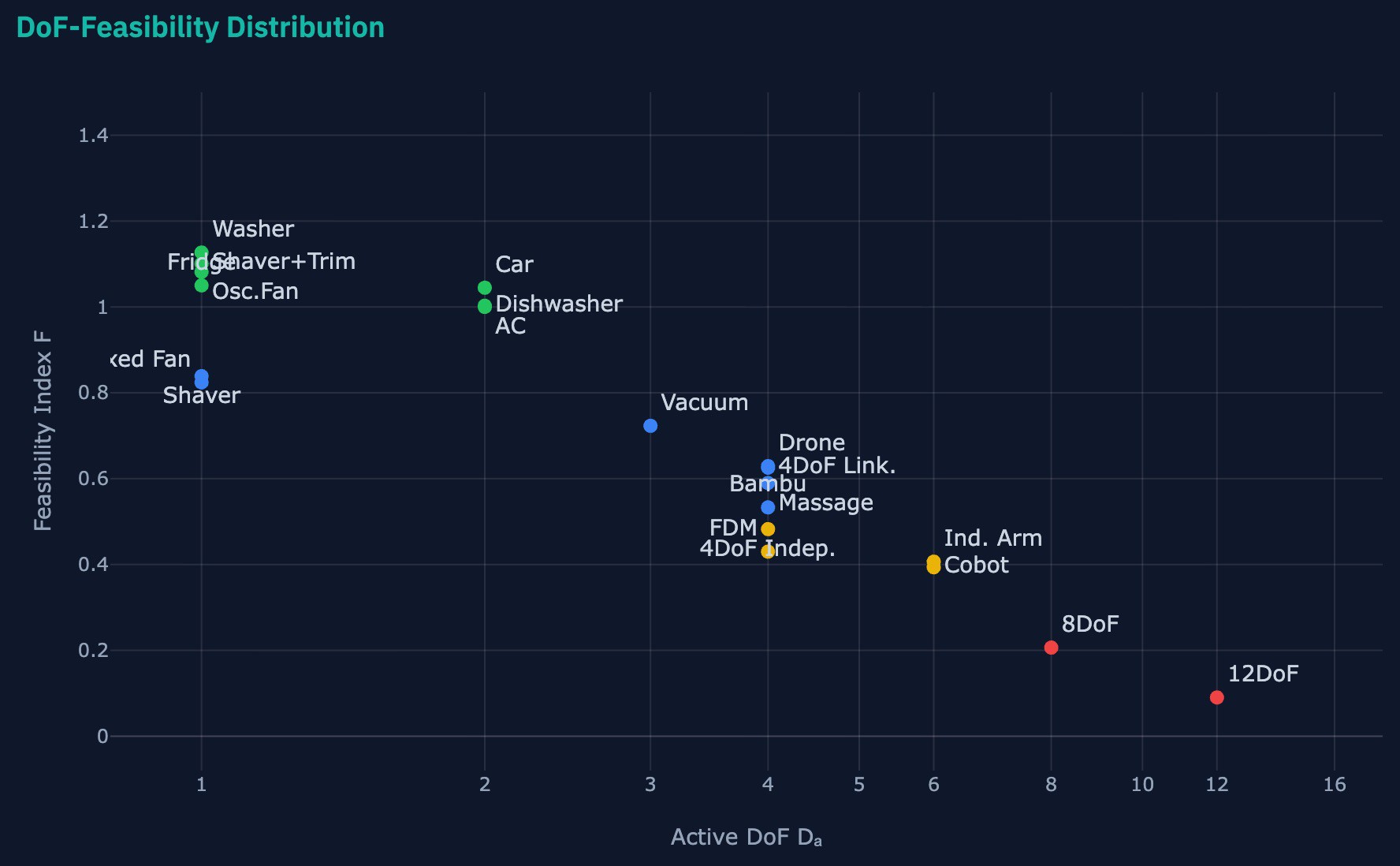
That idea grew from a broader question about robot feasibility: what happens as active DoF rises, and how much can function reuse change the result? I made a heuristic model and interactive calculator at dof.petoi.com. The model treats each active DoF as both added capability and added cost, then asks how reusing one DoF for several functions changes that tradeoff.

What the Body Computes
Roboticists call this approach mechanical intelligence or morphological computation. Geometry, elasticity, inertia, and contact forces do work that might otherwise require sensors, active joints, and software. Tendons and ligaments play a similar role in animals. They store energy, constrain motion, and filter impacts without asking the brain to solve every variable.
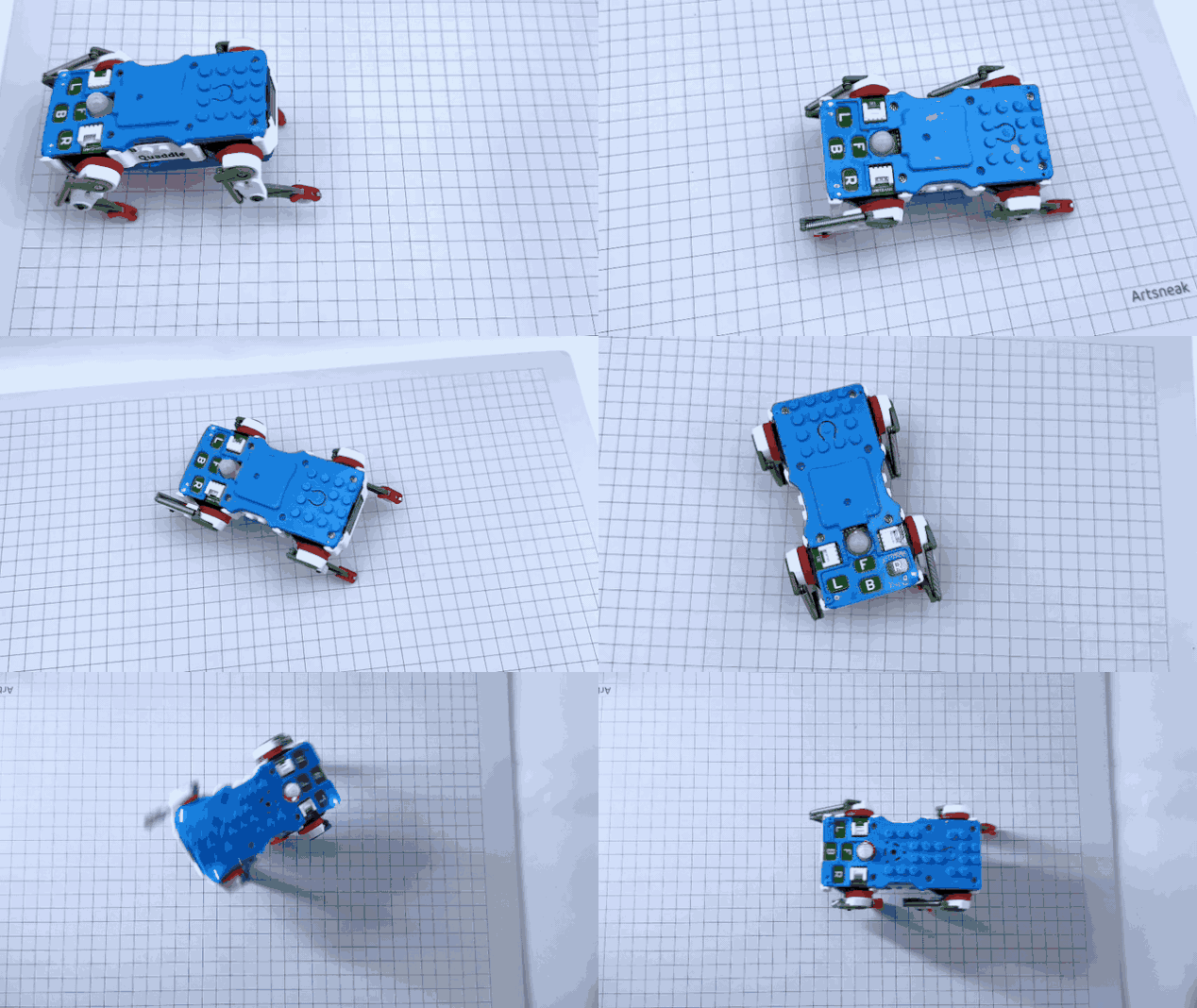
Quaddle still needs software. A CPG-inspired gait layer coordinates the relative phase, amplitude, direction, and speed of four periodic shoulder motions. Symmetric patterns move forward. Differences between sides turn the body. Sideways motion needs a more delicate combination of phase, compliance, toe contact, and friction.
Here, “omnidirectional” describes forward motion, turning, and surface-dependent sideways motion—not the arbitrary planar velocity of a Mecanum platform or independent 3D foot placement. Prototypes have also walked on three legs, righted themselves, flipped, and glided. This range shows what four servos can do, not that they can replace twelve in every application.
Compared with a fully actuated quadruped, Quaddle has less control over body height, foot orientation, contact force, and unknown terrain. Some gaits need tuning for a particular surface. Removing motors also ties dimensions, spring behavior, clearances, materials, and timing more closely together. Manufacturing tolerances matter because the mechanism forms part of the controller.
That trade makes sense for a desktop platform whose users mostly call high-level motion APIs. It would not make sense for research that requires arbitrary foot placement or independent access to every joint.
Keep the Motion Layer Boring
The electronics keep real-time motion separate from fast-changing applications. A lower board manages charging and power. A shared USB Type-C connector supplies power and provides a programming link to the middle board. This ESP32-S3 motion board controls gait timing, reads the IMU, handles communication, and enforces safety limits. Users can program it in Arduino C or MicroPython and connect hardware through unused GPIOs.
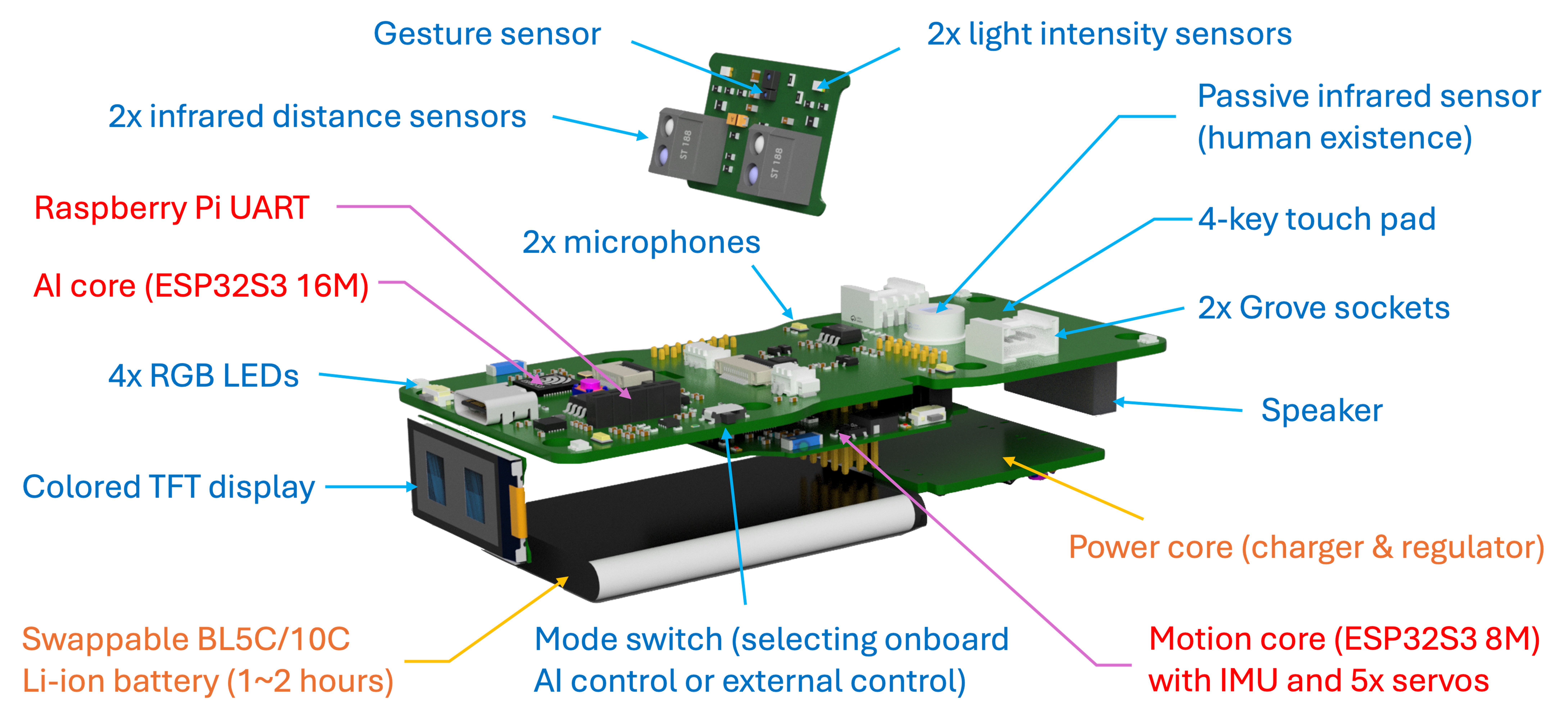
An optional upper board adds sensing, touch, voice, networking, and higher-level interaction. The application layer sends commands for gait, skill, posture, direction, and speed. It leaves servo timing to the motion board. In turn, the motion board does not need to understand natural language. A phone, gamepad, PC, Python script, voice agent, or Linux board can all use the same motion vocabulary.
The Education/Classroom upper board carries an ESP32-S3 AI Core and a socket for a Raspberry Pi Zero. They share one UART connection to the motion controller. A physical switch connects to one or the other. Selecting the Pi also cuts power to the AI module. The Builder version omits the upper board. A replaceable BL-5C/BL-10C-format battery supplies power instead of a sealed proprietary pack.
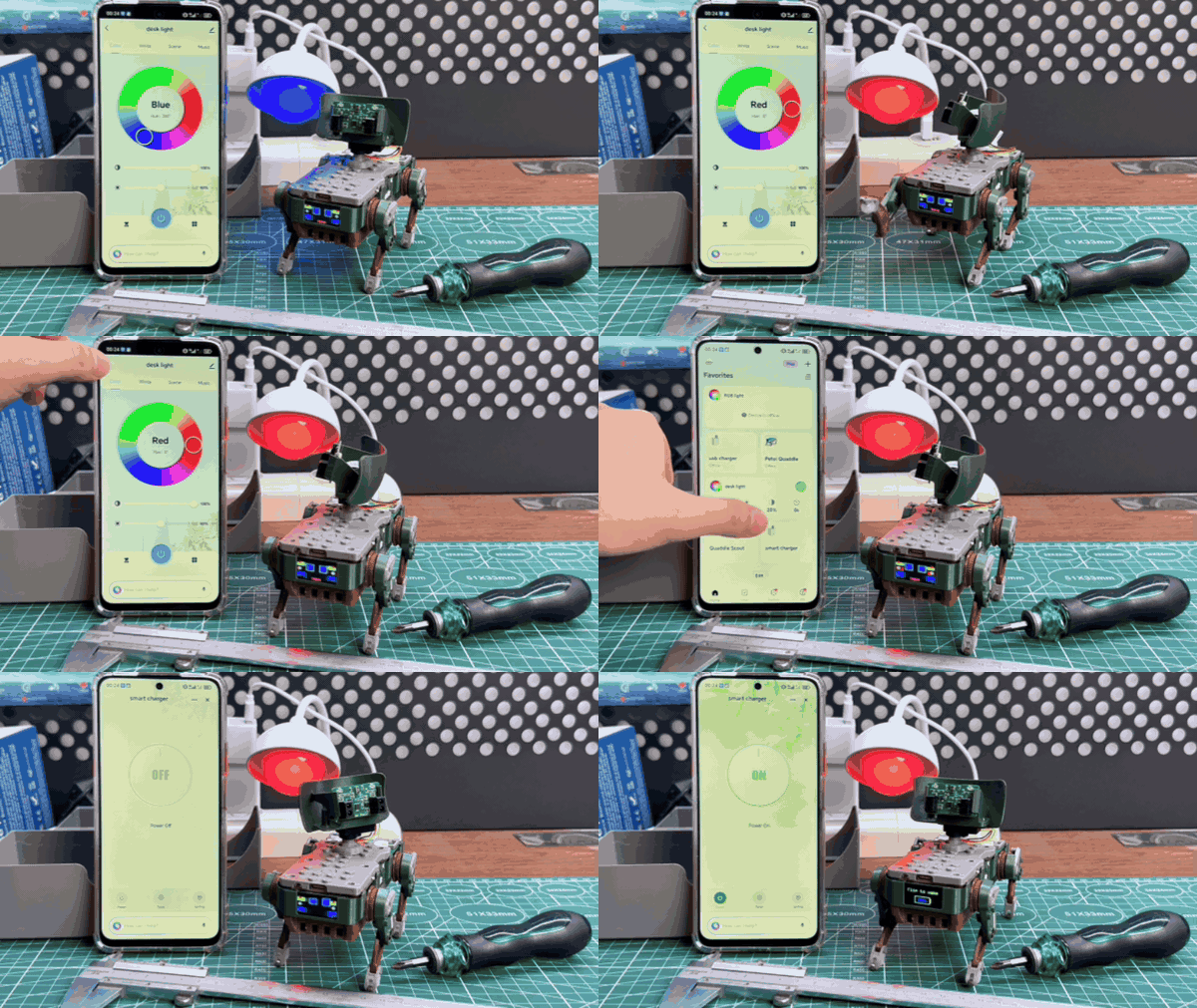
Position-feedback servos also enable Learn & Replay. In a safe mode, users move the legs by hand. The controller records the sequence as a reusable skill. About ten seconds of hand-guiding can teach a fast gait or a new behavior. Users can refine it later in the graphical Skill Composer, but they do not need to start with kinematics.
Physical assembly follows the same approach. Snap-fit parts and four main screws let users go from parts to walking in about fifteen minutes. Every unnecessary fastener, awkward wire route, or ambiguous orientation can create a support case. The body still folds, provides expansion points, and accepts LEGO-compatible construction. Simpler assembly does not require a sealed platform.
From Simulator to Injection-molded Legs
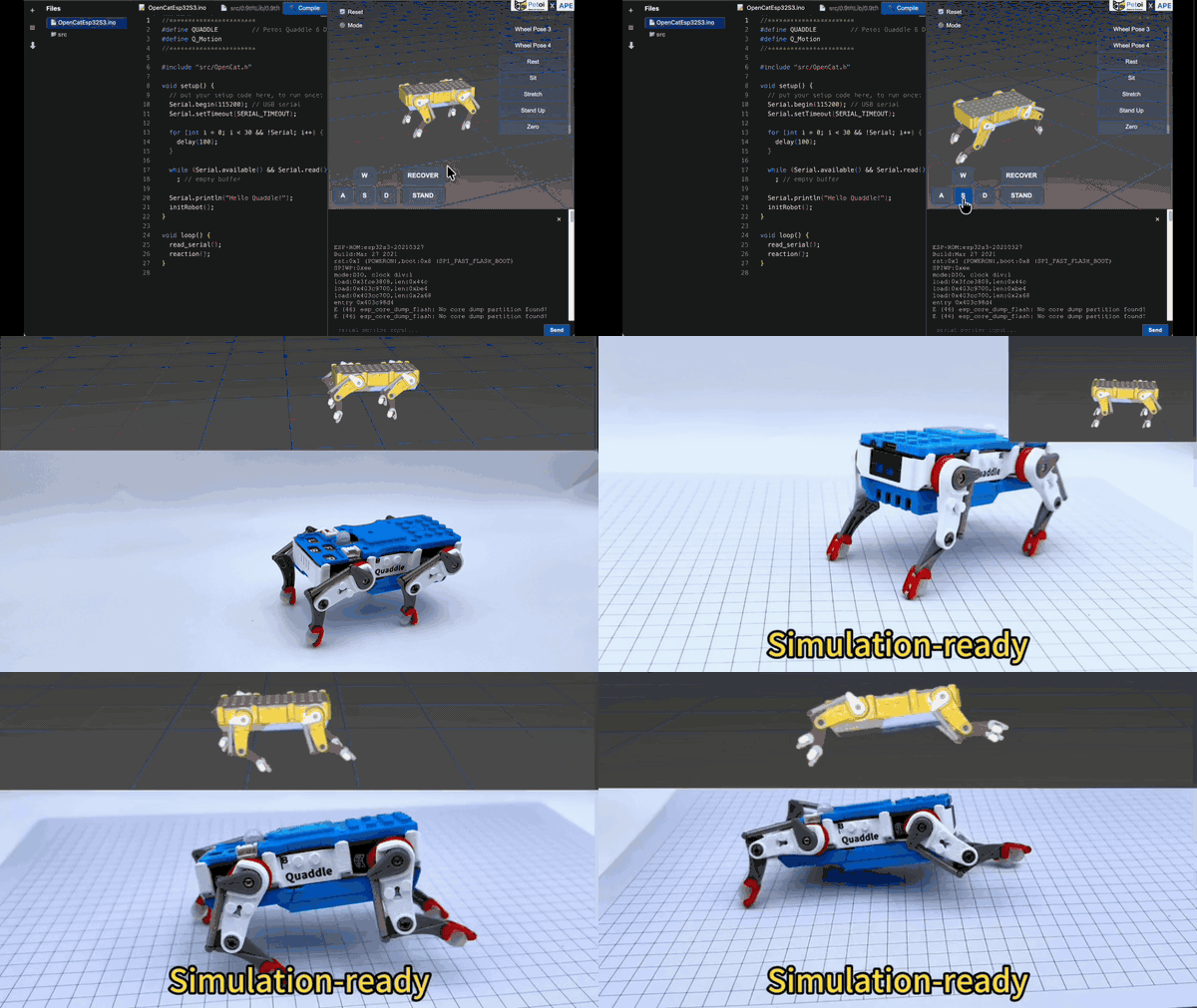
You can play with this simulator (also an emulator for ESP32 S3) in your browser, even on your mobile phone:
https://www.petoi.com/pages/quaddle-robot-dog-simulator
We've uploaded the URDF to Hugging Face.
https://huggingface.co/petoi/quaddle
The mechanism has moved beyond a sketch. We compared the simulated model with physical prototypes, adjusted the geometry, and made injection molds for the leg. Tests then confirmed that the molded parts reproduced the modeled behavior at this scale.
 It did not answer everything:
- How should spring rate, damping, and toe friction scale with body mass?
- Can the model transfer to a new body size without extensive retuning?
- Can sensing improve gait transitions and lateral motion without giving back the simplicity we gained?
Quaddle supports Arduino and MicroPython, the OpenCat Python API, graphical tools, and mechanical expansion, while MinDoF makes motion simpler and cheaper. We created this Hackaday.io project to explore that tradeoff with the community, and we look forward to seeing the mods and applications that builders share here.