 Teemu Hakala

The board takes power and data from PoE-enabled switch. The power is routed to the board where DC/DC module converts it down to 5 volts, while data is passed through transformer to the other Ethernet Jack. A short patch cable is used to connect the shield and Raspberry Pi, Raspberry Pi's own PHY handles the Ethernet communication.
No software setup is needed for the board, board handles the PoE negation automatically and powers the Raspberry Pi through the pin header's 5V connection.
This is not a proper HAT for two reasons:
- the board is longer and Ethernet connectors are directly above Raspberry Pi's USB and Ethernet connectors
- there is no EPROM and we have long pinned connector so that you can plug a proper HAT on top of your Raspberry Pi
 We assembled a few of the new PoE-shields,
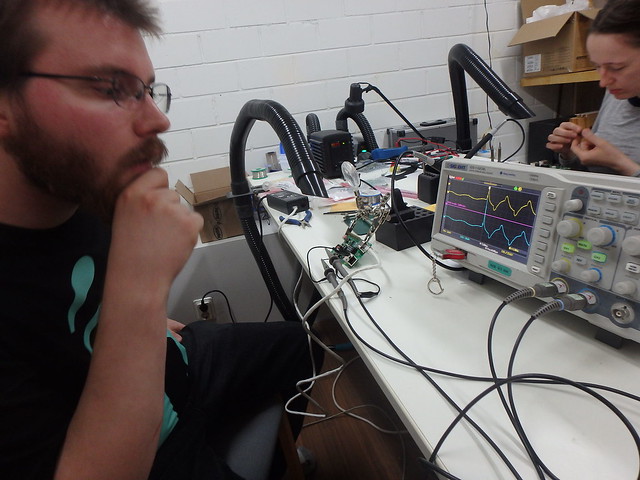 It was very interesting to see what happens when the area has a lot of creative people, and facilities to support them around. Helsinki Hacklab had Ethernet sockets already available all over the place, and with our PoE switch we could enable PoE in any socket in less than a minute.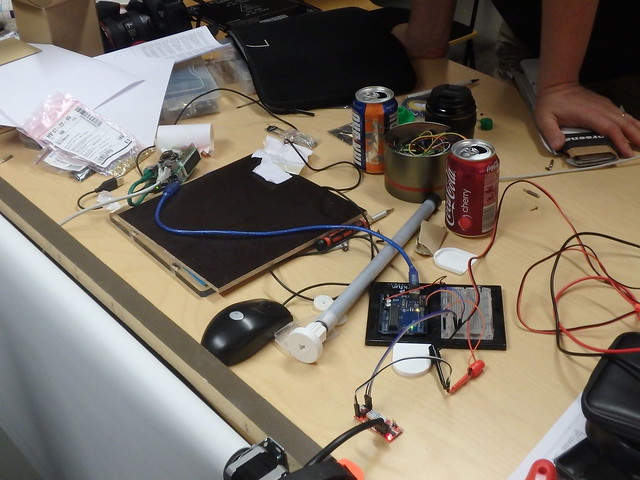
 We tested the boards, full 100MBit/s speed was reached. The next test was to see if our clamping diodes work as they should, so it was oscilloscope o'clock.
 The protection diode clamps the voltage spike to roughly 9 volts. Next thing to do was to plug the cable in and out ~100 times and see if the board would still connect. And connect it does! Now all that remains is to do a few cosmetic adjustments and launch the campaign.



 Jamie Nichol
 Giuseppe
 TM
TM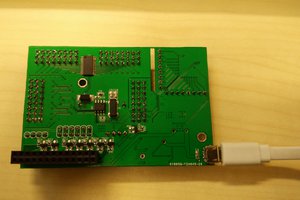
 Salvatore
... need to upload a new pic instead of the 1st prototype :D