 Russell Kramer
After getting the monitor to turn on I pointed the zapper at the screen and started looking at the detector wire on an oscilloscope. To my surprise I wasn't getting any activity. At first I thought the zapper was broken, but after some research and hardware hacking I figured out the issue and fixed it.
With older light guns like those used by Atari 2600 and Sega MasterSystem you could cheat at any game by simply aiming at a bright light. The game console flashes a white rectangle over a target then thinks the light gun was pointed at the target because it picked up light. Nintendo didn't want it to be that easy to see the last level of Duck Hunt, so they designed the zapper to not be fooled by this trick. It only responds to flashes lasting about a millisecond so it will not be fooled by a static light source.
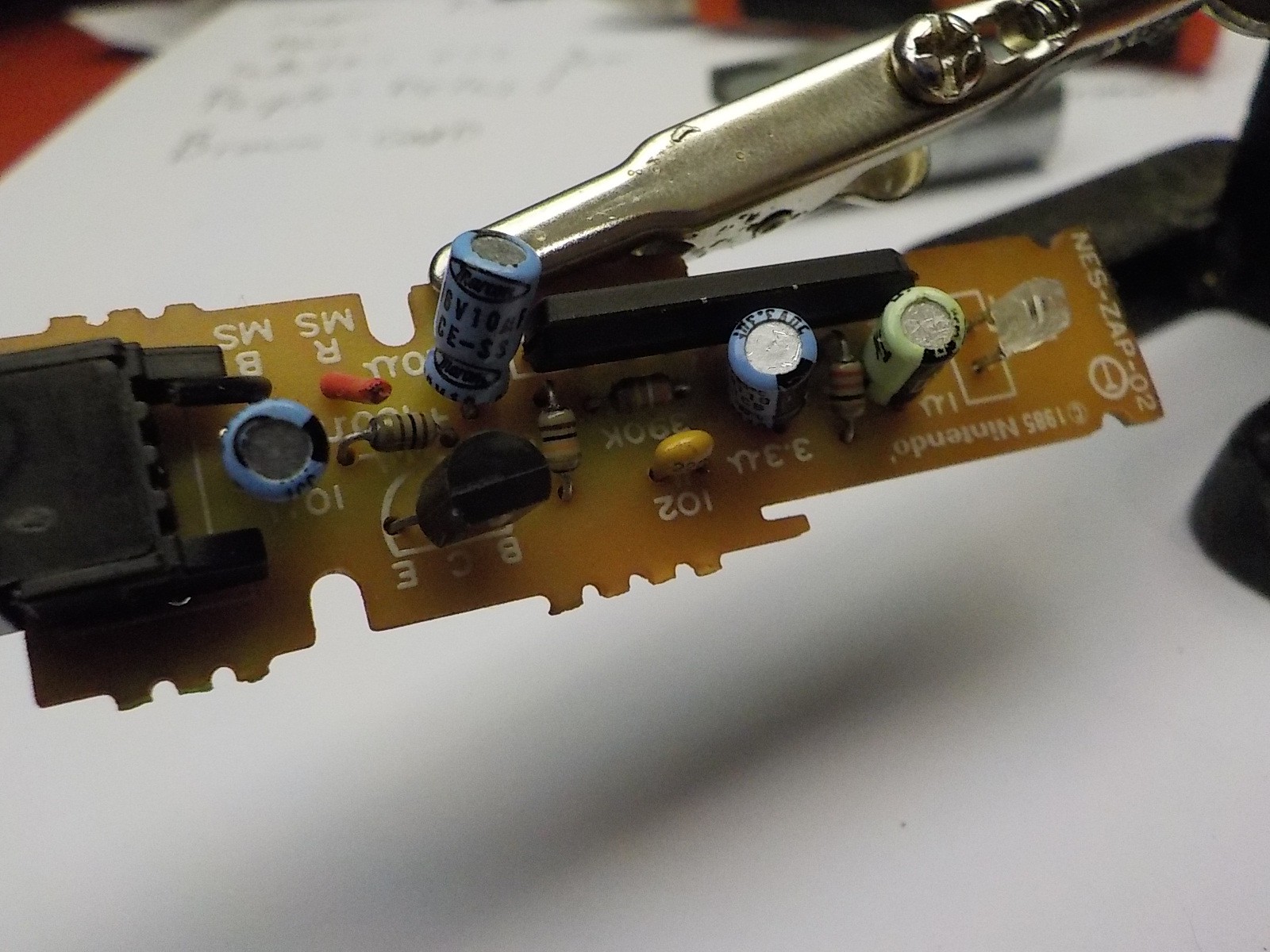
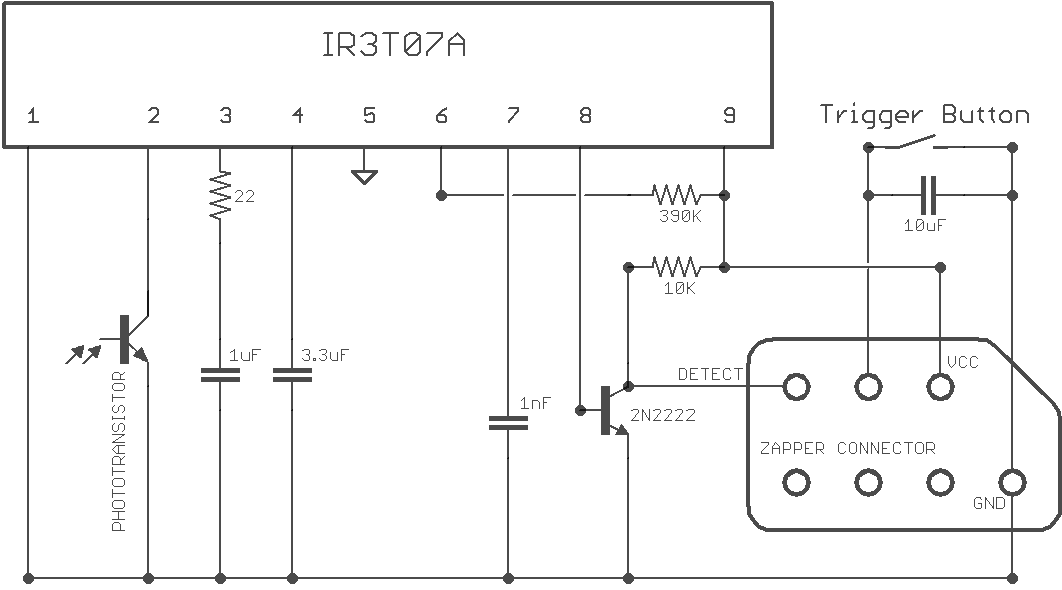
I opened up the light gun and drew out the circuit found inside. As you can see almost all the light detection work is done by an IR3T07A chip. I was unable to find any datasheets for this chip so I started poking around and trying to find a way to get the zapper to respond to static light sources instead of just flashes.
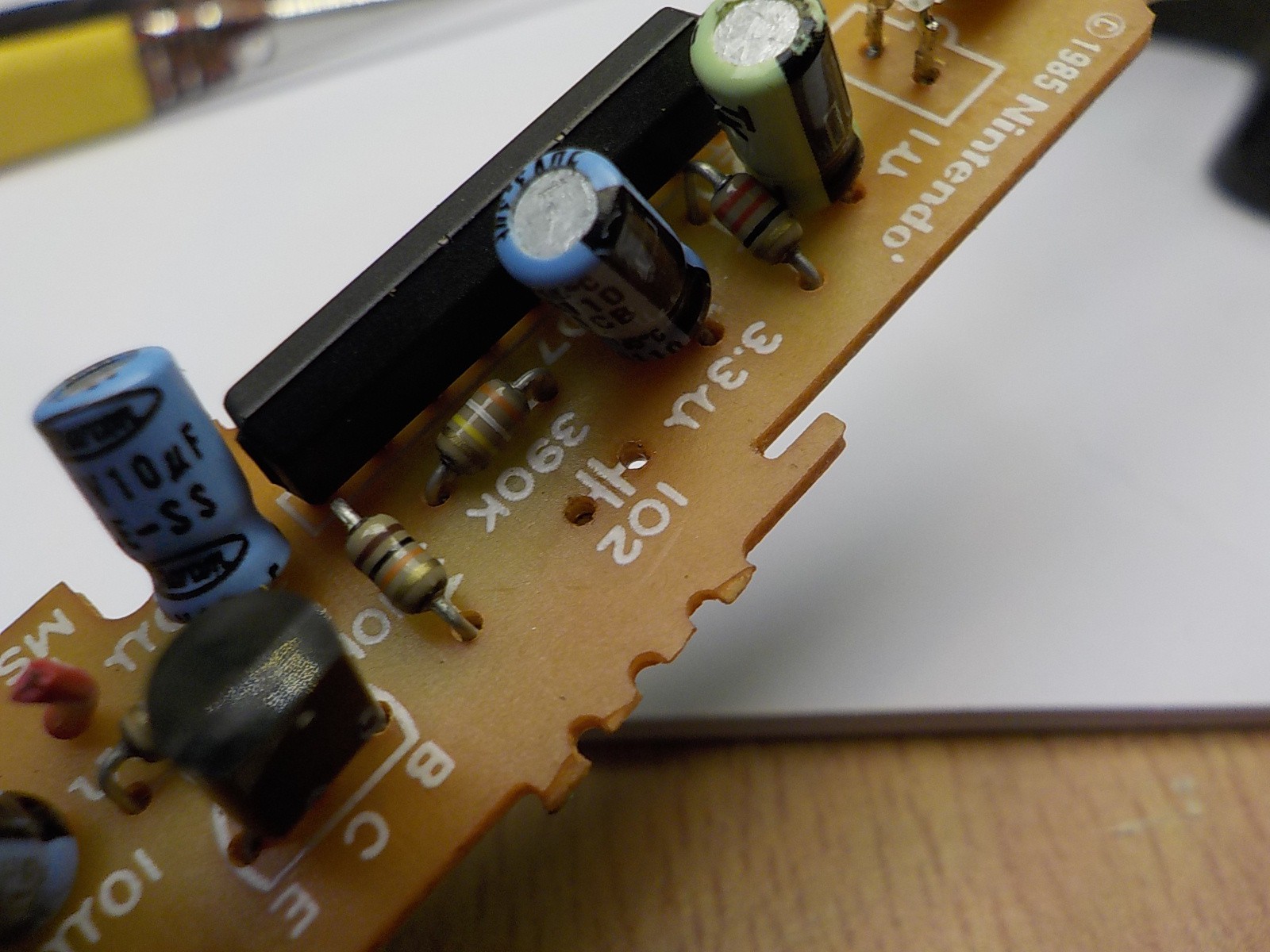
I eventually discovered I could get the results I wanted by removing the 1nF capacitor from the PCB. Strangely the light gun still doesn't respond to being pointed at a lightbulb, but it does respond to the CRT monitor. I think the 1nF capacitor sets the acceptable light flash duration. Removing it leaves a couple pF between the PCB traces, which makes the invisible 60Hz flicker of a CRT monitor acceptable, but not a static light source.
Discussions
Become a Hackaday.io Member
Create an account to leave a comment. Already have an account? Log In.
I know this is really old but I have an original NES Zapper I got cheap because it was inop. I am wanting to use it with a modern LCD screen and use NES emulator with lag calculated and introduced via a patch. I have purchased an aftermarket Tomee light gun that is supposed to work. I was hoping to modify the original NES Zapper to work also. A transistor was poorly desoldered and may have wrecked the original PCB. I was already planning to replace the phototransistor with a photosensitive diode Specs "Response Peak Wavelength:940 nmReceive Wave Range : 400-1100 nmReceving Angle : 40°Material:Si, Plastic, MetalForward Current: 5mAVceo : 0.4VHead Color : ClearHead Size : 5 x 8.6mm / 0.2 x 0.34 inch (D*H)Pin Dia : 0.5 mm / 0.02 inchTotal Length: 36mm / 1.4 inchPackage Type: DIP(Dual In-line Package)Polarity: Anode (Longer Part) | Cathode (Shorter Part)" I don't have the tomee gun yet to look how they did it. I have some bread board and resistor kit, a capacitor kit, and I have a transistor kit coming, and I can solder but designing it from scratch is a bit over my head. I am not sure I can develop my own schematic but was hoping someone had already done this. I will be connecting this to an arduino attiny85. I have removed the original cord and connector and will be connecting via USB. I have that part working. I can share the link where I found the patch (https://neslcdmod.com/schemes/) I like the original trigger and the weight and feel of the NES Zapper was just hoping to get the circuit to work on a modern LCD with some help with software. I don't have a flash cartridge. I may try to get one at some point but plan to play this in an emulator on a modern TV. They mention that the Zapper will need to be modified but gloss over that part. I understand I may need a different part for the light detection or I might need a different IC chip. I do have a particular IC Chip programmer as I had a dead motherboard but that is for a very specific chipset. It is this set on Amazon:
SOIC8 SOP8 Test Clip Flash IC Clips Socket Adpter Programmer BIOS with USB Programmer CH341A 24 25 Series Flash Module DIY Kit
I would prefer to stay away from IC chip reprogramming if I can.
Any help would be greatly appreciated.
Are you sure? yes | no
"Strangely the light gun still doesn't respond to being pointed at a lightbulb" -- That is because it looks for light dissipation. not light coming or staying on.
Are you sure? yes | no
When I 'scoped the pins on the IR3T07A, it was similar to other infrared demodulators (like the GL3274 or CX20106A), just using a visible-light photodiode, and tuned to 16kHz instead of 37kHz
Are you sure? yes | no