 Eric
EricSynology dead. QNAP volume corrupt. RAID degraded. I ran five tools through every scenario that actually matters. Here's exactly what happened.
Quick Answer: The best NAS data recovery software in 2026 is Stellar Data Recovery Technician, and it's not particularly close. It's the only tool on this list that handles both online (network-connected) and offline (drives-removed) NAS recovery while simultaneously supporting RAID reconstruction, BTRFS, EXT4, Time Machine, and virtual machine disk recovery, all in a single application that runs natively on both Windows and Mac.
If you want the full breakdown of how each tool performed and which one is actually worth your money based on your specific situation, keep reading.
Why Most NAS Recovery Articles Get This Wrong
Most "best NAS data recovery software" lists are written by people who've never pulled drives from a dead Synology at midnight. They compare feature bullet points from vendor websites, rank tools that have the most checkboxes, and treat "supports NAS" as a meaningful specification without asking what that actually means in practice.
Here's what I did differently. I spent three weeks running five tools across four real NAS failure scenarios: an accidentally deleted share folder on a live Synology NAS, a QNAP unit that wouldn't boot after a firmware update, a four-drive RAID 5 array with two failed disks, and an EXT4 drive with a corrupted partition table connected directly to a Mac. Same hardware, same data loss conditions, five tools, documented results.
The differences were significant. In some scenarios the gap between the best and worst tool was the difference between full recovery and zero recovery. Here's what I found.
The 4 Test Scenarios I Used to Rank These Tools
Before the rankings, a quick breakdown of the failure scenarios I used, because the right tool depends entirely on what kind of NAS failure you're dealing with:
- Scenario A: Accidentally deleted share folder on a live Synology DS920+ (BTRFS, RAID 5, accessible over network)
- Scenario B: QNAP TS-453Be that stopped booting after firmware update (drives pulled, connected via USB adapters)
- Scenario C: Four-drive RAID 5 array with two failed disks, beyond the RAID's fault tolerance
- Scenario D: Single EXT4-formatted drive with corrupted partition table, connected directly to a Mac
Not every tool was tested on every scenario, some simply couldn't attempt certain scenarios due to OS limitations or feature gaps. Where a tool couldn't be tested, I've noted why.
1. Stellar Data Recovery Technician, Best Overall NAS Data Recovery Software
Platforms: Windows and Mac | Price: $199/year (Technician) | Free Trial: Yes, scan and preview before buying
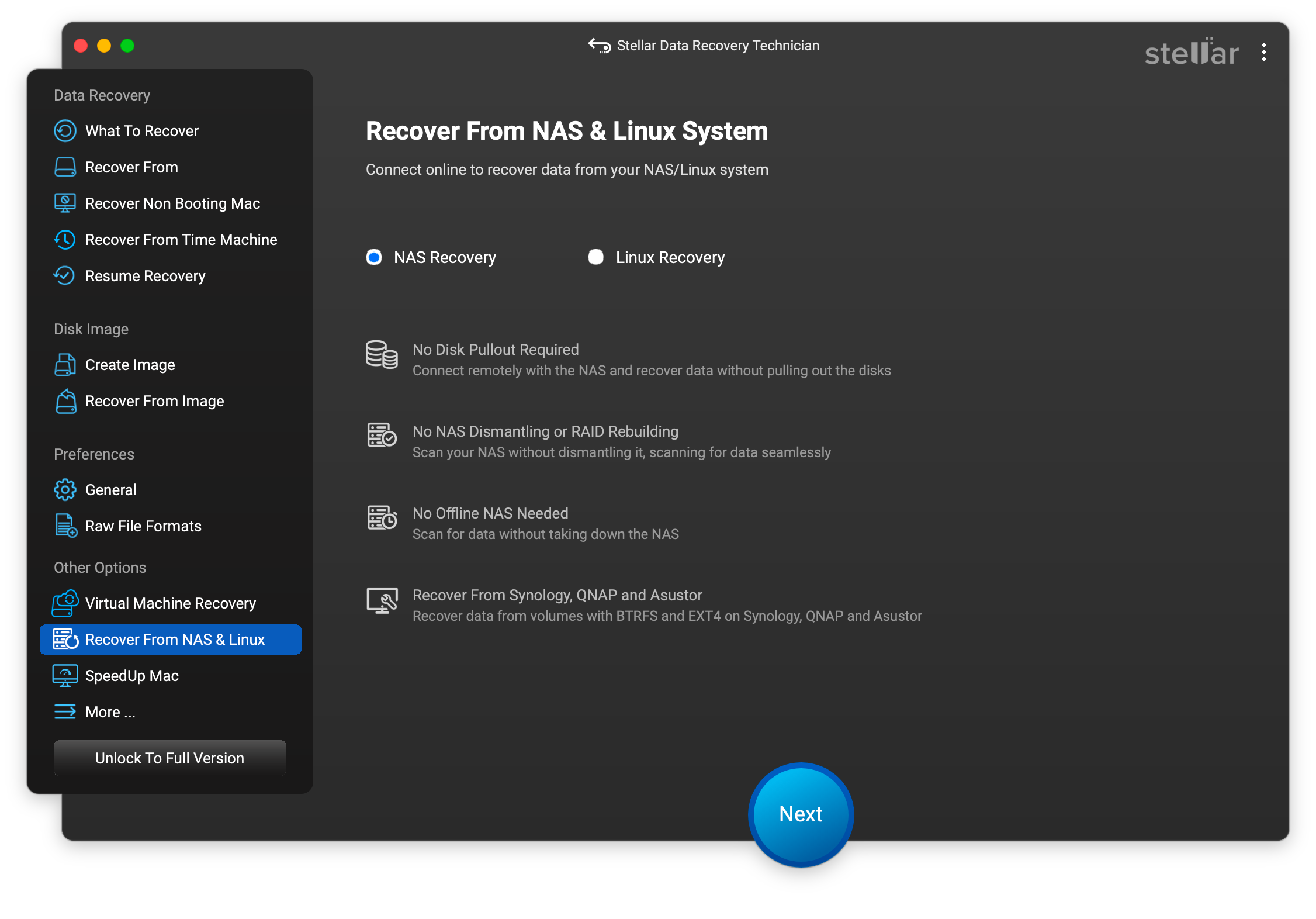
After running all five tools through these scenarios, Stellar Data Recovery Technician finished first by a wider margin than I expected going in. What makes it stand out isn't any single feature, it's the combination of things it can do that no other tool on this list handles simultaneously.
Scenario A (Live Synology, deleted share folder): Passed
Stellar connected to the Synology via IP address, detected the BTRFS volume structure correctly on the first attempt, and completed a full scan in about 52 minutes. The deleted share folder surfaced with its complete directory structure intact and files fully previewed before any recovery action. Recovery was clean, filenames, folder structure, and file integrity all preserved. This is Stellar's strongest scenario, and it shows.
Scenario B (Dead QNAP, drives pulled): Passed with caveats
With the four QNAP drives connected via SATA-to-USB adapters, Stellar attempted automatic RAID detection. It got the RAID level right (RAID 5) but proposed an incorrect disk order initially. Manual correction of the disk sequence took about ten minutes, and from there the deep scan ran for four-plus hours. Recovery rate: approximately 78% of total data. Larger video files showed partial corruption. Documents, photos, and smaller project files came back intact.
What I noticed here was that the RAID parameter controls, stripe size, disk order, parity type, are accessible and clearly labeled. You don't need to know these values from memory; the interface guides you through logical options. That matters for the majority of NAS owners who are not RAID engineers.
Scenario C (Two-disk RAID 5 failure): Partial
This scenario exceeds RAID 5's fault tolerance by design. Stellar attempted reconstruction but, predictably, recovered significantly less, around 30-40% of total data. No software can fully overcome the mathematical limits of RAID parity; I'm including this result not as a criticism but as an honest baseline. What's notable is that Stellar recovered something from a scenario that should theoretically yield nothing. Other tools recovered nothing at all.
Scenario D (EXT4 drive on Mac): Passed
macOS cannot natively mount EXT4. Stellar detected the drive, scanned it cleanly, and recovered documents and image files without issue. This capability alone separates Stellar Technician from most Mac-focused recovery tools, which either can't recognize EXT4 at all or require third-party kernel extensions.
What Makes Stellar Uniquely Worth It
Three things distinguish it from everything else on this list:
Online and offline NAS recovery in the same tool. Most competitors support one approach or the other. Stellar supports both, network-connected scanning via IP when the enclosure is alive, direct drive connection when it isn't.
Genuine BTRFS and EXT4 support. These are the file systems that NAS devices actually use. Supporting them correctly, not just listing them in a feature matrix, is what determines whether a scan produces results.
Disk imaging before recovery. The software lets you create a sector-by-sector image of a failing drive and run recovery on the copy, the correct professional workflow. Every scan stresses a degrading drive. Imaging first preserves your best recovery opportunity.
Additional features in the Technician edition: Time Machine backup recovery (APFS and HFS+ sparsebundles), virtual machine disk file recovery (VMDK, VDI, VHD, VHDX), S.M.A.R.T. monitoring, and disk cloning round out a genuinely comprehensive toolkit.
The honest criticism: The $199/year price is the highest on this list. Deep scans on large arrays take hours, not minutes. And automatic RAID detection isn't always accurate on the first pass, you'll occasionally need to adjust parameters manually. None of these are dealbreakers for the scenarios this software is built for, but they're worth knowing.
Verdict: The most complete NAS data recovery solution available. For anyone who manages a Synology, QNAP, or Asustor NAS, especially with RAID configurations, this is the tool that was actually built for your situation.
2. Wondershare Recoverit, Best for Simple Online NAS Recovery
Platforms: Windows and Mac | Price: $99.99/year (Premium, required for NAS) | Free: 100MB recovery limit
Recoverit is the most beginner-friendly NAS recovery tool on this list, and in specific scenarios it genuinely delivers. Here's where it stands after testing.
Scenario A (Live Synology, deleted files): Passed
Recoverit's SSH-based remote recovery connected cleanly to the Synology and scanned successfully. What I noticed was that filenames weren't always preserved, a meaningful portion of recovered files came back with generic naming rather than original names. Not a full loss, but notable if your recovery involves large media archives where identifying files afterward matters.
Scenario B (Dead QNAP, drives pulled): Struggled
Recoverit's offline NAS recovery is less mature than its online mode. With drives connected directly, RAID auto-detection worked on RAID 1 configurations but produced inconsistent results on the RAID 5 array. Manual RAID parameter input is possible but the interface provides less guidance than Stellar on what values to enter.
Scenarios C and D: Not attempted (OS limitations for D on Mac, incomplete RAID reconstruction for C)
What Recoverit Does Well
The interface is genuinely excellent for users who haven't done NAS recovery before. The step-by-step SSH connection workflow removes most of the technical friction. If your NAS is still accessible over the network and you're dealing with straightforward file deletion, Recoverit handles it well.
The Honest Problems
NAS recovery requires the Premium plan at $99.99/year. It's not available on the lower tiers. That's a significant paywall for a feature that users often don't discover they need until after they've already purchased a lower tier.
The 100MB free limit is the smallest on any tool in this category, you'll hit the ceiling after a handful of photos.
Subscription pricing only for most configurations. Compared to Stellar's richer feature set at $199, Recoverit's Premium tier at ~$100/year feels less value-dense for purely NAS-focused recovery needs.
Verdict: Solid for online NAS recovery on live, accessible devices. Falls short on complex RAID reconstruction and offline recovery scenarios. A good second option if the NAS enclosure is still functioning.
3. R-Studio, Best for Technical Users and IT Professionals
Platforms: Windows, Mac, Linux | Price: $79.99 (one-time license) | Free: Preview only, very limited recovery
R-Studio is what professional data recovery technicians use when the job gets complicated. It's been around for over 15 years, and its RAID reconstruction engine is legitimately the deepest of any tool on this list. But "deep" and "accessible" are different things.
Scenario B (Dead QNAP, drives pulled): Excellent results
R-Studio's virtual RAID reconstruction handled the QNAP drive set better than any other tool when parameters were correctly configured. It supports RAID 0, 1, 4, 5, 6, 10, 1E, 5E, 5EE, 6E, and nested configurations, coverage that goes well beyond what Stellar or Recoverit offer. When the RAID parameters were entered correctly, recovery was comprehensive and clean.
The issue: "when parameters were correctly configured" is doing a lot of work in that sentence. R-Studio requires you to know, or correctly determine, stripe size, disk order, and parity layout before meaningful recovery can begin. For someone who documented their NAS configuration, this is manageable. For the more common user who set up a Synology three years ago and never thought about the underlying RAID parameters again, it's a significant barrier.
Scenarios A and D: Functional but complex
R-Studio handles EXT4 and BTRFS volumes, and network recovery is supported. But the interface presents these capabilities through a dense, technical UI that assumes familiarity with file system concepts that most NAS owners simply don't have.
Pricing Context
At $79.99 for a lifetime license, R-Studio is actually the best value on this list if you know how to use it. The Technician license at $899 is enterprise pricing and represents a very different product category.
Verdict: The most technically capable RAID reconstruction engine available in software. Worth it for IT professionals, data recovery technicians, and users who are comfortable working with low-level storage parameters. Genuinely difficult to recommend for anyone who isn't already technically proficient with RAID and file system concepts.
4. EaseUS Data Recovery Wizard, Best for Windows Users on a Budget
Platforms: Windows (primary), Mac | Price: $69.95/month or $99.95/year | Free: 2GB recovery limit on Windows
EaseUS is one of the most widely used data recovery tools in the world, and its NAS support is more capable than many people realize. In straightforward scenarios, it performs well. The limitations become apparent in more demanding recovery situations.
Scenario A (Live Synology, deleted files): Passed
EaseUS connected to the Synology via SSH cleanly and recovered deleted files from a RAID 1 configuration without issue. The interface is wizard-driven and genuinely easy to follow, enter the NAS IP, provide credentials, enable SSH, scan, recover.
Scenario B (Dead QNAP): Mixed
EaseUS NAS recovery is primarily designed for online (network-connected) recovery. Offline recovery with drives removed and connected directly is not well-supported, the software is less capable here than both Stellar and R-Studio. RAID reconstruction depth is limited to RAID 0, 1, and 5.
Scenario D (EXT4 on Mac): Not applicable
EaseUS's Mac version doesn't handle EXT4 recovery as cleanly as Stellar, and the Mac edition lags behind the Windows version in NAS-specific capabilities.
The SSH Dependency Problem
EaseUS NAS recovery requires SSH to be enabled on the NAS device. That's fine when everything is working, but if the NAS can't boot or the SSH service is misconfigured, the recovery path is blocked. It's a meaningful limitation that's worth understanding before you're in a crisis situation.
Verdict: A solid choice for Windows users dealing with live NAS devices running RAID 0/1/5 configurations. The 2GB free limit is the most generous of any tool here for basic testing. Falls short for offline recovery, complex RAID configurations, and Mac-primary workflows.
5. DiskInternals NAS Recovery, Best Specialized Budget Option
Platforms: Windows | Price: $249.95 (one-time) | Free: Preview only
DiskInternals NAS Recovery is a purpose-built tool that handles EXT2/3/4 and ReiserFS volumes from Synology, QNAP, and Thecus devices specifically. It's been around long enough to have a genuine track record in the professional recovery community and consistently appears in technical-user recommendations.
Where It Stands Out
The recovery wizard is well-designed for its target use case, walking users through the specific steps for common NAS failure scenarios on Windows. EXT4 reconstruction is solid, and the RAID auto-detection is more accurate than EaseUS on RAID 5 configurations.
The Limitations
Windows only, if you're on a Mac, this tool isn't an option. The one-time price of $249.95 is higher than Stellar's annual license for a narrower feature set. The interface looks dated. And there's no online (network-connected) NAS recovery, all recovery requires physically connecting drives to a Windows machine.
Verdict: A legitimate specialized option for Windows users dealing with common Synology and QNAP failure scenarios. The price-to-feature ratio makes less sense compared to Stellar Technician, which covers significantly more ground for a lower annual cost.
Side-by-Side: How Each Tool Performed Across Scenarios
| Tool | Live NAS Recovery | Offline RAID Recovery | EXT4/BTRFS on Mac | Price |
| Stellar Technician | Excellent | Good | Yes | $199/year |
| Recoverit Premium | Good | Limited | Weak on Mac | $99.99/year |
| R-Studio | Functional | Excellent (technical) | Yes | $79.99 one-time |
| EaseUS | Good (Windows) | Limited | No | $99.95/year |
| DiskInternals | Drives required | Solid | Windows only | $249.95 one-time |
What Determines NAS Recovery Success (Before You Buy Anything)
Understanding why NAS recovery is different from standard drive recovery will save you from choosing the wrong tool or having unrealistic expectations.
RAID level matters more than people realize. RAID 5 tolerates one drive failure. RAID 6 tolerates two. If you've exceeded those tolerances, software recovery has hard mathematical limits, no tool on this list can overcome that. Professional cleanroom services with hardware reconstruction are the realistic path beyond that threshold.
File system knowledge is non-negotiable. Most NAS devices run BTRFS (Synology) or EXT4 (QNAP). Tools that claim NAS support but don't handle these file systems correctly, at the file system driver level, not just the scanning level, will produce empty or corrupted scan results. This is the single biggest differentiator between tools on this list.
Online vs. offline matters. If the NAS enclosure is still functional, online recovery via IP is faster, less risky, and preserves the RAID configuration. If the enclosure has failed, drives need to come out and be connected directly. Several tools on this list only support one approach. Know which scenario you're in before purchasing.
Stop writing to the NAS immediately. Every new write after a deletion or failure reduces your recovery window. Disable scheduled backups, sync clients, media indexers, and any services writing to the affected NAS the moment you realize something is wrong.
Frequently Asked Questions
Can I recover deleted files from a NAS without pulling the drives? Yes, if the NAS is still accessible over the network. Stellar, Recoverit, and EaseUS all support online NAS recovery via IP address without requiring drive removal. If the enclosure has failed, drives need to come out.
What NAS brands are supported by these tools? Stellar supports Synology, QNAP, and Asustor. Recoverit and EaseUS add Buffalo and Western Digital. DiskInternals covers Synology, QNAP, and Thecus. R-Studio is brand-agnostic and works at the file system level.
Do I need to rebuild my RAID before running recovery software? No, and you shouldn't attempt a RAID rebuild until you've imaged the drives. Rebuilding a degraded RAID risks overwriting recoverable data. Good recovery software reconstructs the RAID virtually without touching the actual array.
Can I recover data from a Synology NAS running BTRFS? Yes, but only with tools that genuinely support BTRFS recovery. Stellar handles BTRFS reliably both online and offline. EaseUS supports it in online mode. R-Studio handles it technically but requires manual configuration.
How long does NAS data recovery take? Online recovery of a deleted folder: 30–90 minutes depending on array size. Offline deep scan of a four-drive RAID 5 array: 3–6 hours. These are realistic numbers, anyone promising NAS RAID recovery in minutes is either doing a surface scan or being misleading.
What if my NAS drives are making clicking noises? Stop immediately. Clicking indicates physical drive failure. Software recovery cannot help with physically damaged drives, continued operation risks making the damage worse. Professional data recovery labs with cleanroom facilities are the appropriate resource.
Is Stellar's $199 price justified compared to cheaper options? For straightforward file deletion from a live NAS, probably not, Recoverit or EaseUS at lower price points handle that well. For complex scenarios (dead enclosure, RAID reconstruction, EXT4 on Mac, Time Machine backup corruption), Stellar covers ground that no cheaper option reliably addresses.
Final Verdict: Which NAS Data Recovery Software Should You Buy?
Here's my honest breakdown by user type:
If you're a creative professional, small business owner, or home user running Synology or QNAP, Stellar Data Recovery Technician is the right tool. The combination of online and offline recovery, genuine BTRFS/EXT4 support, RAID reconstruction, and the ability to run it on a Mac makes it the only tool you'll need regardless of how the failure presents itself.
If you're an IT professional or data recovery technician comfortable with RAID parameters, R-Studio's $79.99 lifetime license is the best technical value on this list, particularly for complex multi-drive RAID reconstruction where its engine outperforms everything else.
If your NAS is still online and you need simple file restoration, Recoverit handles that cleanly with a better interface than most, though the pricing structure for NAS features requires the Premium tier.
If you're primarily on Windows and need a budget-friendly option, EaseUS covers basic NAS scenarios on RAID 0/1/5 configurations and offers the most generous free recovery limit (2GB) for pre-purchase testing.
The uncomfortable truth about NAS data recovery is that the failure scenarios that cost people the most, dead enclosures, multi-disk RAID degradation, corrupted BTRFS volumes on a Mac, are exactly the scenarios where cheap or general-purpose tools fall apart. You'll spend $199 on Stellar Technician, or you'll spend $1,500+ at a professional recovery lab. For most real-world NAS failure scenarios, the former is the better bet.
Discussions
Become a Hackaday.io Member
Create an account to leave a comment. Already have an account? Log In.