Hackaday.io Hackaday.io
Projects
Discover Contests Courses Stack
More
Courses Tutorials Events Hackerspaces Hackaday.com Tindie Marketplace
Sign up Log in
Close
0%
0%

250W DC-DC Boost Module Test & Reverse Engineering

250W DC-DC Boost Module Test & Reverse Engineering

nqtronixnqtronix
Following Follow project
Liked Like project

Become a Hackaday.io member

Not a member? You should Sign up.

Already have an account? Log in.

Sign up with Github
Sign up with Twitter
OR
Forgot your password?

Just one more thing

To make the experience fit your profile, pick a username and tell us what interests you.

Pick an awesome username
hackaday.io/
Your profile's URL: hackaday.io/username. Max 25 alphanumeric characters.
Pick a few interests
Projects that share your interests
People that share your interests
We found and based on your interests.

Choose more interests.

OK, I'm done! Skip
Join this project
Similar projects worth following
5.6k views
0 comments
9 followers
13 likes
  • Description
  • Details
  • Files 13
    • View all
  • Components 0
  • Logs 4
    • View all
  • Instructions 0
  • Discussion 0
View Gallery
5.6k
0
9
13

Team (2)

  • nqtronixnqtronix
  • romainRomain

Join this project's team
hardware
completed project
module reverse engineering boost dc-dc

This project was created on 01/01/2021 and last updated 4 years ago.

Description

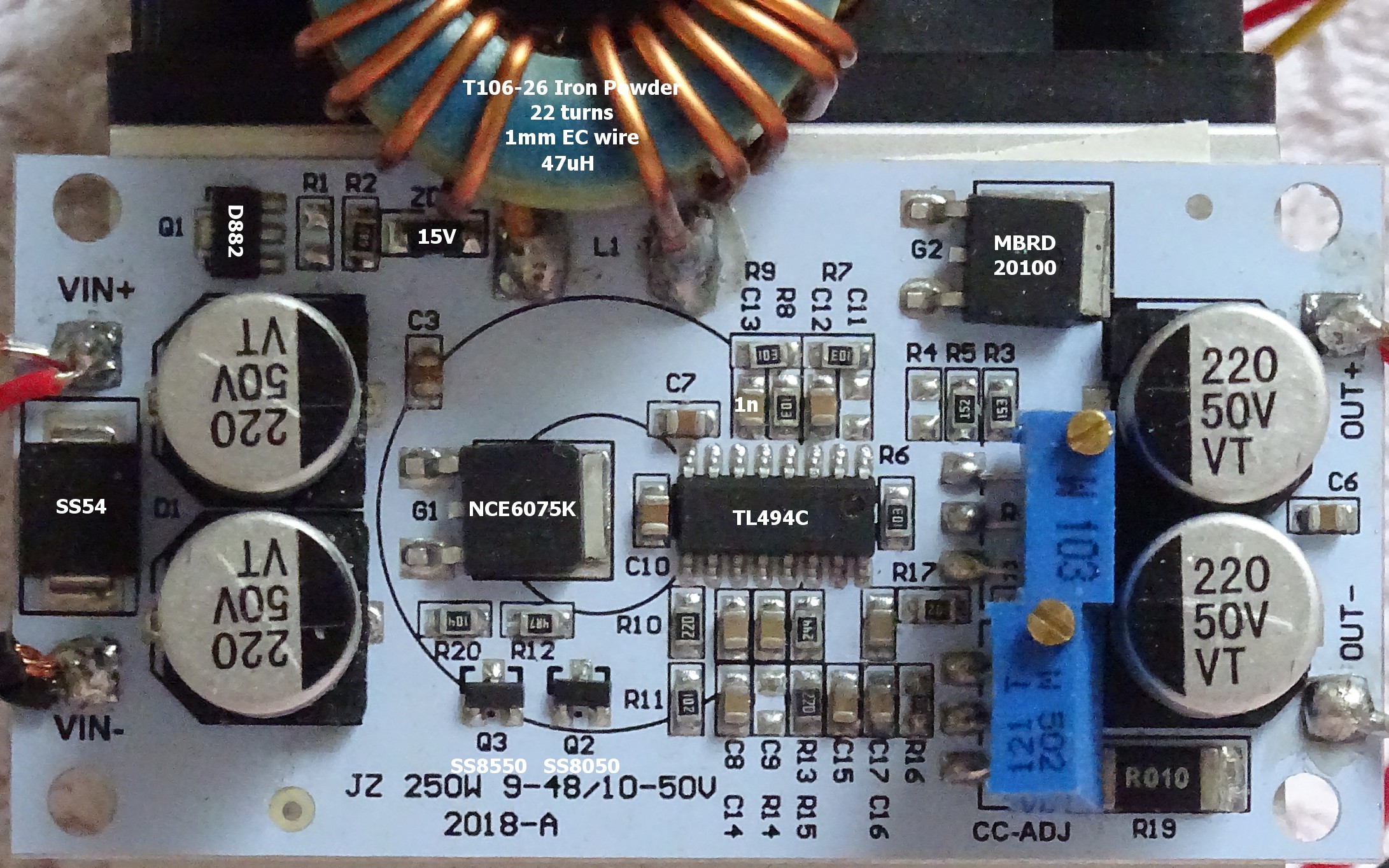
This DC-DC boost module seems to be fairly popular due to its wide operational range, high power and low cost (about 3-5€ on aliexpress). It's build with an aluminium core PCB, to cool it can be attached to a heat sink with thermal adhesive tape.

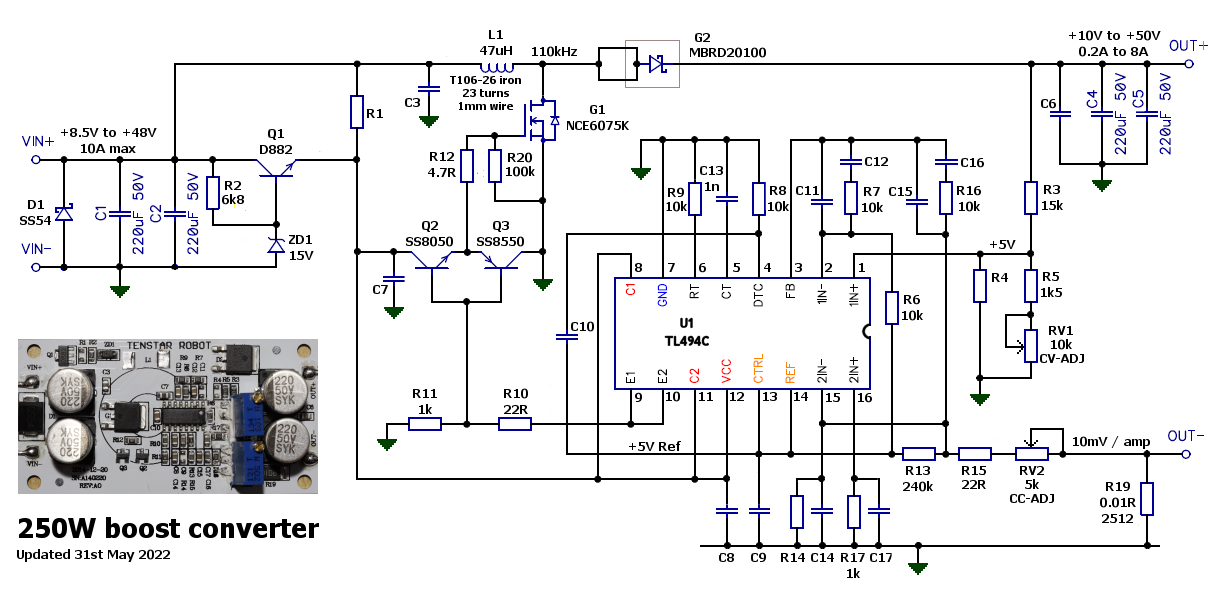
It converts 9-48V to a maximum of 48V, the output power is rated at 250W but effectively limited by the max input current of 6A. The efficiency is about 90-95%.

I was curious on how it works, so I desoldered the inductor and reverese engineered the PCB. It was almost imposible to see the traces, the schematic was derived from a bunch of continuity tests, so there might not be 100% correct. Afterwards I did a quick performance test where I placed it on a small metal case. At 100W output the transistor temperature was only 45°C, at lower loads you propably won't need any extra heatsink at all. Not that this does not have over temperature protection build in, you must verify your application!

Files

20220531_version_2018_by_OneOfEleven.jpg

JPEG Image - 734.66 kB - 05/31/2022 at 17:38

Preview

20220602_full_schematic_by_OneOfEleven.png

latest revision

Portable Network Graphics (PNG) - 162.34 kB - 06/02/2022 at 16:04

Preview

1.JPG

JPEG Image - 11.03 MB - 01/01/2021 at 13:08

Preview

2.JPG

JPEG Image - 11.11 MB - 01/01/2021 at 13:08

Preview

3.JPG

JPEG Image - 8.06 MB - 01/01/2021 at 13:08

Preview

View all 13 files

Project Logs
Collapse

  • Update 3: This should be the final one...™

    nqtronix • 06/02/2022 at 16:10 • 0 comments

    One more update by OneOfEleven, he send me me this:

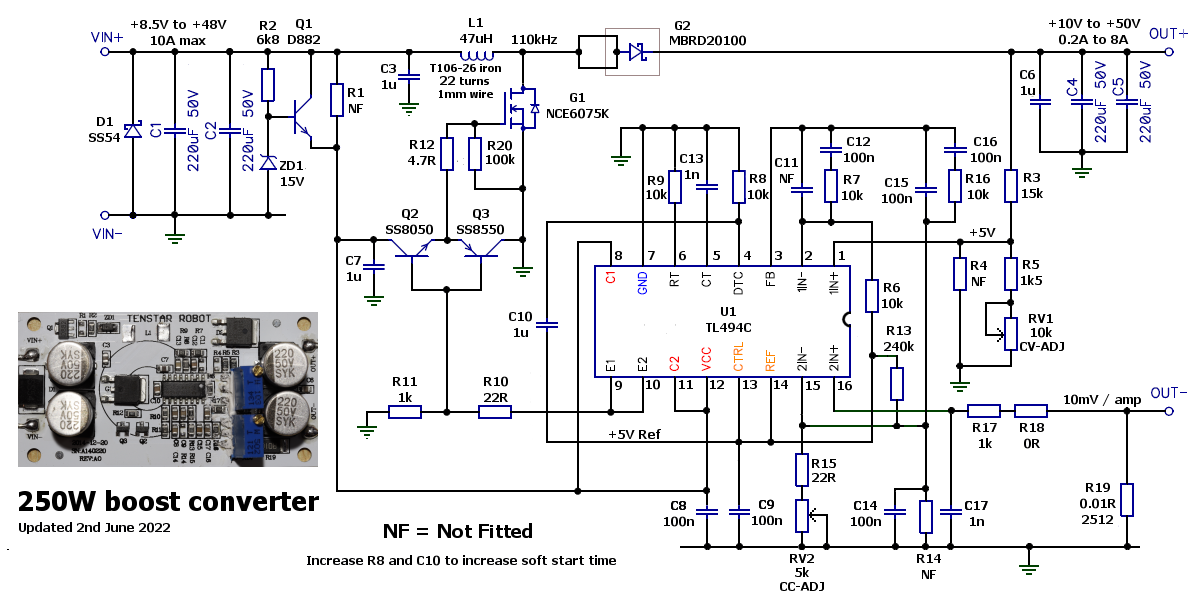
    Found some errors in the schematic nqtronix and added the component values as well. This should now be the final and correct schematic ..

  • Update 2: New PCB revision

    nqtronix • 05/31/2022 at 17:43 • 0 comments

    Another helpful update by OneOfEleven:

    Your PCB looks to be a 2014 version, mine appears to be a 2018 version (only difference is R1 & R20 I think). Here's a piccy of mine you could add if you wanted to help others.

  • Update: Complete Schematic by @OneOfEleven

    nqtronix • 05/31/2022 at 14:56 • 0 comments

    OneOfEleven has created a correct and complete schematic of this module, you can find it in the project files or below. Thank you for sharing this!

  • Additional Information

    nqtronix • 12/11/2021 at 15:49 • 0 comments

    By chance I found another post about this dcdc converter with in-depth measurements. Check it out here: https://lygte-info.dk/review/Converter DC-DC 10A 8.5-48V to 10-50V 250W UK.html

View all 4 project logs

Enjoy this project?

Share

Discussions

Log In/Sign up to comment

Become a Hackaday.io Member

Create an account to leave a comment. Already have an account? Log In.

Sign up with Github
Sign up with Twitter
OR

Similar Projects

Follow the spirit of FR4 origami, sphere300 gives you a sparkling golden ball with no need of frame or jigs.
Project Owner Contributor

Sphere300: Modular Origami with Flexible PCB

warmbitwarmbit

RF2126 module received from Amazon. It did not work for 2.4GHz as announced. So tuning was performed.
Project Owner Contributor

RF2126 module (amazon) tuning for 2.4GHz

denys-zaikinDenys Zaikin

Proper PCB design and less components for updated Blue Dmod.
Project Owner Contributor

Blue Dmod v1.1

uhpowerupuhpowerup

It is a hobby project main goal of which is to build a PCB board that can receive the GPS signal and send its location to the Ground Station
Project Owner Contributor

Airborne radioboard

pavelPavel

Does this project spark your interest?

Become a member to follow this project and never miss any updates

Going up?

About Us Contact Hackaday.io Give Feedback Terms of Use Privacy Policy Hackaday API

© 2026 Hackaday

By using our website and services, you expressly agree to the placement of our performance, functionality, and advertising cookies. Learn More

Yes, delete it Cancel

Report project as inappropriate

You are about to report the project "250W DC-DC Boost Module Test & Reverse Engineering", please tell us the reason.

Send message

Your application has been submitted.

Remove Member

Are you sure you want to remove yourself as a member for this project?

Project owner will be notified upon removal.