 ivoras

The module's pinout seems to be:
- 3V3 - module power supply
- GND - common ground
- OUT - outgoing light voltage
- IN - incoming light voltage
- CDS - light detect / module disable feature
As far as I can currently tell, it works something like this: if the CDS is not pulled low, the module will send out pulses and measure their return times. If a change in return times is detected (i.e. something in the path of the radio waves has changed position), it will connect the IN and OUT lines (most likely with a MOSFET). So if there's a light connected to the OUT line, and an external power source (4V - 28V) is connected to IN, it will light up. The OUT line will go low after a short period of time (a few seconds) if movement stops. Of course, GND lines must be connected together.
I'll need to experiment with it some more.






 Ruslan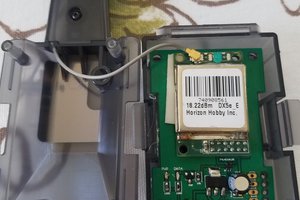
 PhillyFlyers
 Ai-Thinker
 Scott Clandinin
Here the Python equivalent code for Raspberry Pi
import os
import sys
import getpass
import time
import pigpio
import RPi.GPIO as GPIO
# #include <VirtualWire.h>
env=os.path.expanduser(os.path.expandvars('/home/' + getpass.getuser() + '/lib'))
sys.path.insert(0, env)
import piVirtualWire.piVirtualWire as piVirtualWire
PIN_RADAR = 4 # #define PIN_RADAR 2
PIN_TX = 17 # #define PIN_TX 9
# PIN_LED = 13 # #define PIN_LED 13 # print instead
# void setup()
baud_rate = 1000 # baud rate instead of bps connection speed
GPIO.setmode(GPIO.BCM)
GPIO.setup(PIN_RADAR, GPIO.IN)
# GPIO.setup(PIN_LED, GPIO.OUT)
# not needed
# pinMode(PIN_LED, OUTPUT);
pi = pigpio.pi()
# vw_set_tx_pin(PIN_TX); # and
# vw_setup(6000);
tx = piVirtualWire.tx(pi, PIN_TX, baud_rate)
rv = -1 # int rv = -1; # "unused"
try:
# void loop()
while True:
#print("PIN_LED would be HIGH if you want to use it")
# GPIO.output(PIN_LED, GPIO.HIGH) # LED on # digitalWrite(PIN_LED, HIGH);
v = GPIO.input(PIN_RADAR) # int v = digitalRead(PIN_RADAR);
if(v != rv):
rv = v
# char msg[20];
# sprintf(msg, "R %lu %d", millis() / 1000, v);
msg = "R %f %d" % (time.time(), v)
tx.put(msg) # vw_send((uint8_t *)msg, strlen(msg));
print(msg) # Serial.println(msg);
tx.waitForReady() # vw_wait_tx();
#print("PIN_LED would be LOW if you want to use it")
# GPIO.output(PIN_LED, GPIO.LOW) # LED off # digitalWrite(PIN_LED, LOW);
time.sleep(0.1)
except KeyboardInterrupt: # press Ctrl + C to stop
GPIO.cleanup()
tx.cancel()
pi.stop()