Close
0%
0%

Pomelo: Gamma Spectroscopy Module

A complete low-power gamma ray spectrometer that can be used by itself or integrated into other projects

Similar projects worth following
Pomelo is a radiation detector for hobby-level gamma spectroscopy. I’m designing it according to the following requirements:

- Low cost. Target is below 150 Eur in components
- Commercial off-the-shelf scintillator and SiPM
- Low power. Ideally ~5mA while data taking
- USB connectivity (CDC for dumping data to a terminal)
- UART for interfacing with an external MCU
- Energy range: 50 keV – 3 MeV
- Onboard histogramming and run control
- List-mode data option
- Temperature compensation
- Coincidence measurements with two devices using dedicated hardware handshaking
- Software configurable energy threshold

Pomelo will be launching on Crowd Supply https://www.crowdsupply.com/pomelo-instrumentation/pomelo

This project is inspired by three awesome projects, two of them being open-source:
All-In-One Gamma-Ray Spectrometer https://hackaday.io/project/185211-all-in-one-gamma-ray-spectrometer
Cosmic Pi https://github.com/CosmicPi
Radiacode https://www.radiaco

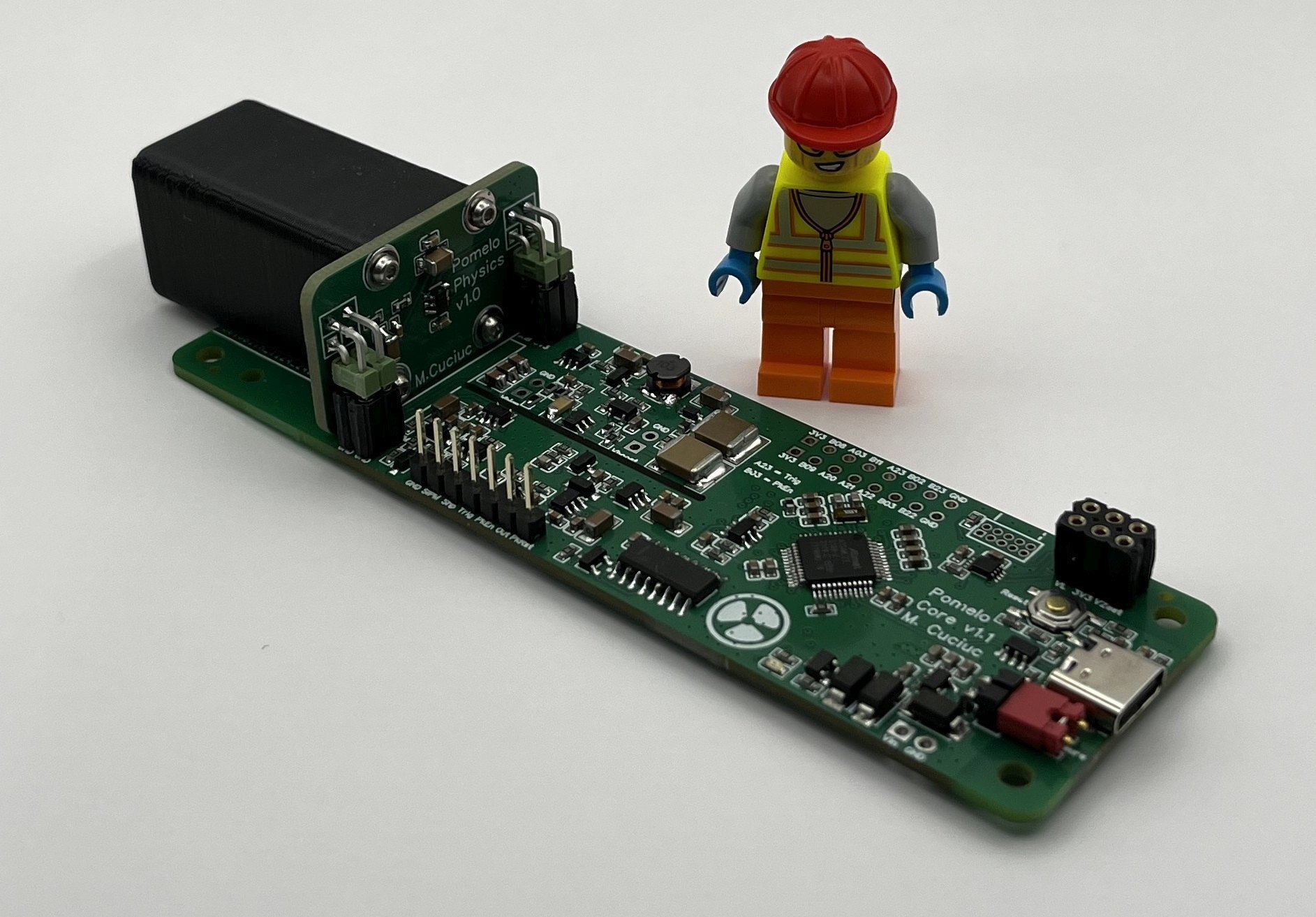
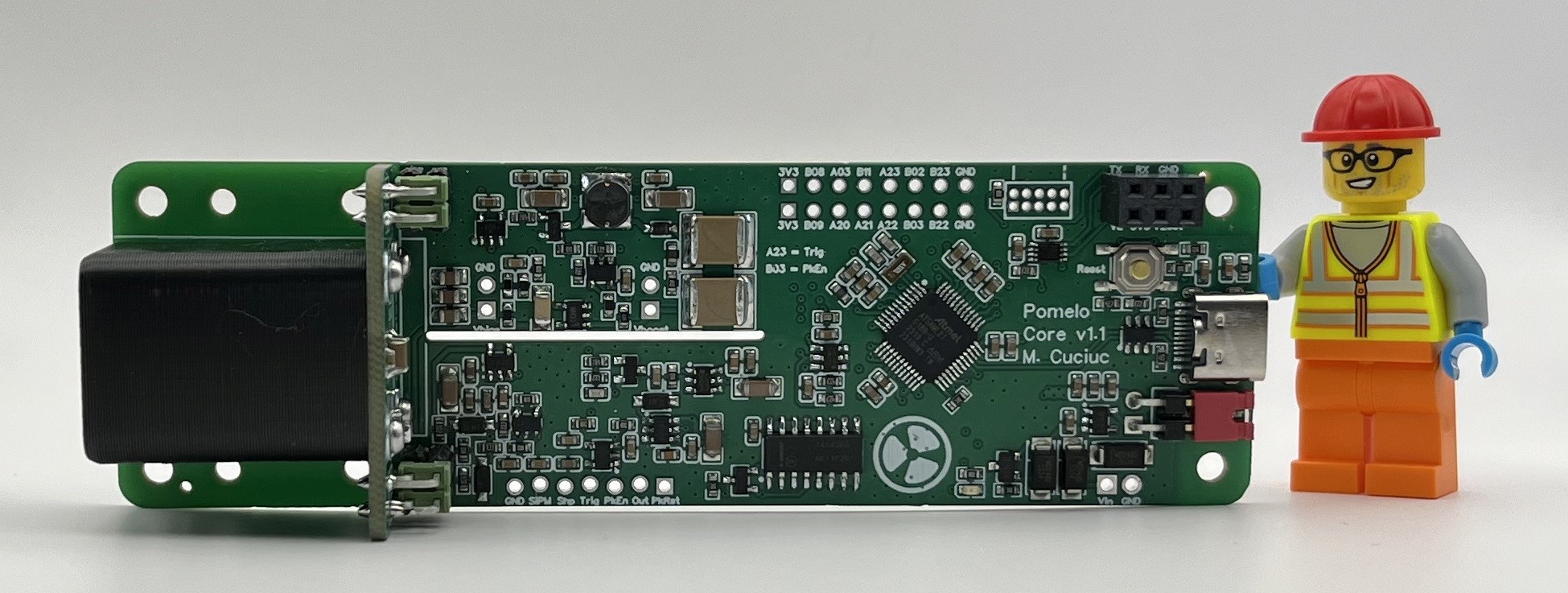
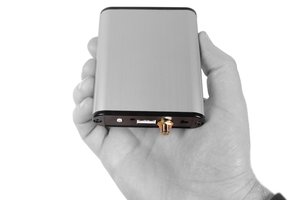
Complete gamma spectroscopy module ready to be connected either to a laptop or an embedded system. It measures less than 130mm x 40mm x 30mm

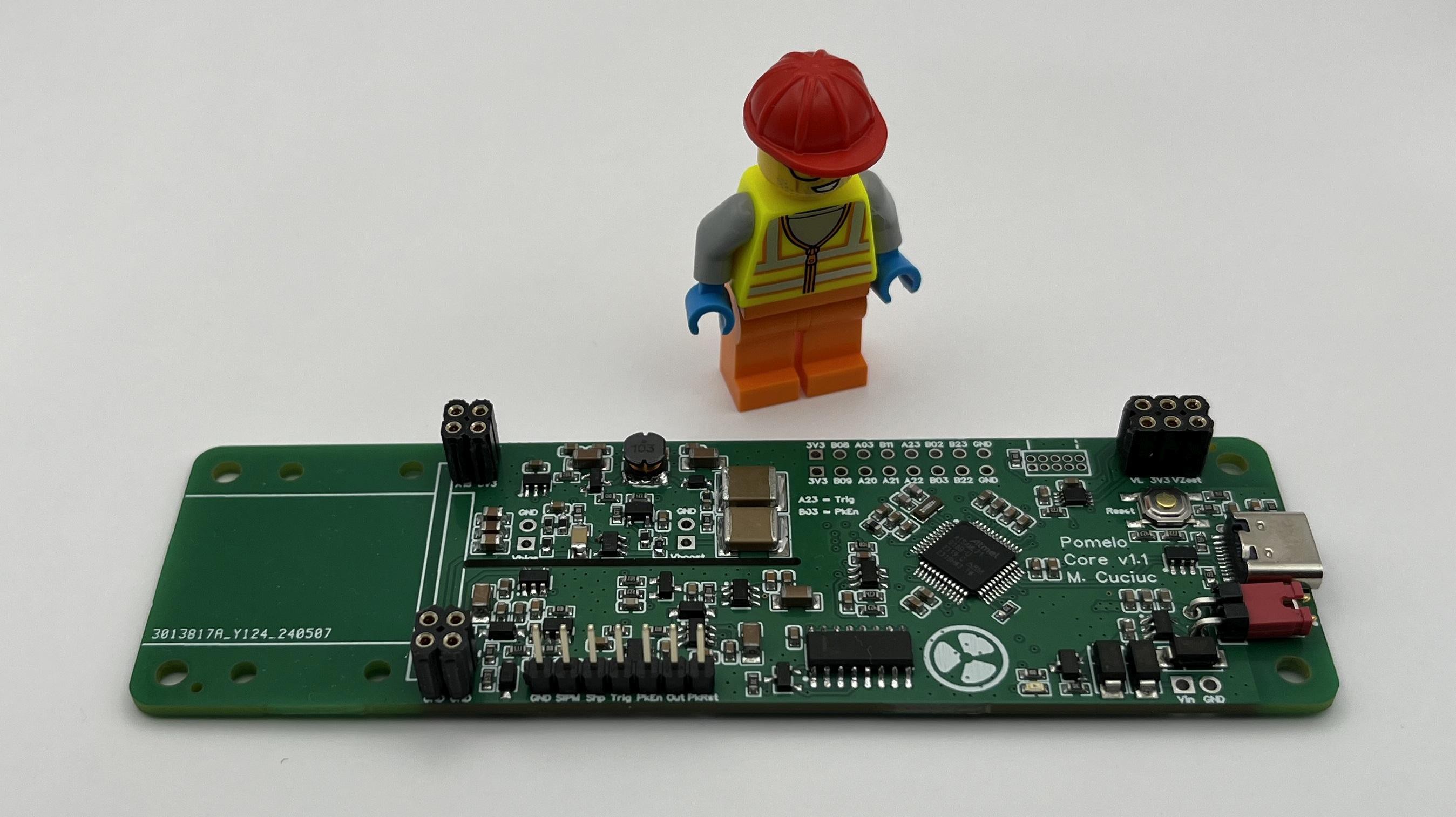
This contains everything that’s needed for gamma spectroscopy and nothing more. It has the detector assembly (Pomelo Physics) with scintillator and silicon photomultiplier, as well as the accompanying electronics (Pomelo Core) with bias supply, analog front end, and digital electronics.

Its USB and UART connectivity allow it to interface to lots of things, like a laptop, an Arduino, or a Raspberry Pi. It integrates a level shifter on the UART lines so it can talk to both 3.3V as well as 5V systems. I have used it during development to perform measurements with radioactive sources or cosmic muons:

I made an Arduino-compatible board that contains supporting circuitry to make a complete hand-held instrument based on the Pomelo Core and Physics. It has buttons and a screen, battery, and lots of wireless connectivity:

I'm also using Pomelo to experiment with visualizing gamma spectra in a more intuitive way, shown as colors on an LED strip:

Pomelo Physics
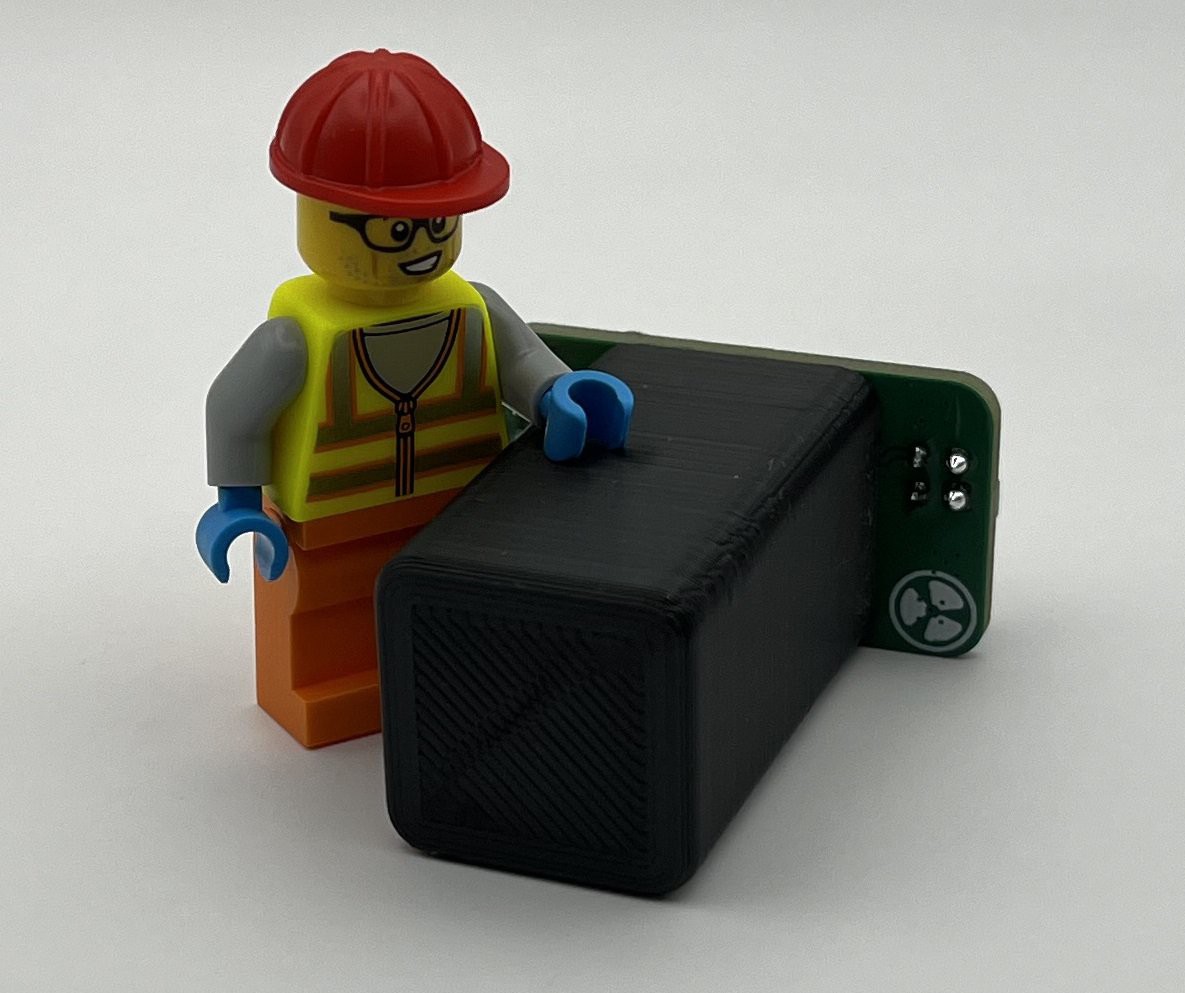
Pomelo Physics is the detector assembly, containing:

Pomelo Core

Pomelo Core contains all the associated electronics:

  • Digitally controlled SiPM bias supply ~32V - ~48V
  • Digitally controlled threshold
  • Low power analog front-end
  • ARM Cortex-M0+ microcontroller, Microchip ATSAML21G18B
  • UART connectivity with integrated level shifter
  • 10 unused GPIO pins for further expansion

Performance
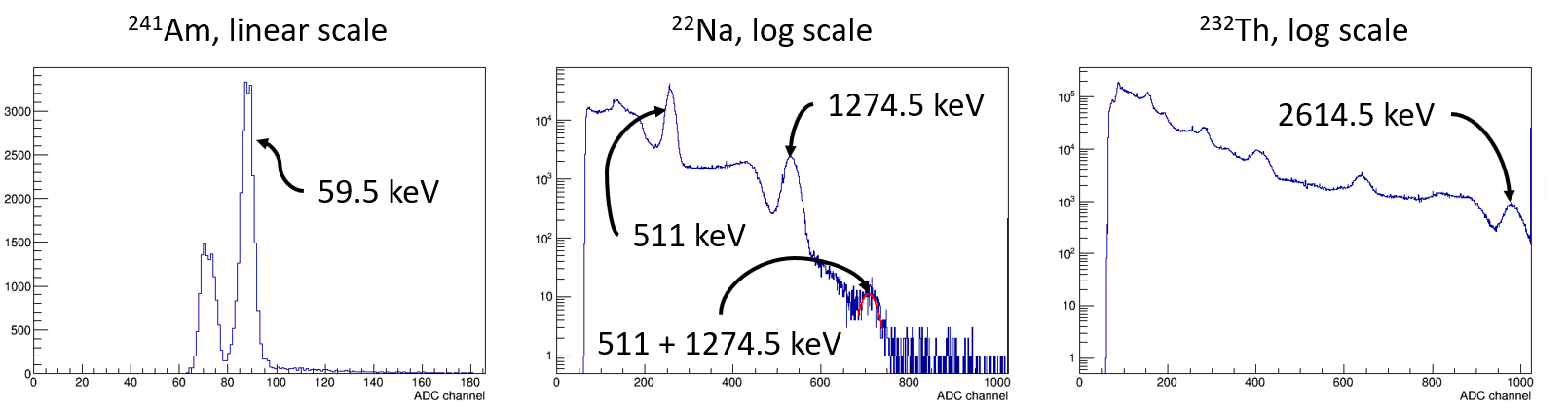
Spectra for various radioactive sources taken with Pomelo

The energy resolutions at different energies are:

  • <30% @ 59.5 keV
  • <11% @ 511 keV
  • <7% above 1274.5 keV

This is the original description when I started the project in January 2024

This is very much a work in progress and most of the requirements are not satisfied yet. But thanks to excellent documentation done by NuclearPhoenix on the All-In-One Gamma-Ray Spectrometer and the Cosmic Pi project I have a proof of concept working.
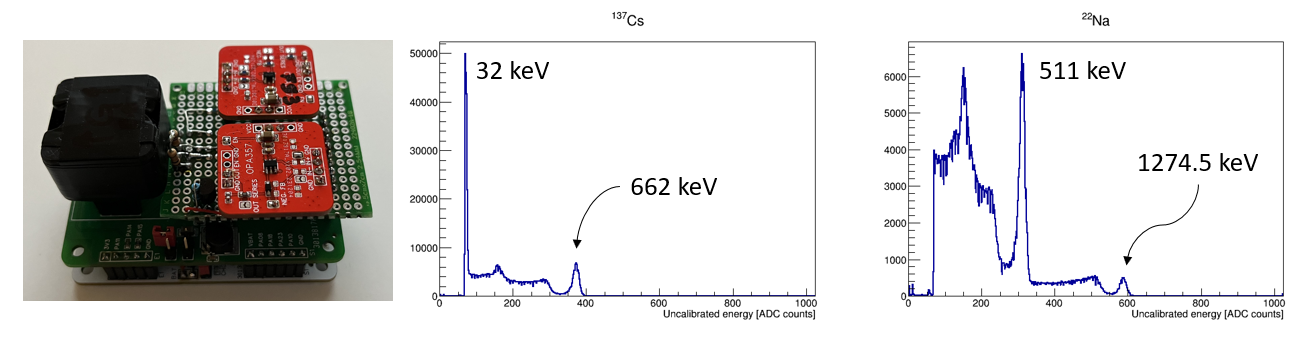
Pomelo hardware and gamma spectra taken with Cs137 and Na22

Current version of the hardware includes:

  • 4mm x 4mm x 10mm GAGG(Ce) scintillator crystal with light reflector and 3D printed “dark” box
  • 4mm x 4mm Broadcom AFBR-S4N44P014M Silicon photomultiplier (SiPM) with optical grease coupling to scintillator
  • MAX1932 SiPM bias supply
  • Shaper to decrease bandwidth of SiPM pulses
  • Peak detector circuit
  • ATSAML21E18B MCU that performs triggering, pulse height measurement, and peak detector reset

Energy resolution is 14.3% @ 662 keV and 12.4% @ 1274.5 keV.

Architecture
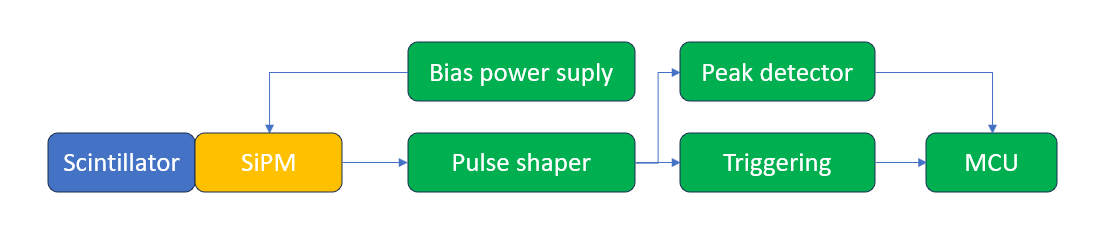
  • Gamma spectroscopy

    mihai.cuciuc • 08/31/2026 at 05:11 • 0 comments

    I went to the lab and took a short video recording some gamma spectra taken with Pomelo and describing the basics of gamma spectroscopy.

  • How to tell if something is radioactive - with confidence

    mihai.cuciuc • 08/30/2026 at 08:13 • 0 comments

    Deciding if something contains some radioactivity when its activity is very low can be quite tricky because of background radiation. Here's a my understanding of the topic, in video form.

  • Gamma attenuation experiment

    mihai.cuciuc • 08/28/2026 at 18:28 • 0 comments

    This is an experiment that I originally made as a Hackaday project but I now had the opportunity to make a video of. It uses the Pomelo detector and a lab source to check how much gamma radiation is stopped by several layers of aluminium and by a thin sheet of lead for comparison.

  • Inverse square law experiment

    mihai.cuciuc • 08/23/2026 at 21:39 • 0 comments

    While distancing helps protect against radiation, it also makes detecting it a lot more challenging. Here I look at an example of the inverse square law with the Pomelo detector and a lab source.

  • Education & Outreach

    mihai.cuciuc • 08/04/2026 at 05:06 • 0 comments

    For the past year I've been busy improving the hardware but also running a small-ish educational project funded by the Romanian Ministry of Education and Research. I'm going to high-schools to discuss ionizing radiation, and to take measurements with the students in the classroom using this hardware. It's been a great opportunity to get feedback on the hardware and to try to get students interested in the many topics of radiation and its measurement.

    One of the deliverables for this project is a series of YouTube videos. While I'm definitely not made to be on camera, I had a blast making them! I'll post them here. Any feedback is extremely welcome!

  • Pomelo on Crowd Supply

    mihai.cuciuc • 01/30/2025 at 05:33 • 0 comments

    Pomelo will be launching on Crowd Supply where you can subscribe to be notified when it's ready: https://www.crowdsupply.com/pomelo-instrumentation/pomelo

    The business side of things is a very new topic to me, and it's full of challenges. But what I did not expect was that, since I'm super passionate about building this detector and sharing it with the community, I seem to enjoy most of these challenges.

  • Theremino MCA

    mihai.cuciuc • 08/02/2024 at 21:16 • 0 comments

    Pomelo is all about interfacing with as many things as possible. Theremino MCA is a popular open-source gamma spectroscopy software designed to work with DIY detectors. It relies on the PC’s sound card for digitizing pulses in order to build a spectrum.

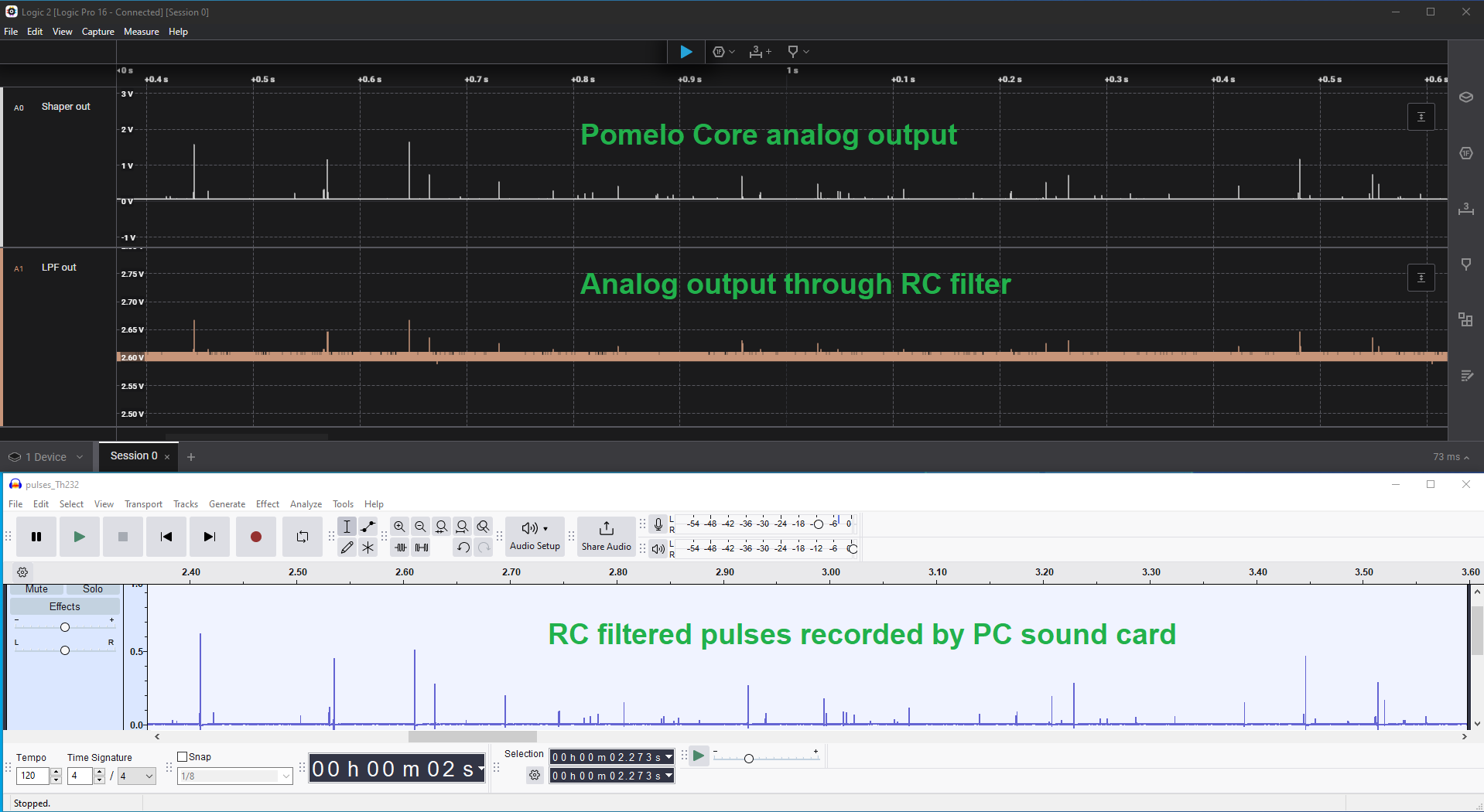
    Pomelo Core makes internal analog signals available on a pin header, mostly for debugging. Among these there is a low-pass filtered version of the SiPM output. Unfortunately, it’s still a bit too fast to be properly digitized by a PC sound card and while it does work, the results are a bit wonky. But if we slow it down a bit more using an RC low-pass filter, it becomes just right. I used 10 kOhm and 10 nF.

    To get a feel for how well the pulse amplitudes match between the Pomelo Core output and the signal that is read by the sound card I grabbed some pulses both with a Saleae logic analyzer and with Audacity and manually aligned the time scales to look at the same pulses.

    Pulses from a Th-232 source at different stages in the analog chain. The time scale is manually aligned to look at the same pulses in both Saleae Logic and Audacity.

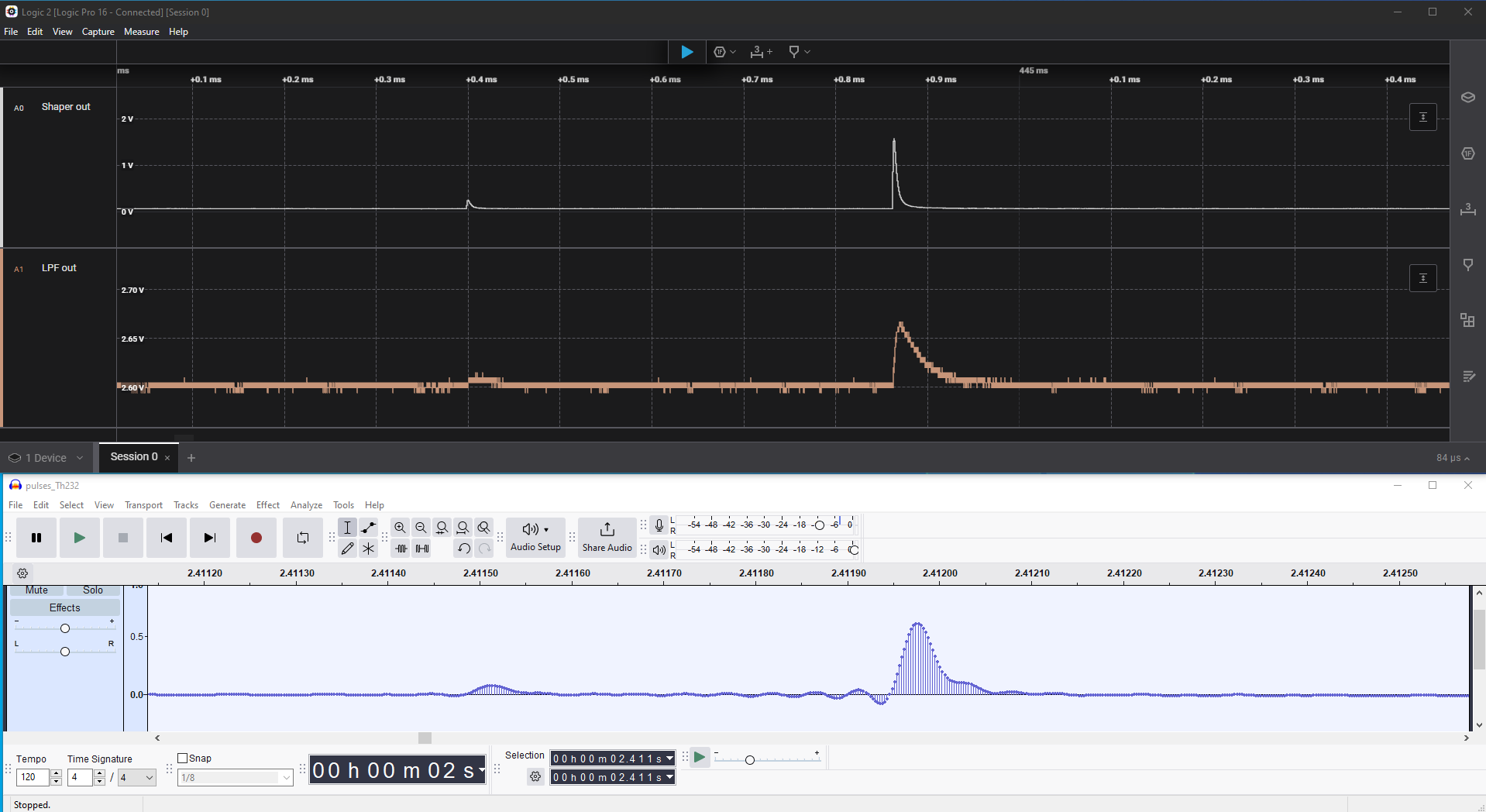
    Same plot as above but zoomed in to see the shapes of individual pulses

    The sound card is detecting pulses as being negative, despite the Pomelo output being positive. I inverted the waveform in Audacity to make things easier to see.

    One thing to notice is that the RC filtered signal rides on a DC baseline of ~2.5V. This is due to the PC’s sound card providing bias for the microphone -- it’s not a huge problem for Pomelo, as its output is fed directly from a stiff source, an op-amp’s output. The 10 kOhm resistor nicely isolates these two.

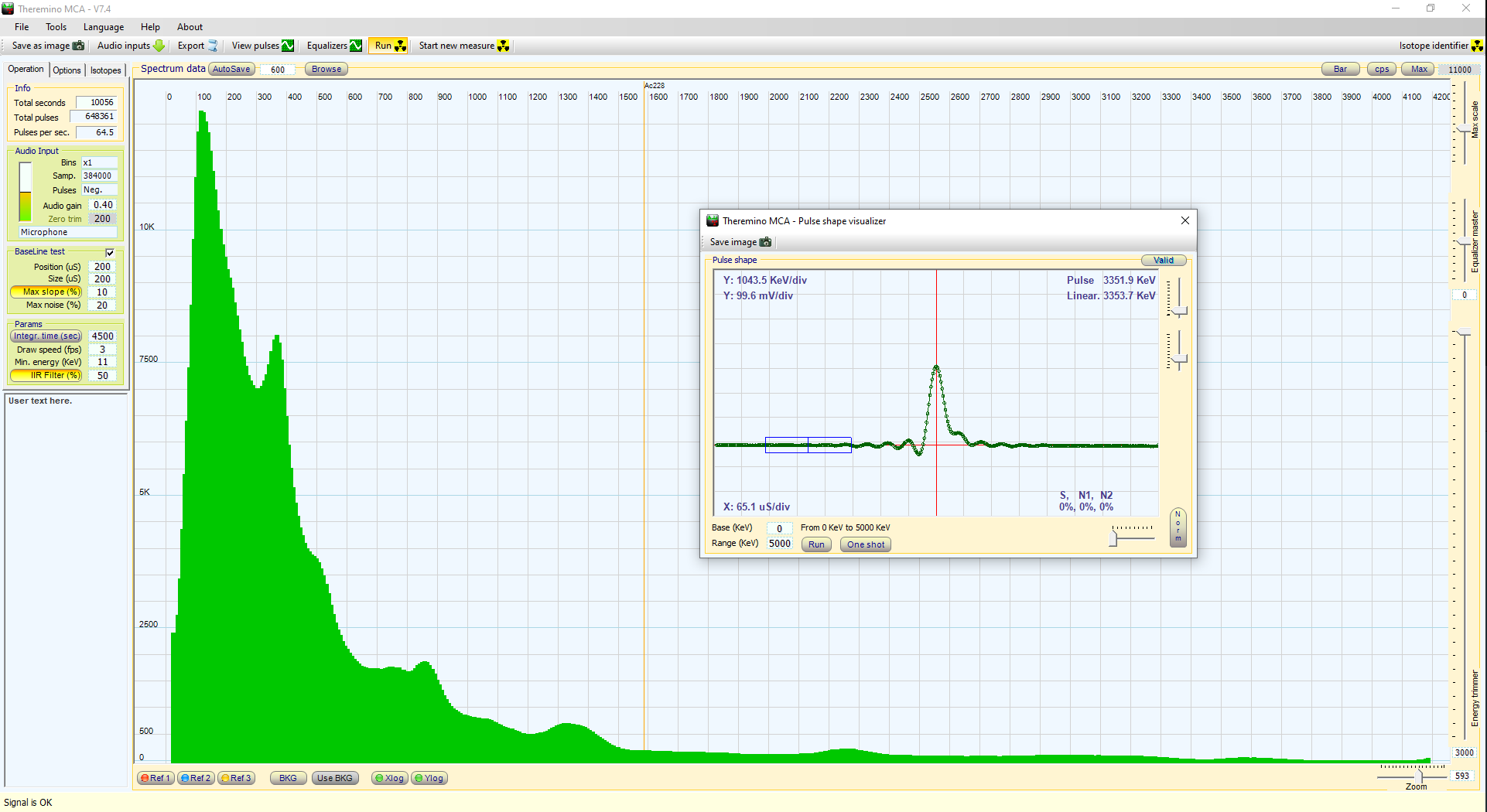
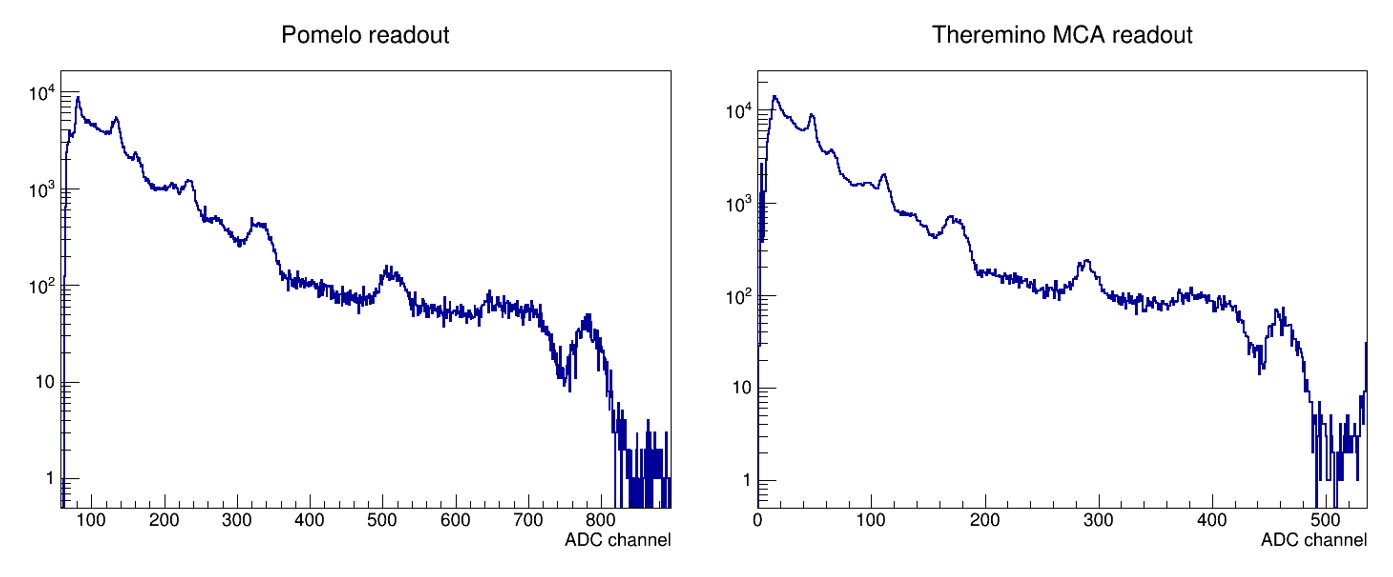
    The spectrum of a Th-232 source looks very good both in the Theremino MCA software, as well as exported and displayed alongside the spectrum recorded by Pomelo Core.

    Th-232 spectrum and individual pulse in the Theremino MCA software

    Spectra taken with both Pomelo Core as well as with Theremino MCA, with uncalibrated x axes scaled to cover the same energy range

  • Pomelo core in coincidence mode

    mihai.cuciuc • 07/15/2024 at 04:18 • 0 comments

    I used a pair of modules are run in coincidence mode to detect and measure cosmic muons.

  • Pomelo Core new use case

    mihai.cuciuc • 06/21/2024 at 04:28 • 0 comments

    I added a new project describing an experiment that uses Pomelo to measure gamma attenuation in aluminum. The result is surprisingly close to the literature value.

  • Updated scintillator and wide range energy linearity

    mihai.cuciuc • 06/17/2024 at 16:15 • 0 comments

    Pomelo sales rep showing off the latest prototype sporting a 10mm x 10mm x 20mm CsI(Tl) crystal

    I designed the device dimensions with a 2cc (10mm x 10mm x 20mm) CsI(Tl) scintillator in mind, but only had 3cc ones to test with. It’s why the detector element extended beyond the device’s edge, but now that the 2cc crystals arrived, I can share the final design and some preliminary performance plots.

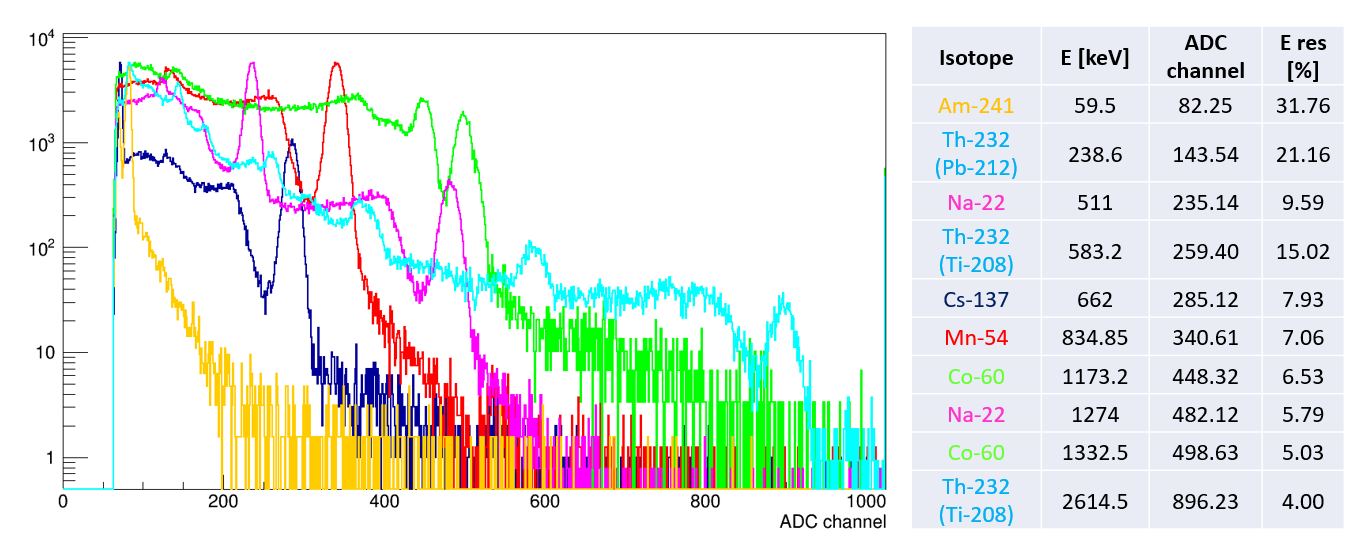
    The scintillator is not yet potted in silicone, which does decrease light output a little (and thus worsens resolution). I took spectra with several lab sources and computed the resolutions for every gamma line and checked the detector linearity.

    Spectra for Am-241, Na-22, Cs-137, Mn-54, Co-60, and Th-232 on the same plot in logarithmic scale. Energy resolutions for each energy shown in the last column

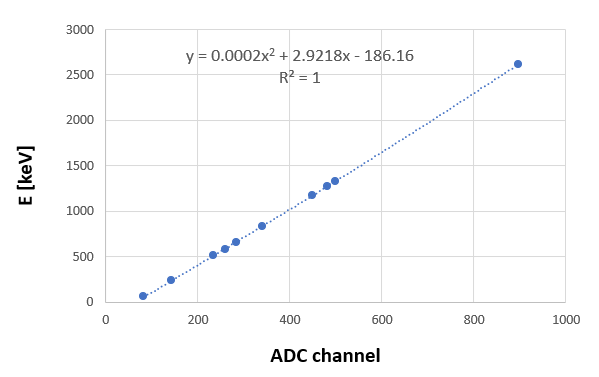
    Detector linearity plot. There is a small quadratic term that is typical of SiPMs

View all 24 project logs

Enjoy this project?

Share

Discussions

Residual Entropy wrote 08/09/2024 at 18:41 • point

I've been looking for a way to do gamma spectroscopy semi-affordably and this is exactly what i was looking for, this is awesome!!

  Are you sure? yes | no

[deleted]

[this comment has been deleted]

mihai.cuciuc wrote 07/14/2024 at 16:33 • point

Hi, Dylan,

Yup, that's the plan -- in its entirety, actually. I plan on selling them and making the firmware and schematics available. Not the PCB layout though, as by the time you start modifying that you're better off redoing the whole thing anyway.

It will take me a while to start selling them -- I'm reasonably good at engineering, not at the business side of things. But if you're way too eager to get one, PM me.

  Are you sure? yes | no

Dan Maloney wrote 06/04/2024 at 23:39 • point

Fantastic project, love the lesson in scintillation counting. Wrote this up for the blog, should publish soon. Great work!

  Are you sure? yes | no

peter jansen wrote 04/17/2024 at 05:01 • point

Super interesting!  How small do you think you could ultimately make the sensor and accompanying electronics?  

  Are you sure? yes | no

mihai.cuciuc wrote 04/17/2024 at 05:04 • point

Thanks! I'm aiming to fit everything on a 5cm x 10cm PCB, with the height given by the detector laid on its side, so about 2.5cm.

  Are you sure? yes | no

peter jansen wrote 04/17/2024 at 23:34 • point

Since the Radiation Watch Type 5 has been retired, I was hoping you'd say something along it's size so that it could be a close mechanical replacement :) ( https://www.sparkfun.com/products/retired/14209 ).  I've tried to get it to do similar things to what you're doing, by measuring pulse width instead of height/AOC (only a correlate of energy) -- it'd be wonderful to have a proper solution in a small form factor to put on hand-held devices!

  Are you sure? yes | no

mihai.cuciuc wrote 04/18/2024 at 05:39 • point

Oooh, I see -- the Radiation Watch Type 5 was indeed pretty cool -- I'll think about what could be done in similar size constraints.

Meanwhile, I suggest you take a look at the Semeatech Mini Gamma Sensor ( https://semeatech.com/Products/Radiation%20Detection/Mini%20Gamma%20Sensor.html ). It's super small, draws very little power, and has decent performance above 300 keV. I played around with them a little so let me know if you want some spectra.

  Are you sure? yes | no

Mitchell de Vries wrote 02/14/2024 at 22:46 • point

Those spectra are looking nice and clean, you're inspiring me to restart my radiation detecting projects! Did you have much issue sourcing suitable calibration sources? Also, I'm guessing you'll be implementing calibration?

  Are you sure? yes | no

mihai.cuciuc wrote 02/15/2024 at 06:14 • point

Thanks! I'm glad to hear my toying around is inspiring!

I have a gamma spectroscopy lab at work, so we have quite a few radioactive sources I could use for calibration. Yup, right now I do energy calibration offline, and it's pretty linear, with a very small quadratic term that is fairly common with SiPMs. The plan is to store calibration constants on the device.

But I also had good success calibrating it without lab sources, using commercial Th-232 welding rods (WTh20), a smoke detector Am-241 source (but they don't sell those in the EU any more), and K-40 from salt substitute. This last one requires some patience though :)

  Are you sure? yes | no

Muth wrote 01/18/2024 at 15:01 • point

This is highly interesting ! May I ask if you have advises to source scintillators and SiPM ?

Thanks !

  Are you sure? yes | no

mihai.cuciuc wrote 01/19/2024 at 06:02 • point

Thanks!

Sure, I got the SiPM from Farnell: https://ro.farnell.com/broadcom/afbr-s4n44p014m/silicon-photomultiplier-1-ch-420nm/dp/4236230

I chose them because they're fairly inexpensive and seem to be quite new (i.e. not going to be EoL soon).

As for the scintillators, I have them from OST-Photonics: https://www.ost-photonics.com/product-category/scintillation-crystal-2/

  Are you sure? yes | no

Muth wrote 01/23/2024 at 15:38 • point

Thanks you very much !

  Are you sure? yes | no

Similar Projects

Does this project spark your interest?

Become a member to follow this project and never miss any updates