mihai.cuciuc
-
Gamma spectroscopy
08/31/2026 at 05:11 • 0 commentsI went to the lab and took a short video recording some gamma spectra taken with Pomelo and describing the basics of gamma spectroscopy.
-
How to tell if something is radioactive - with confidence
08/30/2026 at 08:13 • 0 commentsDeciding if something contains some radioactivity when its activity is very low can be quite tricky because of background radiation. Here's a my understanding of the topic, in video form.
-
Gamma attenuation experiment
08/28/2026 at 18:28 • 0 commentsThis is an experiment that I originally made as a Hackaday project but I now had the opportunity to make a video of. It uses the Pomelo detector and a lab source to check how much gamma radiation is stopped by several layers of aluminium and by a thin sheet of lead for comparison.
-
Inverse square law experiment
08/23/2026 at 21:39 • 0 comments -
Education & Outreach
08/04/2026 at 05:06 • 0 commentsFor the past year I've been busy improving the hardware but also running a small-ish educational project funded by the Romanian Ministry of Education and Research. I'm going to high-schools to discuss ionizing radiation, and to take measurements with the students in the classroom using this hardware. It's been a great opportunity to get feedback on the hardware and to try to get students interested in the many topics of radiation and its measurement.
One of the deliverables for this project is a series of YouTube videos. While I'm definitely not made to be on camera, I had a blast making them! I'll post them here. Any feedback is extremely welcome!
-
Pomelo on Crowd Supply
01/30/2025 at 05:33 • 0 commentsPomelo will be launching on Crowd Supply where you can subscribe to be notified when it's ready: https://www.crowdsupply.com/pomelo-instrumentation/pomelo
The business side of things is a very new topic to me, and it's full of challenges. But what I did not expect was that, since I'm super passionate about building this detector and sharing it with the community, I seem to enjoy most of these challenges.
-
Theremino MCA
08/02/2024 at 21:16 • 0 commentsPomelo is all about interfacing with as many things as possible. Theremino MCA is a popular open-source gamma spectroscopy software designed to work with DIY detectors. It relies on the PC’s sound card for digitizing pulses in order to build a spectrum.
Pomelo Core makes internal analog signals available on a pin header, mostly for debugging. Among these there is a low-pass filtered version of the SiPM output. Unfortunately, it’s still a bit too fast to be properly digitized by a PC sound card and while it does work, the results are a bit wonky. But if we slow it down a bit more using an RC low-pass filter, it becomes just right. I used 10 kOhm and 10 nF.
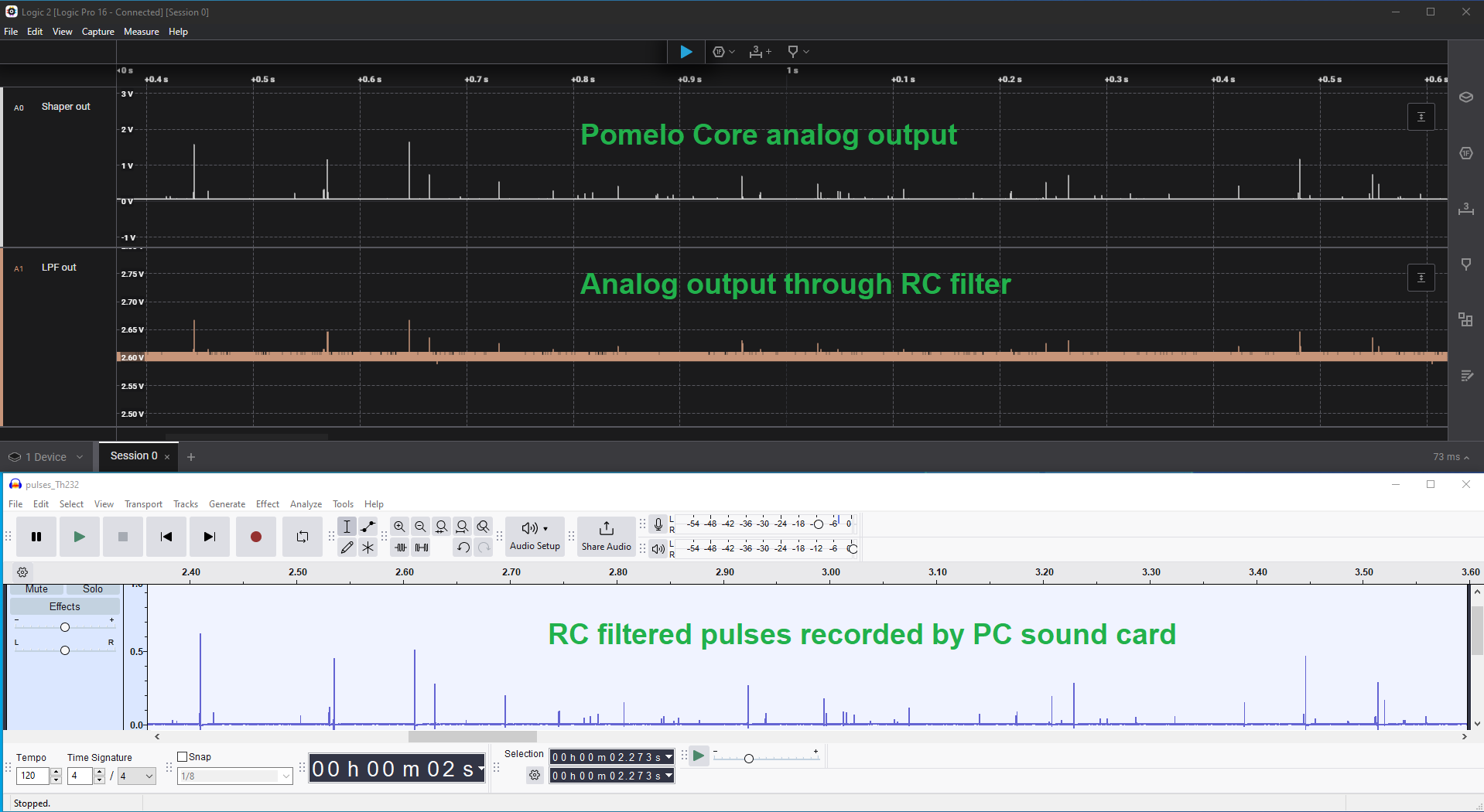
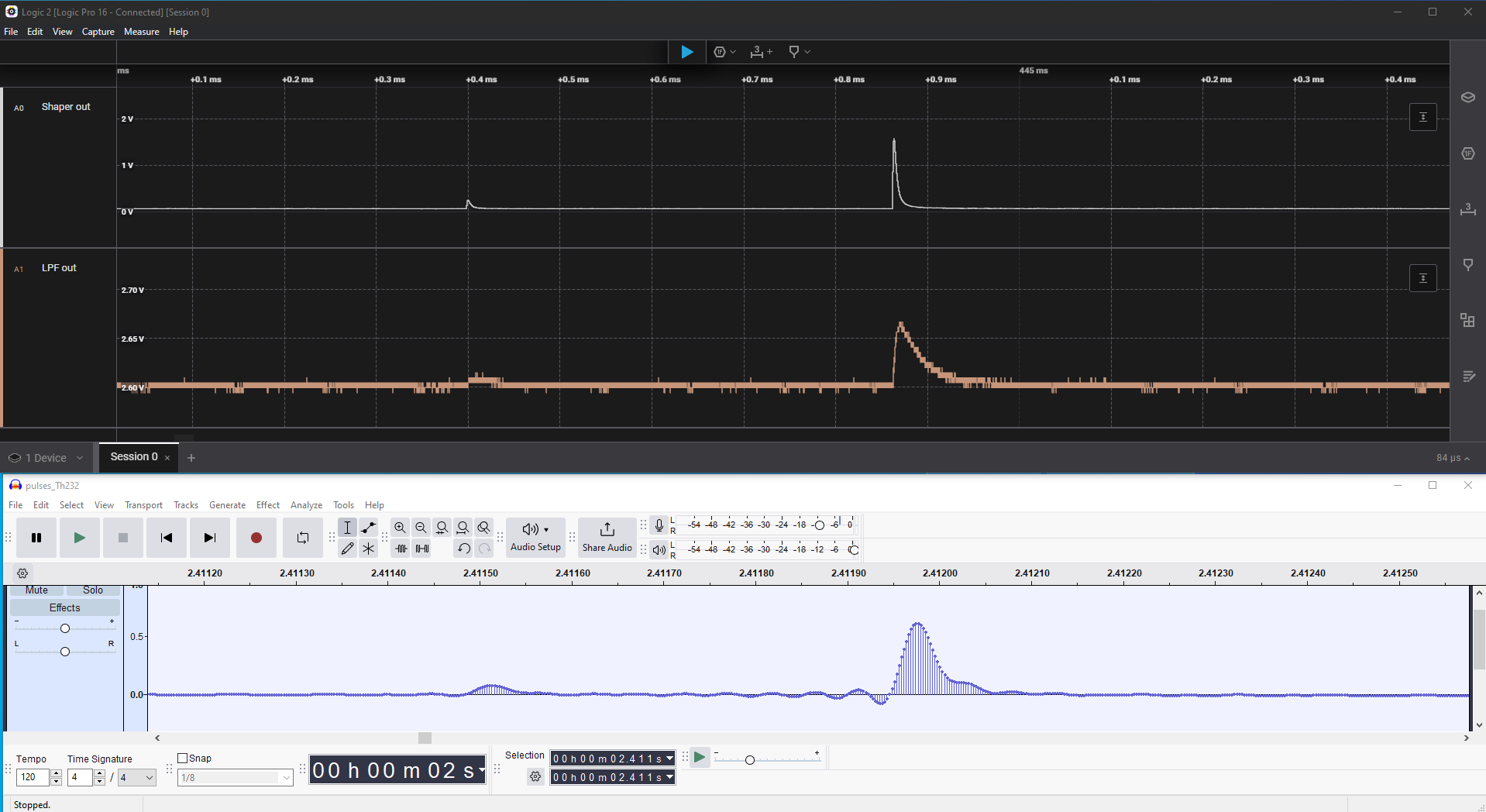
To get a feel for how well the pulse amplitudes match between the Pomelo Core output and the signal that is read by the sound card I grabbed some pulses both with a Saleae logic analyzer and with Audacity and manually aligned the time scales to look at the same pulses.
![]()
Pulses from a Th-232 source at different stages in the analog chain. The time scale is manually aligned to look at the same pulses in both Saleae Logic and Audacity.
![]()
Same plot as above but zoomed in to see the shapes of individual pulses
The sound card is detecting pulses as being negative, despite the Pomelo output being positive. I inverted the waveform in Audacity to make things easier to see.
One thing to notice is that the RC filtered signal rides on a DC baseline of ~2.5V. This is due to the PC’s sound card providing bias for the microphone -- it’s not a huge problem for Pomelo, as its output is fed directly from a stiff source, an op-amp’s output. The 10 kOhm resistor nicely isolates these two.
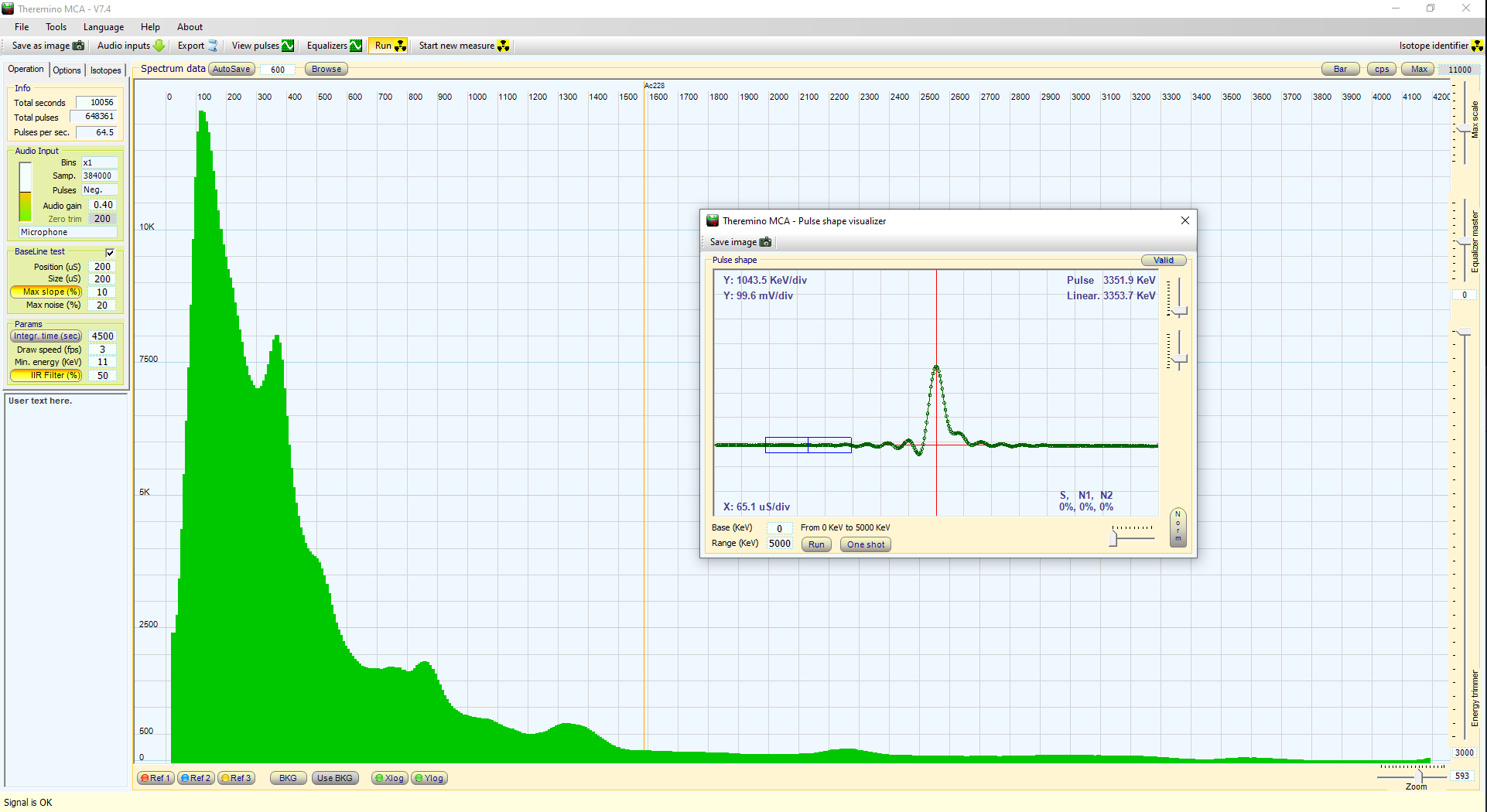
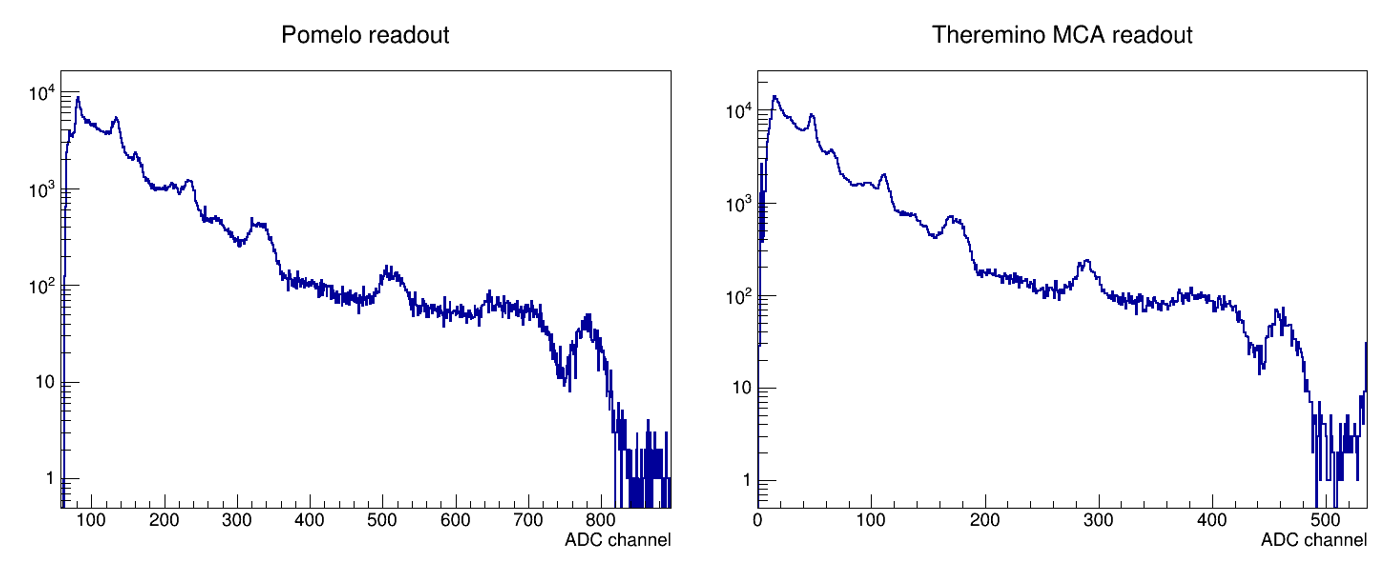
The spectrum of a Th-232 source looks very good both in the Theremino MCA software, as well as exported and displayed alongside the spectrum recorded by Pomelo Core.
![]()
Th-232 spectrum and individual pulse in the Theremino MCA software
![]()
Spectra taken with both Pomelo Core as well as with Theremino MCA, with uncalibrated x axes scaled to cover the same energy range
-
Pomelo core in coincidence mode
07/15/2024 at 04:18 • 0 commentsI used a pair of modules are run in coincidence mode to detect and measure cosmic muons.
-
Pomelo Core new use case
06/21/2024 at 04:28 • 0 commentsI added a new project describing an experiment that uses Pomelo to measure gamma attenuation in aluminum. The result is surprisingly close to the literature value.
-
Updated scintillator and wide range energy linearity
06/17/2024 at 16:15 • 0 comments![]()
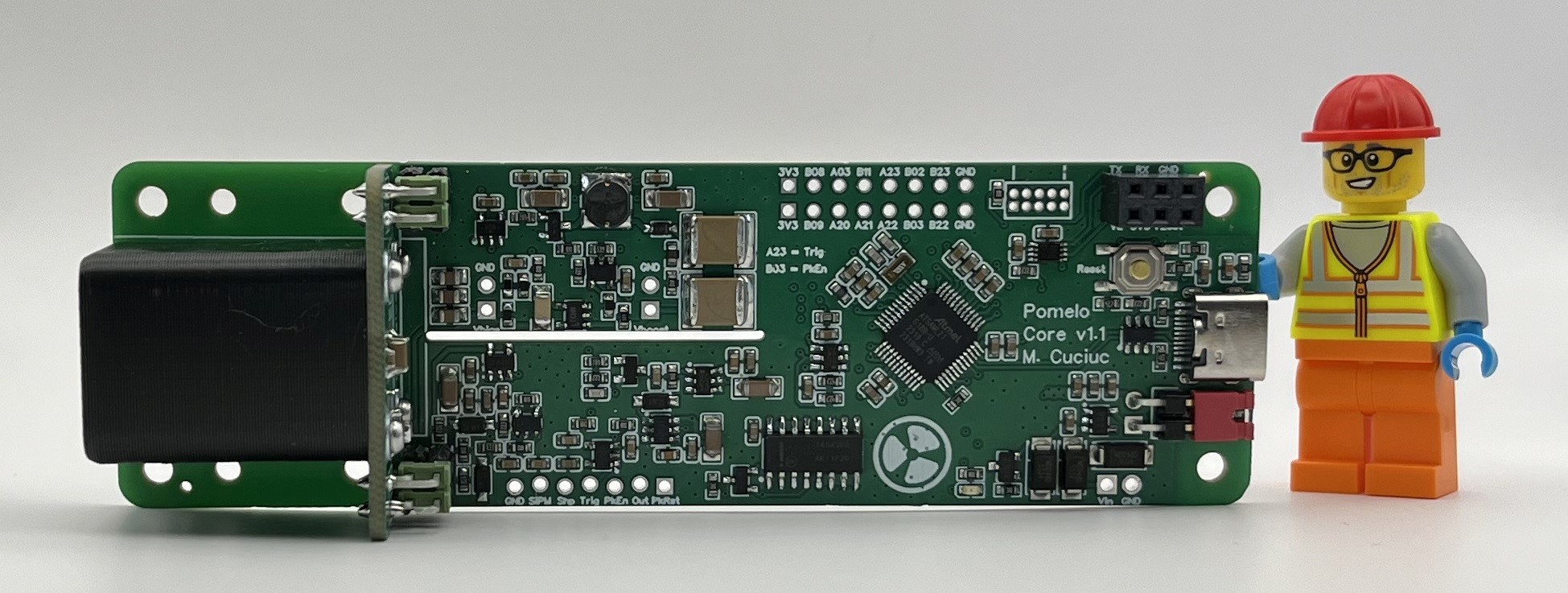
Pomelo sales rep showing off the latest prototype sporting a 10mm x 10mm x 20mm CsI(Tl) crystal
I designed the device dimensions with a 2cc (10mm x 10mm x 20mm) CsI(Tl) scintillator in mind, but only had 3cc ones to test with. It’s why the detector element extended beyond the device’s edge, but now that the 2cc crystals arrived, I can share the final design and some preliminary performance plots.
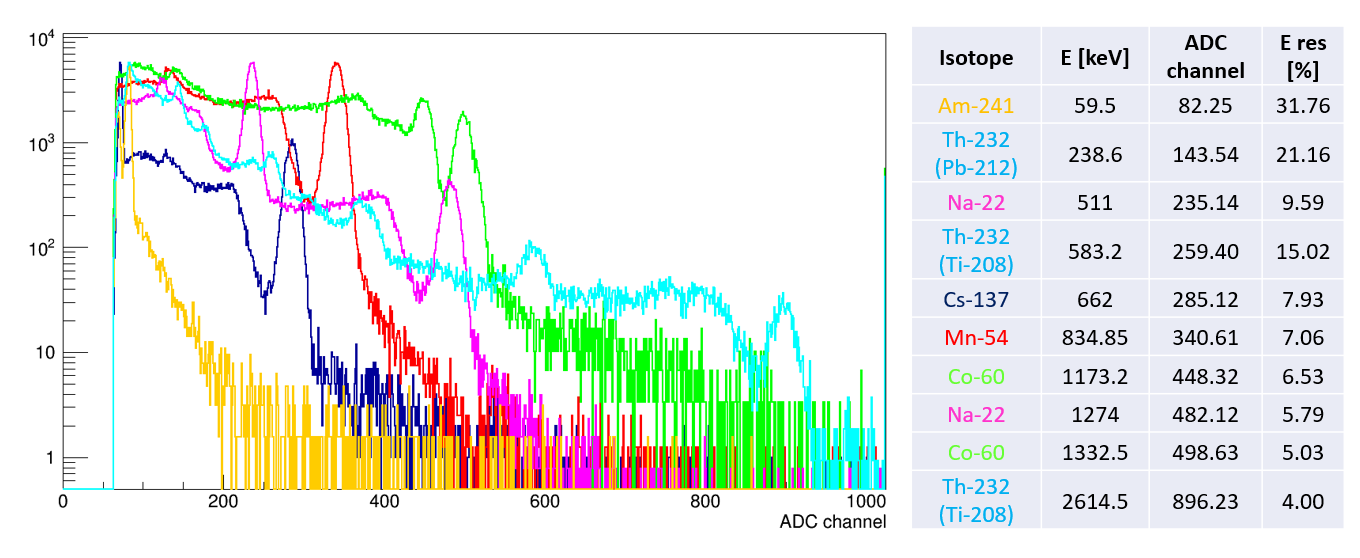
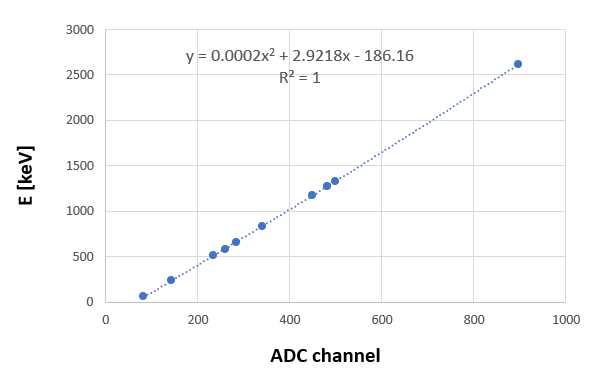
The scintillator is not yet potted in silicone, which does decrease light output a little (and thus worsens resolution). I took spectra with several lab sources and computed the resolutions for every gamma line and checked the detector linearity.
![]()
Spectra for Am-241, Na-22, Cs-137, Mn-54, Co-60, and Th-232 on the same plot in logarithmic scale. Energy resolutions for each energy shown in the last column
![]()
Detector linearity plot. There is a small quadratic term that is typical of SiPMs
Pomelo: Gamma Spectroscopy Module
A complete low-power gamma ray spectrometer that can be used by itself or integrated into other projects