James Pilgrim
-
GSPro sockets interface working (at least on test platform)
03/23/2024 at 22:32 • 0 commentsA simulated GSPro launch monitor interface and test sockets server is now complete. The server simulates an actual GSPro Connect system in order for me to be able to do end-to-end testing. This LM interface send results data to the GSPro socket whenever a ball is hit. I don’t actually have a real GSPro system yet - still need to rummage around for a sufficiently modern graphics card and build a machine to run that.
An example JSON object that was sent from the launch monitor to the simulated GSPro server (and the simulated response) is shown below. Hopefully I can validate on a real system soon. The only thing I can see wrong at this point is that the spin angle is somehow being truncated to 0. Probably a dopey radians/degree mistake on my part.
[2024-03-23 16:18:46.440414] (0x0000007fb2794040) [trace] Received the following message from the Launch Monitor:
{
"DeviceID": "PTrac LM 0.1",
"Units": "Yards",
"ShotNumber": 1,
"APIversion": "1",
"BallData": {
"Speed": 31.0,
"SpinAxis": 0.0,
"TotalSpin": 0.0,
"BackSpin": 3743.0,
"SideSpin": "-358.0",
"HLA": 13.3,
"VLA": "-7.9"
},
"ClubData": {
"Speed": 0.0,
"AngleOfAttack": 0.0,
"FaceToTarget": 0.0,
"Lie": 0.0,
"Loft": 0.0,
"Path": 0.0,
"SpeedAtImpact": 0.0,
"VerticalFaceImpact": 0.0,
"HorizontalFaceImpact": 0.0,
"ClosureRate": 0.0
},
"ShotDataOptions": {
"ContainsBallData": true,
"ContainsClubData": false,
"LaunchMonitorIsReady": true,
"LaunchMonitorBallDetected": true,
"IsHeartBeat": false
}
}
[2024-03-23 16:18:46.441129] (0x0000007fb2794040) [trace] Sending the following message from the GSPro simulated server:
{
"Code": 201,
"Message" : "GSPro Player Information",
"Player" : {
"Handed": "RH",
"Club" : "DR"
} }
-
New form factor for the Launch Monitor
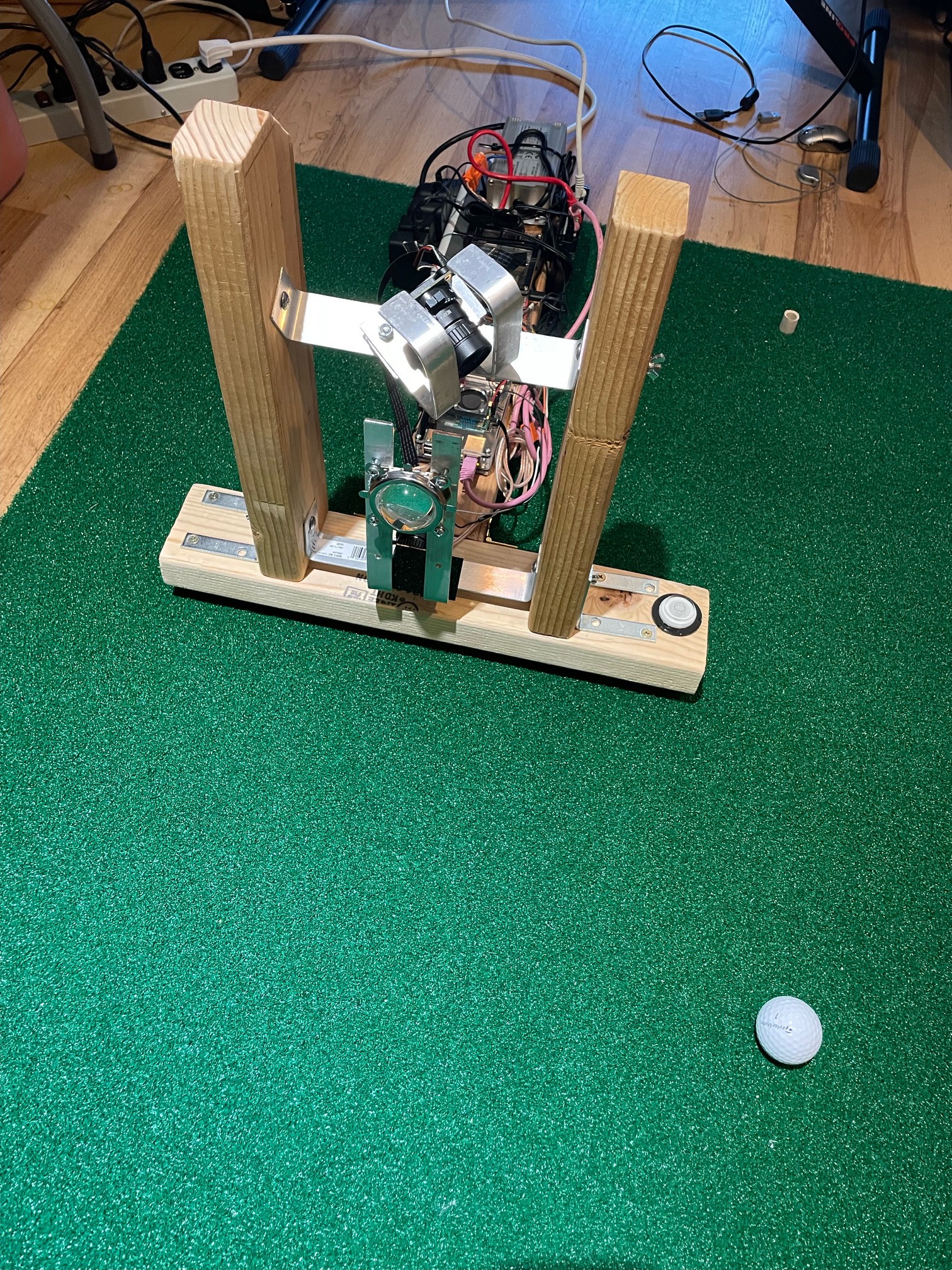
03/23/2024 at 14:48 • 0 commentsThe absurdly long extension arm has been replaced with a more compact form factor. The LM now has both cameras stacked vertically, and each both can be independently aimed.
![]()
The math for location computation took a while to finish, but seems to have actually increased accuracy. The z-axis measurements are no longer purely ball-radius based, as the ball can now be seen at an angle.
With the ability to tilt the cameras, there is much more flexibility for where to tee the ball up versus where it will be imaged after it is hit. Hopefully, this will allow for a greater range of ball speeds, as we can make up for slow reaction times that are currently inherent in the part of the system that senses the initial ball movement and begins the strobed imaging of the ball in flight. For example, by placing the ball a little further back, there's more time to react to the movement of a fast-hit ball and get images of it before it flies out of the frame of the second (bottom) camera.
PiTrac - The DIY Golf Launch Monitor
Launch monitor using low-cost Raspberry pi and camera hardware to determine ball launch speed, angles and spin