 Yann Guidon / YGDES
So it seems I reinvented the wheel, again. According to Wikipedia, my system looks like a cousin of TMDS : Transition-minimized differential signaling, except:
- ParPop maximises the transitions instead of reducing them. Note: it's just a matter of inverting a bit to get TMDS behaviour, I'll have to test this!
- ParPop adds only 1 bit so it's more of a 8b/9b transform, not 8b/10b
- ParPop uses the extra/free computation of parity to increase error detection, not just 1-bit errors
- It uses 2× longer words than TMDS for richer functionalities without increasing overhead
- TMDS does not scramble (apparently ?)
- TMDS performs DC balance / droop reduction (uses 1 of the 10 bits for this)
- TMDS has 2 stages but it seems that one is congruent with the NRZ(i) operation
... (tbc)
It's 1999 technology so in case of problem, despite the important differences, the core patents have expired anyway.
I'm not sure that a TMDS approach (with M meaning Minimizing) is good for an isolated twisted pair link: statistically, it would increase droop. But by how much ? As noted above, a trivial ParPop modification can minimize the transitions instead of increasing them. The picture shows that it's just a matter of turning an OR into a NOR (or add a XOR if you want it to be configurable).
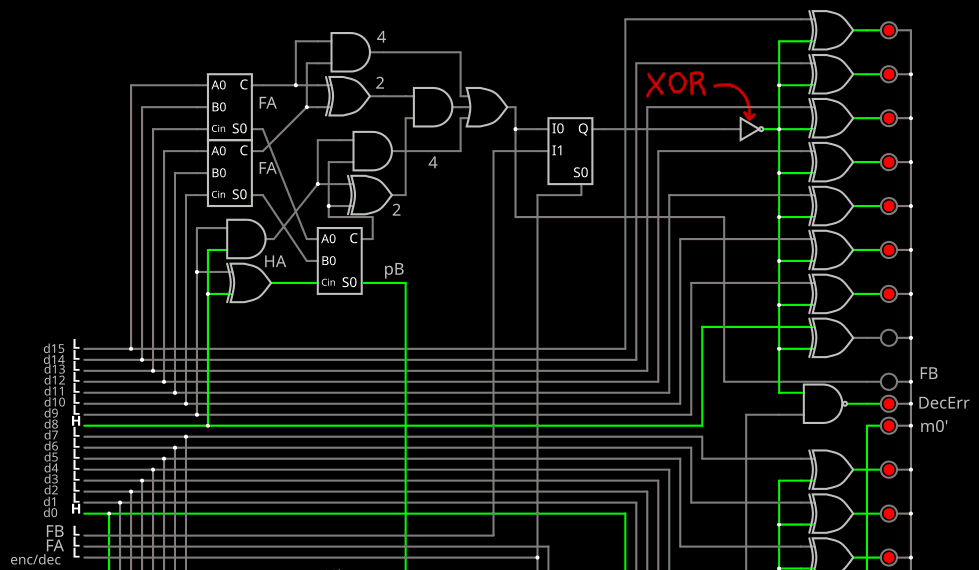
But there are still bits that remain set, at least 1 per 10 bit: the worst case is if the number of data bits is 8 then al the output bits are cleared but the Flip bit is set. Now I have to test this...
Could this transition reduction be a way to increase transmission speed?
Bonus question: could the ParPop coding properties be used to help with error correction (Viterbi-like) ?
Discussions
Become a Hackaday.io Member
Create an account to leave a comment. Already have an account? Log In.