 photondreams
Finding out which chips were available when is not always easy. Vintage pricing information is even harder to get.
Sometimes we get lucky and datasheets or manuals have dates, but not always. Fortunately betwen bitsavers and archive.org we have access to a treasure trove of period magazines that can help us.
In this episode, the main CPU, Hitachi HD68000-12 or Motorola MC68000L12.
The 12.5MHz Motorola chip was released in 1982, as the first update to the 68000 lineup since the 1979 introduction. The next (and final) speed bump to 16MHz only occured on April 5 1988, the same day the 33MHz 68020 was announced. (press release)
I happen to own a beautiful MC68000L12 dated 1986 so I know for a fact you could get them in time for Amagaki.
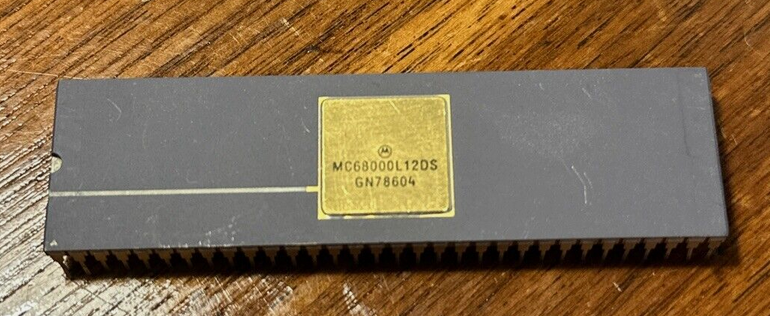
According to the old 1983 datasheet, page 9-2, the DS suffix on that particular chip indicates Level III "Better" Processing. MIL standard temperature cycling, high-temperature testing and burn-in conditions equivalent to 168 hours at +125 degrees C. YIKES!
But what about the Hitachi version?
Hitachi was already a second source for Motorola 6800 and 6809 by the time the 68000 launched and were an early second source for it. They helped Motorola with their CMOS process for the 68020 and co-developed the CMOS 68HC000.
The HD68000-12 is described in the 1985 Hitachi Microcomputer Data Book, so it's legit for our project as well.
This is what they look like :
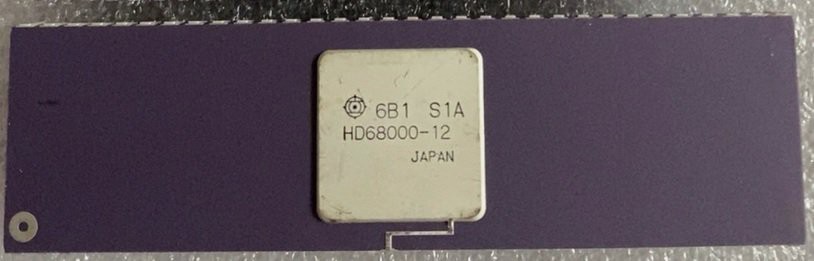
A different take on the ceramic package, but still awesome. Nothing is more cool than having all your DIP ICs in formation around the HUGE 68k like a carrier battlegroup!
But certainly, something so cool as a top-speed ceramic 68000 must have been expensive at the time?
Turns out, not so much...
By 1986 the mighty 68020 was available in quantity and was battling it out with the 286 and the new, game-changing 386. The 68012 was obsolete, the 68010 was uninteresting but still somewhat expensive and the 68000 was downright cheap.
Here is a closeup of an old Jameco(!) price list I found at the back of this 1987 issue of Radio Electronics (page 110).
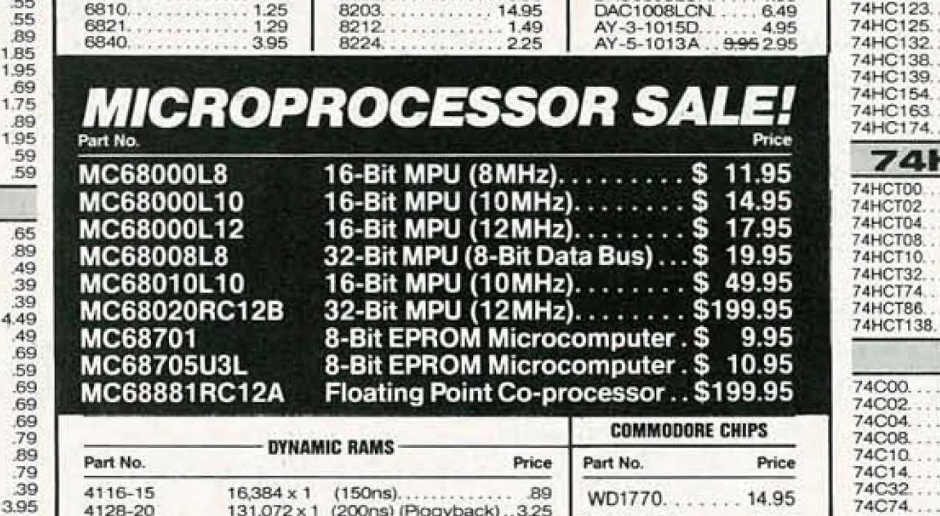
$17.95 US dollars for a ceramic 12.5MHz 68000, in single quantity, sold to tinkerers and hobbyists in october 1987. 68010 is 3 times the price, 68020 and FPU are out of reach.
In the same magazine, JDR microdevices sells 8088s for $6.95, NEC V20 and V30 for $10.95 and $13.95, the 286 for $129.95.
Conclusion
Unfortunately, there is no way to get exact, medium volume pricing for late 1986 but I think it is reasonable to establish the Jameco price as an acceptable estimate.
Our CPU of choice was therefore available and probably cost-effective for our design.
Discussions
Become a Hackaday.io Member
Create an account to leave a comment. Already have an account? Log In.