Jonathan Bumstead
-
Constructing images from a projector's perspective
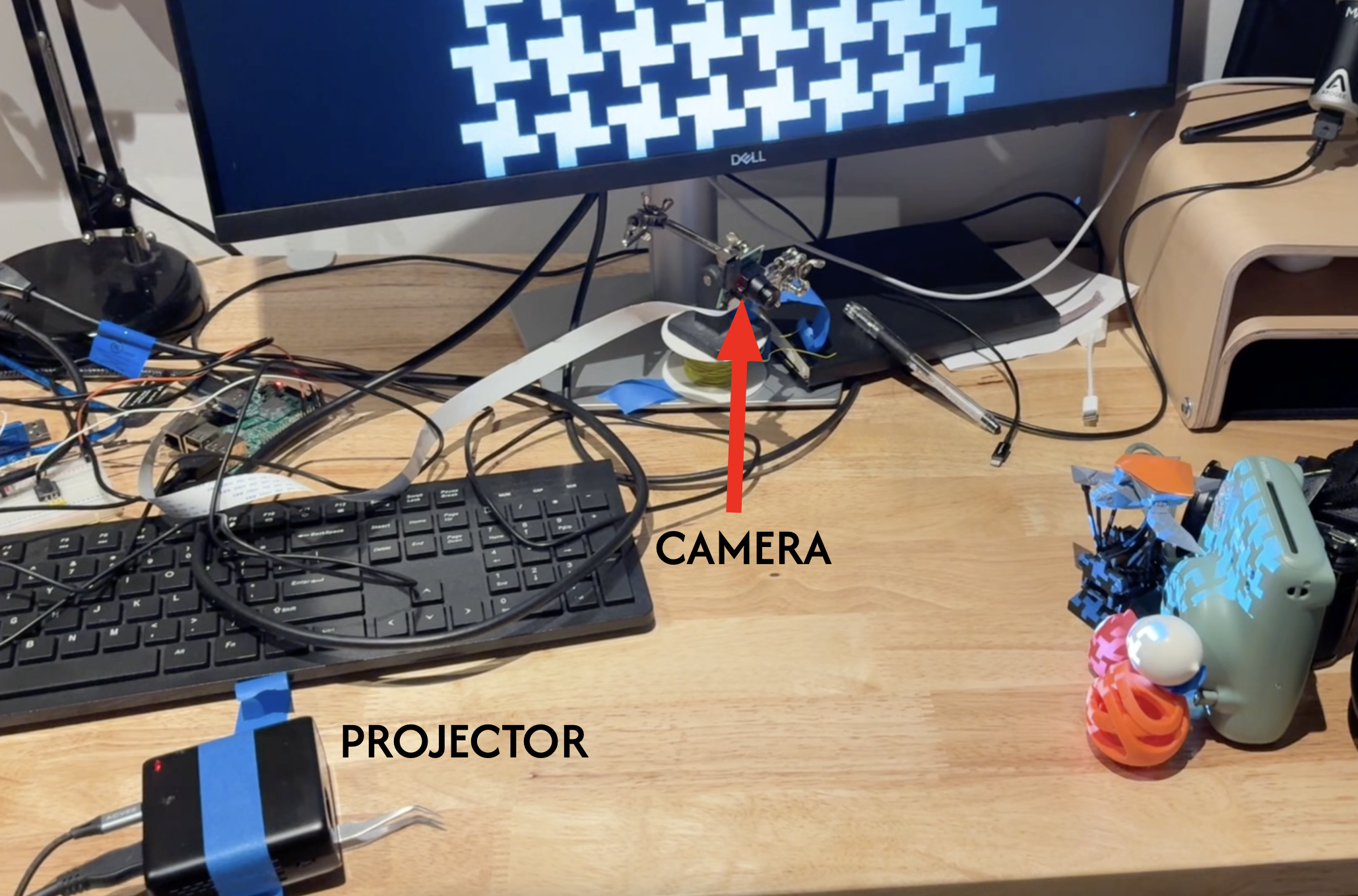
07/28/2025 at 22:37 • 0 commentsI recently continued this work using a camera and projector, instead of the LED matrix and single photodetector.
The video with a full explanation for this work is here: https://www.youtube.com/watch?v=TcXMf0mTh94
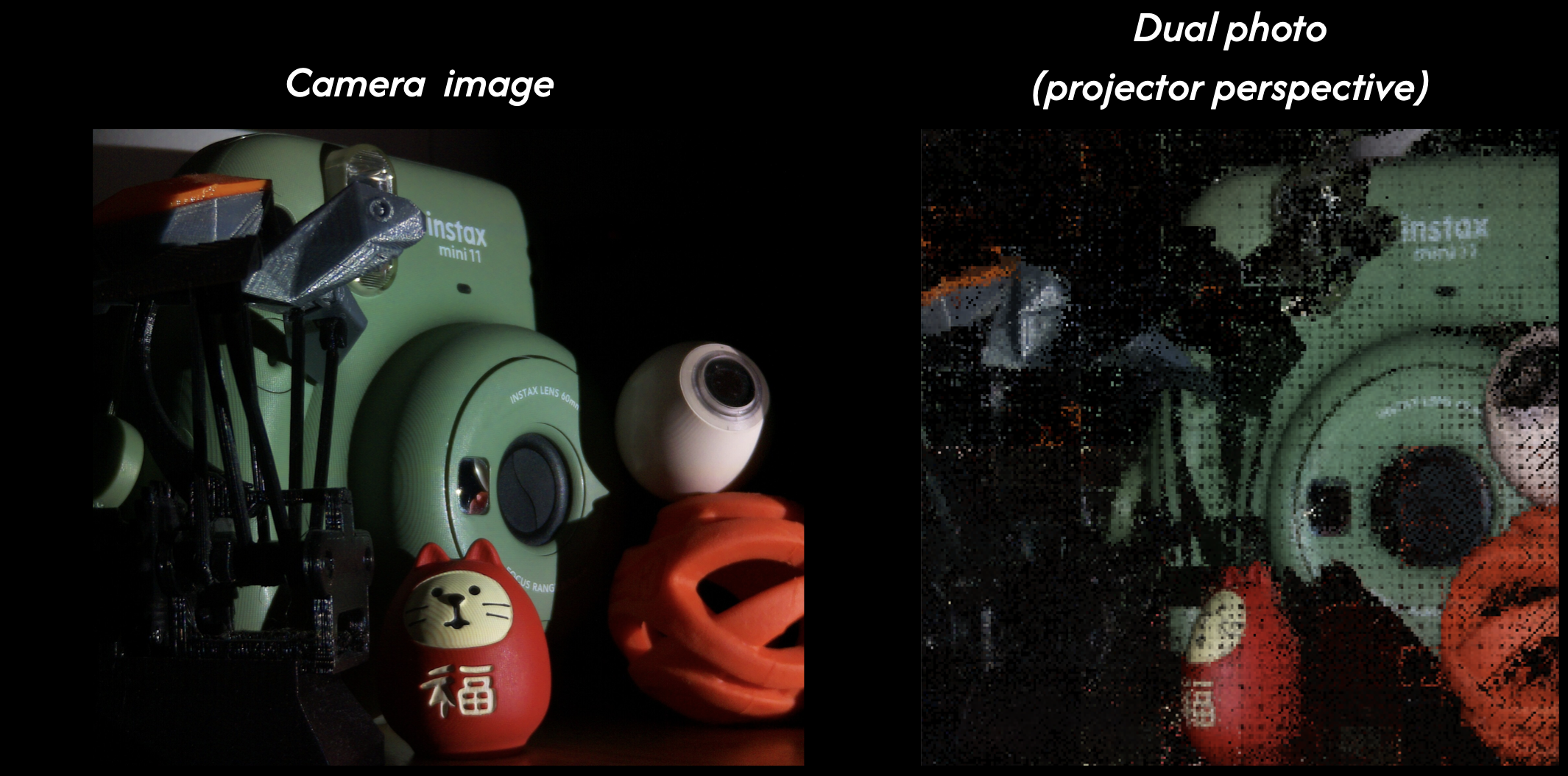
The basic idea is to measure the light transport between a projector and camera by mapping each illumination pixel to camera pixels. With this amazing things are possible:
1) Reconstructions from the perspective from the projector
2) Synthetic illumination - reconstruct images to appear as though they were illuminated with any illumination pattern
One of the keys to implementing this with a camera is binary encoded structured illumination. The video has an explanation for how this works and it is the key to data acquisition. Instead of illuminating the scene one illumination pixel at a time, each illumination pixel has a unique binary code. Each digit in the code corresponds to a different illumination sequence. 1 means that the illumination pixel is on during that pattern and 0 means that it is off for that pattern.
![]()
![]()
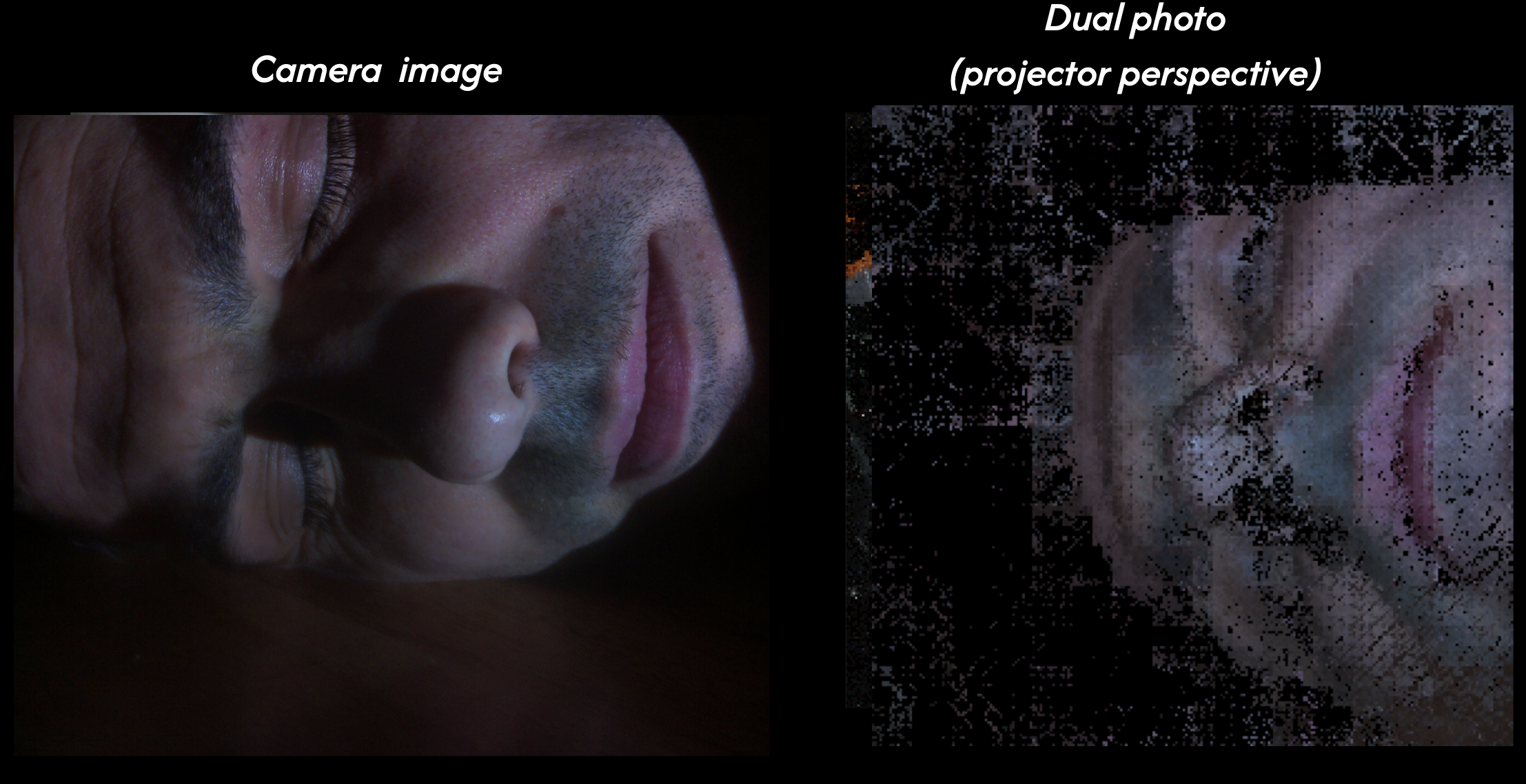
I also did some dual photos of my face, and they are eerie.
![]()
Here are some helpful resources
Info about Pradeep Sen's lab here:https://web.ece.ucsb.edu/~psen/
Dual photography paper. Pradeep Sen, Billy Chen, Gaurav Garg, Stephen R. Marschner, Mark Horowitz, Marc Levoy, and Hendrik P. A. Lensch. 2005. Dual photography. In ACM SIGGRAPH 2005 Papers (SIGGRAPH '05). Association for Computing Machinery https://doi.org/10.1145/1186822.1073257
Thanks to Professor Shree Nayar @firstprinciplesofcomputerv3258 - range finding lecture:
![]() • Structured Light Range Finding | Active Il...
• Structured Light Range Finding | Active Il...
My first dual photography video with single photodetector:![]() • Imaging objects out of sight using a singl...
• Imaging objects out of sight using a singl...
Thanks to Alex @SuperMakeSomething - DIY scanner:![]() • DIY 3D Scanner (Arduino, 3D Printing, PCB ...
• DIY 3D Scanner (Arduino, 3D Printing, PCB ... Thanks to Michael @TeachingTech - 3D scanning system review:
![]() • Automated and easy 3D scanning with OpenSc...
• Automated and easy 3D scanning with OpenSc...
Generative AI references:
Babaei, R.; Cheng, S.; Duan, R.; Zhao, S. Generative Artificial Intelligence and the Evolving Challenge of Deepfake Detection: A Systematic Analysis. J. Sens. Actuator Netw. 2025, 14, 17. https://doi.org/10.3390/jsan14010017
Karras, Tero, et al. "Progressive growing of gans for improved quality, stability, and variation." arXiv preprint arXiv:1710.10196 (2017). https://arxiv.org/abs/1710.10196Karras, Tero, Samuli Laine, and Timo Aila. "A style-based generator architecture for generative adversarial networks." Proceedings of the IEEE/CVF conference on computer vision and pattern recognition. 2019. https://arxiv.org/abs/1812.04948
Keyence 3D scanner with structured illumination - https://www.keyence.com/products/3d-m...App I used for 3D scanning – KIRI engine https://www.kiriengine.app
Photo of Ron Mueck sculpture by Jack1956, via Wikimedia Commons, https://commons.wikimedia.org/wiki/Fi... -
Transmission based compressed sensing
06/28/2025 at 16:29 • 0 commentsWhat if there was a way to collect an image with a single detector, a single pixel? It doesn’t seem possible - images consist of 2D information - how could all the information be captured with a single point measurement?
One way to do this is by scanning that point over the field-of-view, one-point at a time like a 3D Lidar map - the view of the photodector changes over a scene with a mirror scanner.
But there’s actually another way to solve this problem. And it amazingly doesn’t require any moving parts. I’ve always been fascinated by this idea, so I decided to build it - a one-pixel camera that has no moving parts. Just an LED matrix and a single photoresistor.
The full build is described here: https://www.youtube.com/watch?v=EE9AETSoPHw
https://opg.optica.org/oe/fulltext.cfm?uri=oe-26-3-2427&id=381067 Zi-Hao Xu, Wen Chen, José Penuelas, Miles Padgett, and Ming-Jie Sun, "1000 fps computational ghost imaging using LED-based structured illumination," Opt. Express 26, 2427-2434 (2018)
Non-line-of-sight detection and compressed sensing
Concepts using structured illumination including compressed sensing, non-line-of-sight detection, and range finding