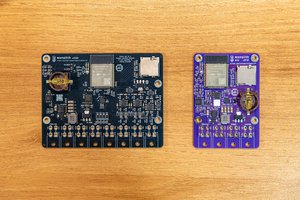
EnergyMe - Home is an open-source solution to the "black box" problem of commercial energy meters. Built on the ESP32-S3, it offers granular, real-time monitoring of up to 17 circuits with no mandatory cloud, ensuring full data ownership. Monitor your entire home's circuits—not just total consumption—with updates every 200ms. It includes an on-board web server and supports MQTT, Modbus TCP, InfluxDB (v1/v2), and REST API. Using Analog Devices ADE7953 IC, it provides accurate measurements of power, voltage, current, power factor, and more, plus 7kHz waveform capture. Hourly energy data is stored on-device for up to 10 years. OSHWA Certified (IT000025), all hardware (EasyEDA), and firmware (PlatformIO/Arduino) are on GitHub for anyone wanting control of their energy data.
Components
1×
ESP32-S3
The beloved and ubiquitous
1×
ADE7953
Semiconductors and Integrated Circuits / Misc. Semiconductors and Integrated Circuits
1×
HLK-PM03
Compact and universal AC to DC (3.3 V) power supply
1×
CD74HC4067
Switches and Multiplexers / Analog Switches and Multiplexers
1×
Audio jack 3.5mm
Easily connect up to 17 CTs without the need to screw anything
EnergyMe-Home is an open-source energy monitoring system for home use, capable of monitoring up to 17 circuits.
It integrates with any platform through REST API, MQTT, Modbus TCP, and InfluxDB.
Built for makers and DIY enthusiasts who want to track their home's energy consumption. The hardware uses ESP32-S3 and ADE7953 energy measurement IC, while the firmware is written in C++ with PlatformIO and Arduino framework.
You can build and customize it yourself — all hardware designs and software are open-source.
Hardware
The hardware (currently at v5) consists of both the PCB design and the components used to build the energy monitoring system.
Key components:
ESP32-S3: controller of the system
ADE7953: single-phase energy measurement IC
Multiplexers: used to monitor multiple circuits at once
3.5 mm jack connectors: used to easily connect current transformers
PCB schematics and BOMs are available in the documentation/Schematics directory, while datasheets for key components are in the documentation/Components directory.
Additional hardware specifications and technical details can be found in documentation/README.md.
Integration docs are available in the documentation folder.
Home Assistant Integration
EnergyMe-Home integrates with Home Assistant through a dedicated custom integration. It exposes all measurements and system information as entities.
Installation and details: https://github.com/jibrilsharafi/homeassistant-energyme
Getting Started
Order the PCB: download design files from the Schematics folder
Populate the board using the provided BOM
Flash the firmware using PlatformIO
Configure Wi-Fi via captive portal
Access the web interface at http://energyme.local (default: admin / energyme)
Full build instructions in documentation/README.md.
Contributing
Contributions are welcome. See CONTRIBUTING.md.
License
This project contains both software and hardware components: