 hide-key
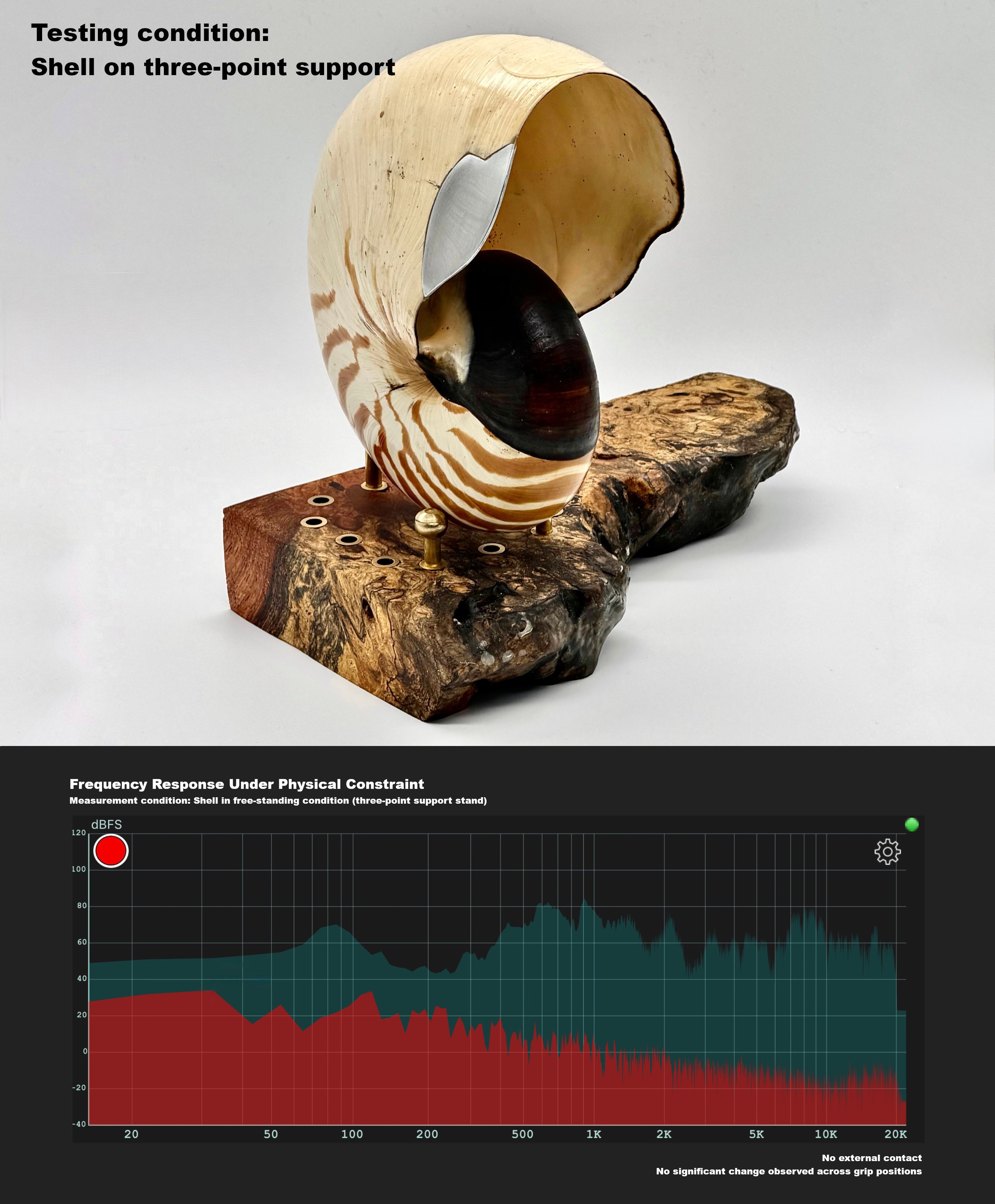
After observing that direct hand contact (H2) produced little change, while aperture blocking (H3) produced a strong effect, attention turned to the role of support conditions.
When the shell was placed on the custom minimal-contact stand (three-point support), a distinct change appeared in the low-frequency region. Compared to hand-held conditions, the measured spectrum showed a clear increase in energy around approximately 50-100 Hz. This low-frequency emphasis was repeatable and consistent.
This result was initially counterintuitive. Human hands introduce large contact areas and soft damping, yet produced minimal effect. In contrast, the stand introduces only three small, rigid contact points—yet significantly altered the vibrational behavior.
The key difference lies not in contact area, but in mechanical impedance and constraint.
The stand constrains global motion modes of the shell, particularly those involving low-frequency, whole-body movement. By partially fixing translational and rotational degrees of freedom, the stand allows certain vibrational modes to store and release energy more efficiently instead of being dissipated.
In contrast, hand contact applies distributed, lossy damping that absorbs energy locally without strongly constraining global modes.
In other words, the stand does not “dampen” the shell—it reshapes its boundary conditions.
This explains why the shell appears robust to touch (H2) but sensitive to support geometry. This observation reframes the shell not as a simple resonator, but as a structure whose behavior is dominated by boundary conditions at a system level.
Discussions
Become a Hackaday.io Member
Create an account to leave a comment. Already have an account? Log In.
Does it matter what's under the stand? At first look I expected that the low freq boost would come from, and be strongly influenced by, the surface supporting the stand. Is it really all (mostly) from the shell as constrained by the stand?
Are you sure? yes | no
That’s a very fair question — and yes, that was my first expectation as well.
In this particular test, the surface under the stand was kept constant, so I can’t yet separate stand–surface coupling from shell–stand constraint in a fully independent way. What I can say at this stage is limited to what was directly observed:
When the shell was hand-held (H2), even with fairly strong and irregular external damping, the low-frequency response did not show a comparable boost.
When the same shell and exciter were placed on the three-point minimal-contact stand, a repeatable increase around ~50–100 Hz appeared.
That contrast is what led me to focus on constraint geometry rather than simple external damping or added mass. My working interpretation (still tentative) is that the stand primarily defines how the shell is mechanically constrained, which in turn changes how internal vibration modes are allowed to develop.
You’re absolutely right that the supporting surface could play a role — isolating that variable is on my list for follow-up tests (e.g. different base materials or compliant layers). For now, I’m trying to document the observation boundary as clearly as possible before jumping to stronger claims.
Thanks for calling this out — it’s exactly the kind of question that helps define the next experiments.
Are you sure? yes | no