 Marco Tabini

Amply is a small “desktop” amplifier designed to live on your workbench or computer desk and deliver roughly 10 Wpp per channel from a Bluetooth audio source. Paired with a good set of small 8 Ω speakers, it produces surprisingly high-quality sound at very low cost.
The design is based on the venerable NE5532 op-amp, which, despite being nearly 50 years old, still offers excellent audio performance at an extremely affordable price.
Amply runs from a single USB-C power supply; on my desk, it is powered by a SJÖSS charger I picked up from IKEA for less than $5. (This doesn't provide the full 10W output, but it's more than enough for typical listening levels, even for someone who is pushing 50).
I originally designed Amply to solve a practical problem: it is surprisingly difficult to find an inexpensive Bluetooth amplifier that also sounds genuinely good. At the same time, it makes a great learning project for anyone interested in amplifier design, since it uses a simple Class AB topology and a handful of common through-hole components that are easy to source from Amazon or a local electronics supplier.
What is a “desktop” amplifier anyway?
To me, a good audio amplifier has to satisfy two criteria: it should perform well from a technical standpoint, and it should fit its intended use case.
For the technical part, the metrics I care about most are total harmonic distortion (THD) and linearity, and signal-to-noise ratio (SNR). Low distortion, predictable frequency response, and low noise matter far more than most of the mythology that surrounds consumer audio.
In simulation, Amply achieves roughly 0.009% THD at full output power, with intentionally gentle high-frequency roll-off above about 10 kHz to keep small desktop speakers from sounding overly harsh. I do not have instrumentation good enough to fully validate those figures in hardware, but subjectively, paired with a decent set of speakers, the amplifier sounds exceptionally clean.
The 10 Wpp output target was a deliberate design choice. Keeping the power level modest makes it possible to achieve very good performance using inexpensive, widely available components. In practice, it's already far louder than what I would normally want at a desk: loud enough to annoy other family members elsewhere in the house, and uncomfortable to sit next to at maximum volume. For this kind of near-field listening setup, additional power would mostly go unused.
PCBs
While it's not impossible to hand-wire Amply on protoboard, the project includes all the files you need to make a 100x100 mm PCB for the amplifier. This will increase the costs a little, but also bring lots of benefits, such as a ground plane that will reduce the likelihood of picking up stray hums from the environment.
The PCB you see in the photo was made by PCBway and cost about $10 shipped. While they are not the cheapest, the quality of the PCB is very good, and they very kindly contacted me to inquire about some of the… less conventional choices I had to make to fit the design in two layers, just to make sure that the designed had not accidentally been mangled in the process.
Another side benefit of having a PCB is that it's much easier to fit the project into a proper 3D-printed enclosure. You are, of course, free to design your own, but I had to make one for myself, too, and so I included it in the Github repo as well.
Oh, in case you're wondering: PCBWay is not sponsoring me. I had never used them before, and this seemed like a good opportunity to try out their service.
Acknowledgments
Much of what I know about amplifier design comes from Rod Elliott’s excellent Elliott Sound Products website, which is an absolute treasure trove of information on audio electronics. If you are interested in learning more about amplifier theory and design, I highly recommend spending some time reading through his articles—especially...
Read more »

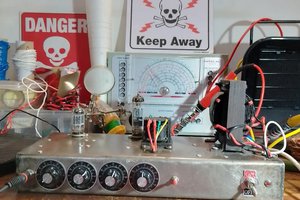
 _electroidiot
 Evangelos Petrongonas
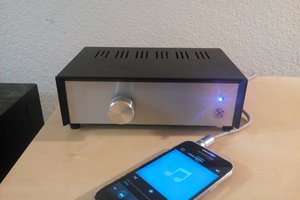
 Szoftveres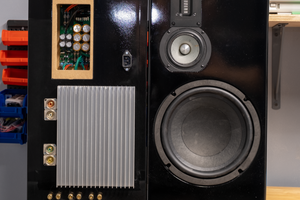
 Viktor Gunnerson
It's hard to write this without appearing critical. Firstly I appreciate the explanation you have penned about circuit operation. That would clarified a lot to me decades ago when I had the amplifier building bug.
In this era though, I wonder if you have listened to one of those compact class D amplifiers described in my project #Playing music remotely with bluetooth at the same price point. In my bedroom I have one connected to my former living room speakers and driven from my workhorse. I have no test equipment to measure the quality but I cannot fault the rendition. I would say my speakers are the limiting factor.
It seems that linearity which used to be achieved by careful design in the analog domain, is now trivially obtained by crystal frequency accuracy in the digital domain, an ongoing trend.
But maybe I should build an analog amp to do something with the parts in my junk^wspare box. 😉