 Juan Flores

This project is partially related to my previous one, the PowerTimer, where I focused on reducing idle consumption to maximize battery life. But I wanted to push the boundaries a little further. After coming across Jasper's solar harvest module, I was inspired to create an environmental sensor that could theoretically run forever using very little indoor solar energy, mitigating long-term chemical degradation by swapping batteries for supercapacitors.
Since I consider this an experimental project, I’ll give you the main takeaways upfront, and then we will dive deep into the technical process:
Is it possible to achieve an unlimited operational lifespan using just a solar panel, a power harvester, and intense optimization?
Potentially yes, BUT we need to touch grass here... it heavily depends on the physical placement of the device. We also had to make several engineering trade-offs; for instance, I had to implement a few "hacks" to make the active cycle ultra-fast, meaning we can't transmit massive data telemetry bursts.
That being said, we now have a very solid ground to start working on more complex implementations.
I made a video to walk you through the entire design and assembly process. It's in Spanish (I struggle a lot recording myself, so it's pretty tough to do it in English for now, but I guess YouTube's auto-translate will do its magic!)
(Available on Sunday afternoon)
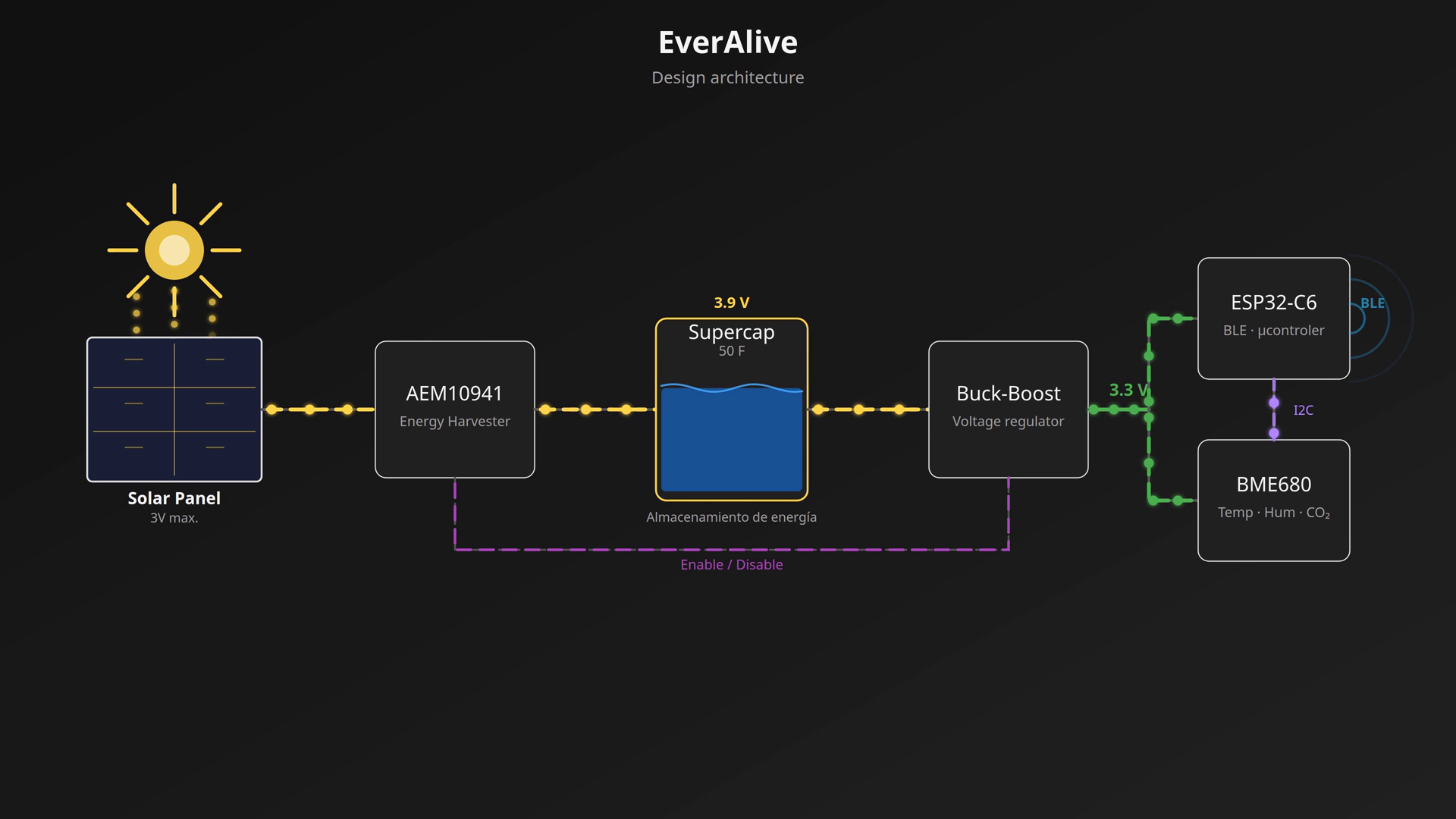
Architecture
The main core philosophy here was to keep things simple. Instead of over-engineering too many custom workarounds, I tried to rely on the default chip configurations as much as possible.
- Power Harvester: This IC captures solar energy and manages the supercapacitor charge. For this specific use case, it is vital to have a highly sensitive harvester capable of squeezing every single photon out of any situation (including faint indoor light).
- Solar Panel: It is crucial to use a panel with an open-circuit voltage below 5V, as that is the absolute maximum supported input for the harvester. Since the objective is indoor operation, an amorphous panel would be ideal compared to a polycrystalline one. However, they are quite hard to source right now, so I am prototyping with a polycrystalline panel for the time being.
- Supercapacitor: Instead of a standard Li-Po battery, I opted for a supercapacitor as the primary energy reservoir. I found some relatively new hybrid capacitors that mimic the voltage behavior of Li-Po batteries, making power management much easier. The main benefits over traditional cells are an exponentially higher charge/discharge cycle life without degradation, and they are significantly safer to operate.
- Buck-Boost Converter: It might not seem like the most exciting part of the BOM, but selecting the right one is vital. On one hand, we need a rock-solid, stable output rail to feed the MCU and sensors. On the other hand, it must feature an ultra-low quiescent current to prevent draining our power reservoir while the system is sleeping.
- MCU: The requirements here were clear: excellent low-power sleep modes, minimal current draw in deep sleep, and wireless capabilities (BLE, Zigbee, or Thread—Wi-Fi wasn't mandatory).
- Sensor: You could use almost anything here, but the chosen telemetry must be compatible with an ultra-fast "wake up, sample, transmit, and back to sleep" duty cycle (we want to avoid anything that requires long, continuous sampling times). Naturally, it needs a proper low-power standby mode.
Schematics and PCB
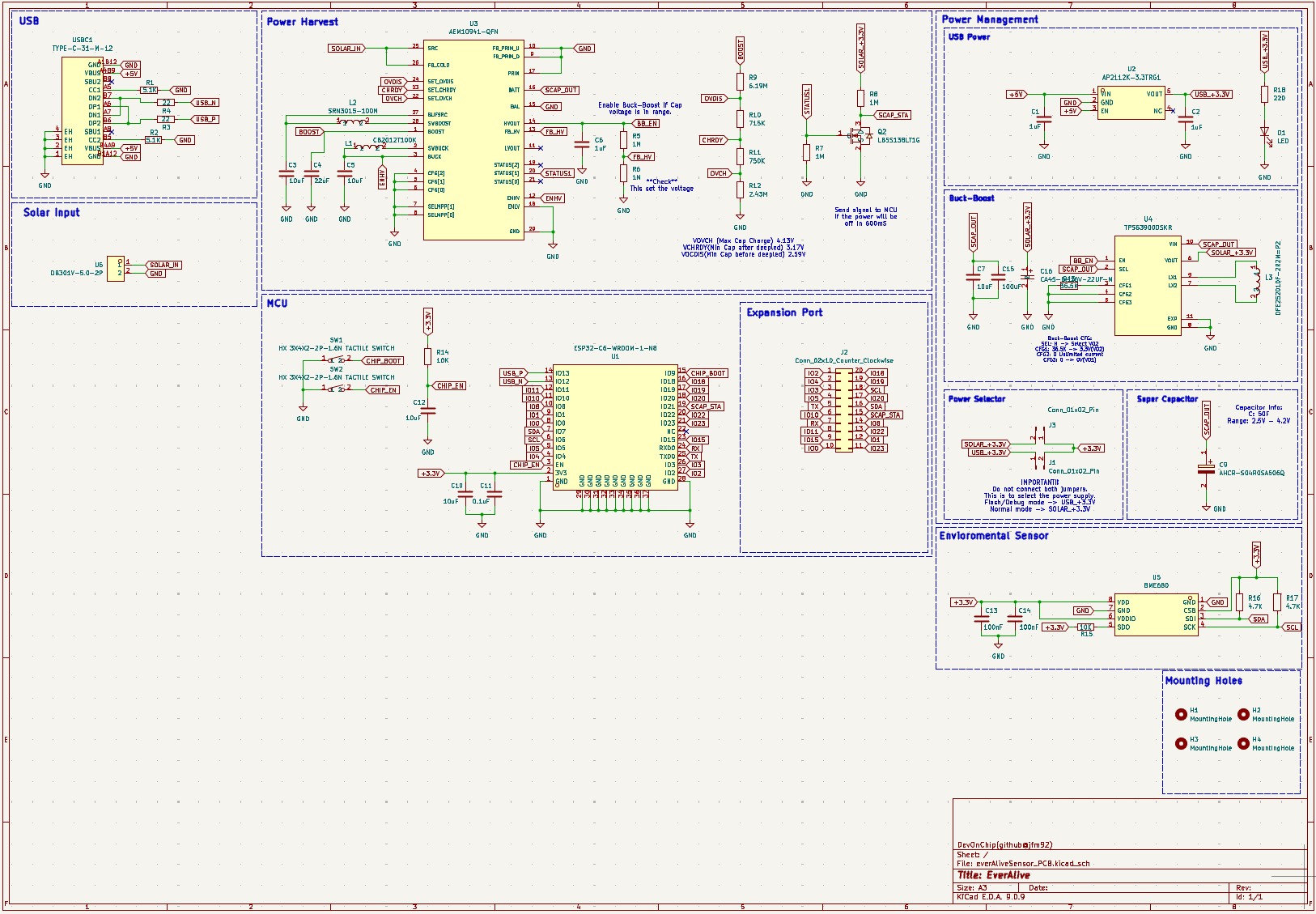
Let's start with the power harvester. I chose the AEM10941 from E-Peas. The technology this company is developing is impressive—they even have models capable of harvesting energy from thermal changes.
I picked this specific IC due to its extremely low-power cold-start capabilities: it only requires 380mV and 3µW to kickstart the harvesting process. Additionally, it supports various energy storages (like single/multi-cell Li-Pos or supercapacitors)...
Read more »
 Brian Sutherland
 Nelectra
 mircemk
 Gos
Gos