Chris
Chris-
The Consept of Proof
an hour ago • 0 commentsGreetings Ladies and Gentlemen of space.
The first days of this project started by remembering a comment on my "SateLight - The Ceiling Light" project, asking to add interlocking modules to create different configurations of the space station. Well, not many people want a whole satelite hanging from the ceiling, and adding the modules would be a one time job only, not to mention balance issues.
Parallel to that I was working on interfacing some 1-Wire sensors at the office, and in the firmware I had created this convoluted way of adding and removing sensors from some system by hotpluging, the system could periodicaly discover the sensors and add them or remove them from the logs as needed.
Sensors that come and go, interlocking modules. Then it hit me! Why not make a modular system to create your own SateLight assemblies? But smaller and nice to play with.But how could I make it satisfying? Well, remember these magnetic charging cables for smartphones, yes they are cool, repeatable and have nice snap to them.
I knew my mission.
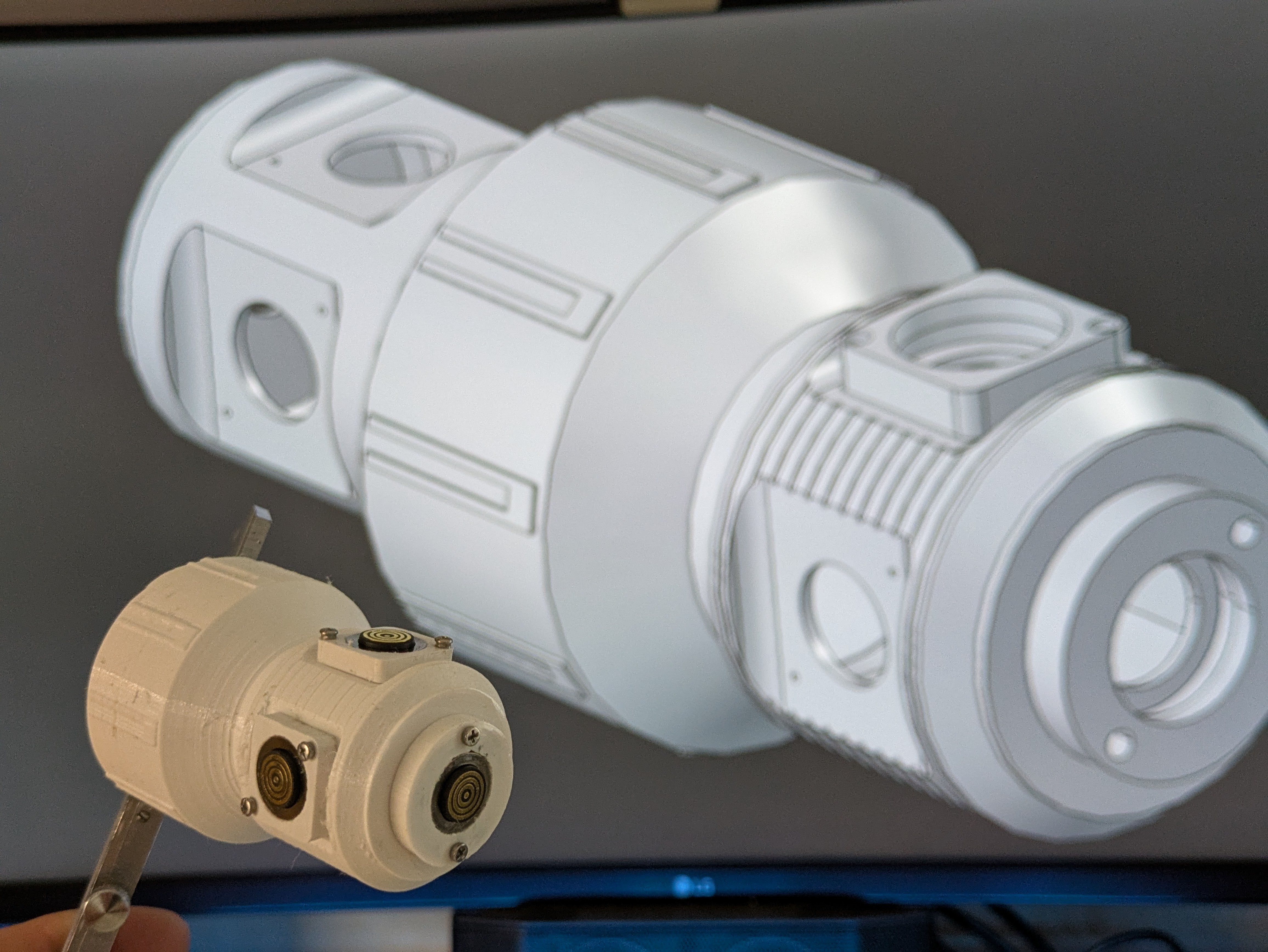
I bough some round magnetic connectors with 4 pins to test how much weight they could handle. I was worried that shear forces would send this project to an early grave. But to my surprise the manufacturer had already sold this problem by using special geometry on the magnetic connector pair. After using the 3D printer to create some holders/testers for the magnets and playing with them a while. I knew that they could easily hold light electronic modules.In my exitement I sat and designed the first body iteration of this project, a simple cylindrical enclosure to hold the connectors in place and start testing if I could pass data through them.
![]()
After painstaikingly connectinc wires from the magnets to the ESP (and buring some leds and an ESP at that).
I was able to successfully control a Neopixel strip.
Day two was to try and get some light data from a custom 1-Wire sensor that I made using an Arduino Nano and a PhotoResitor. This was also successfull.
Finally I could go into this project seriously.
SateLight - A customizable, modular desktop light
A desktop lamp that is hackable, customizable and looks good. Add small magnetic modules to add functionality.