 Carmen Herlo

Hardware
- Host: Intel N150 Mini PC, 16 GB RAM, Ubuntu Server 24.04 LTS (about 168 €).
- Power draw: about 8 W under load, suitable for foldable solar panels or battery packs.
- AI compute: 100% CPU inference, no dedicated GPU needed.
Architecture
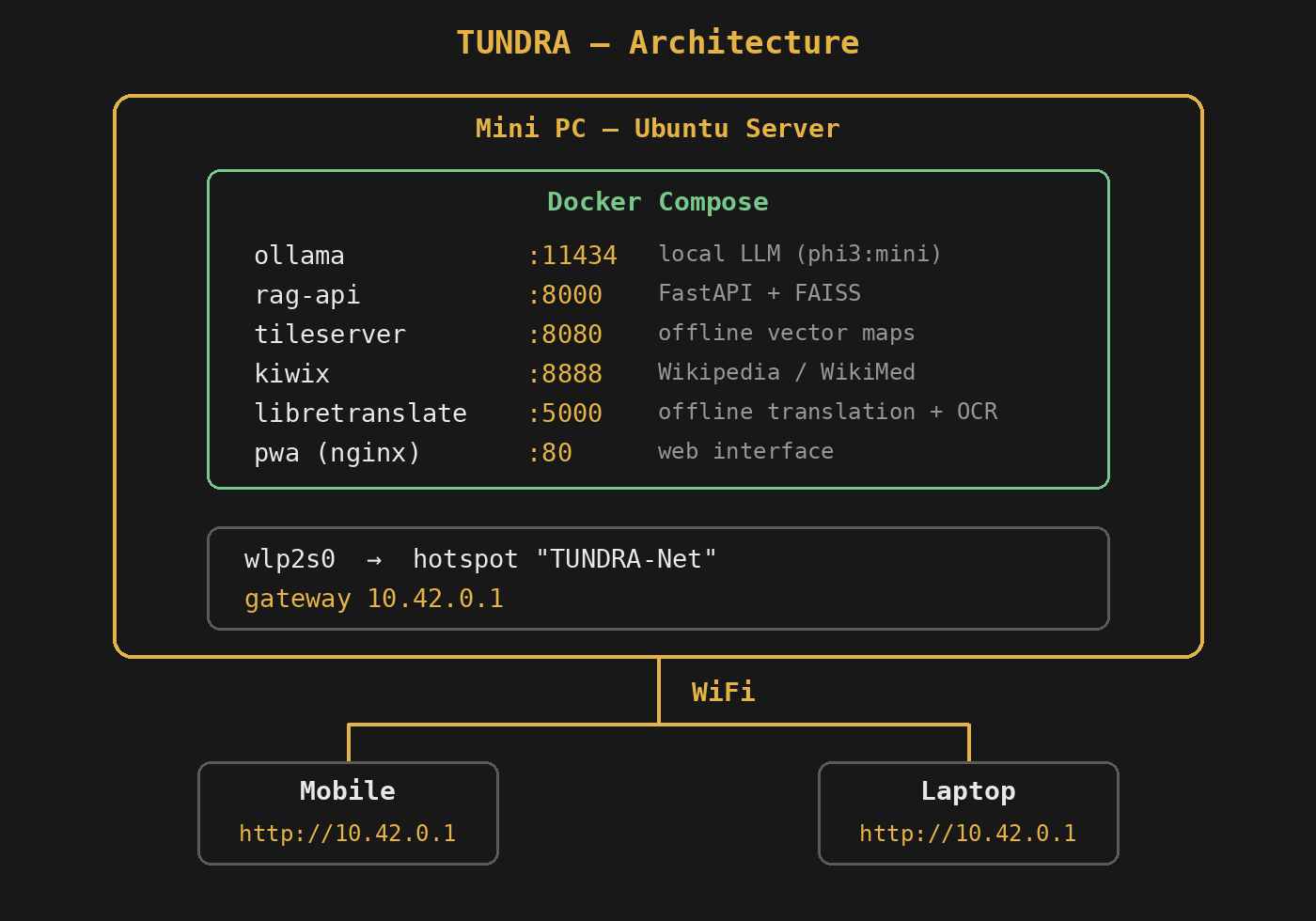
Core services
| Service | Port | Technology | Purpose |
| Frontend UI | 80 | NGINX / PWA | Multi-theme Progressive Web App (Basic / Modern / Retro), installable on mobile |
| Local AI & RAG | 8000/1143 | FastAPI + Ollama + FAISS | `phi3:mini` + `nomic-embed-text` querying survival and first-aid manuals |
| Offline translator | 5000 | LibreTranslate + Tesseract OCR | Neural translation across 9 languages (ES, EN, DE, FR, UK, RU, IT, AR, TR) with OCR image support |
| Offline maps | 8080 | Tileserver-GL | Vector tile maps via MBTiles (sample map of Zurich) |
| Knowledge base | 8888 | Kiwix | Selected offline documents (ZIM format) |
Networking & boot sequence
- Access point: broadcasts the hotspot `TUNDRA-Net` on interface `wlp2s0`.
- Static gateway: always reachable at `http://10.42.0.1` from any browser.
- Headless startup: a custom Systemd service enforces the boot order (NetworkManager hotspot, then Docker Compose).
- Zero cloud dependency: fully operational offline. Internet is only needed for initial setup and content updates.
Usage
Connect to the `TUNDRA-Net` hotspot and open `http://10.42.0.1` in any browser. Vector maps are served at port 8080 and Wikipedia at port 8888. The PWA can be installed directly from the browser (Add to Home Screen).
Install
git clone https://github.com/carmenherlo/survival-station
cd survival-station
sudo bash setup.sh
The script installs Docker, sets up the hotspot and the boot-order service, builds the containers and downloads the models. Then unplug ethernet and reboot: everything starts by itself.
Prototype scope & status
A working prototype for testing and demonstration, with a small survival knowledge base (water, fire, shelter, first aid, food), a sample map of Zurich and the English WikiMed encyclopedia. The architecture is designed to scale with more documents, maps and ZIM files.
Status: functional. Headless cold start without ethernet validated.
Roadmap
- Multi-user local chat between connected devices
- Field validation: answer quality, mobile UX, real power draw, concurrent users
- LoRa / Meshtastic, SDR (FM, NOAA, ADS-B, AIS), APRS
- GNSS and GPS-denied navigation (dead reckoning and sensor fusion on a companion device)
- Local weather station, battery/solar monitoring, UPS integration
- Satellite messenger (Garmin inReach) as a last resort
License: CC BY-NC 4.0 (free to use and adapt with attribution, no commercial use without written permission).
Source code: https://github.com/carmenherlo/survival-station
 Enki
Enki
 diddy
diddy
 Thaddaeus
 Amine Mehdi Mansouri