Close
0%
0%

Akula: a 2m autonomous model submarine

A 2m modular autonomous model submarine I'm building alone in my apartment: 3D-printed hull, ballast, sonar. Civilian, educational.

Similar projects worth following
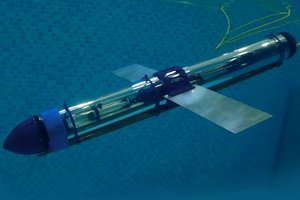
Akula is a 2m autonomous model submarine I'm building alone in my apartment. It's a civilian, educational and research AUV. The hull shape is inspired by the Akula-class submarine, 3D-printed as 16 parts, design depth 10m.

The outer hull is free-flooding by design. The electronics will live in a separate dry container inside, still in design. The vehicle is modular: ballast, propulsion, sonar, power and communications are separate subsystems, each built, tested and filmed on its own.

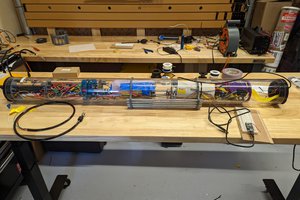
Where it stands: early build. Hull printed but rough. Ballast on a test bench, not tested yet. Sonar: an early test board showed a repeatable return in a bucket, range not confirmed.

I'm a radio engineer who spent twenty years in software and went back to hardware in 2024. Most of this is new to me, so expect mistakes. The failures stay in the log.

Not a product or a kit. Advice from people who built underwater vehicles is very welcome.

**Hull.** Shape inspired by the Akula-class submarine. The outer hull is 3D-printed in PETG/PLA: 240 mm diameter, 5 mm wall, a 2 m envelope. It is 16 prints: 8 sections, each split into upper and lower halves. Status: printed, still rough.

**Waterproofing.** The outer hull is free-flooding by design. The dry volume is a separate PVC pressure shell, 200 mm in diameter and about 1.35 m long including its end cone. The generator sits in its own steel section next to it, not inside the dry shell. Design depth 10 m. Status: dry shell in design; sealing is not designed yet.

**Ballast.** Pneumatic ballast: an acrylic tank of about 1 liter floods through bottom vents to dive, and high-pressure air from a small aluminum receiver (8–10 bar) blows it clear. At the surface, a 12 V compressor refills the receiver through the snorkel. The full system also includes a moving-mass trim actuator and control fins. Status: in progress, not tested. The first test is on a bench, and the boat does not dive in it.

**Propulsion.** Two counter-rotating propellers, each driven by its own brushed DC motor (Class 795, 12–24 V). Status: design; parts not yet bought.

**Sonar.** ARGUS-6, a rotating active sonar built from scratch, using 200 kHz piezo transducers (HC200E27TR-1). Status: in progress. An early single-channel test board showed a repeatable return in a bucket test; range not confirmed yet.

**Power and charging.** Batteries: two Li-ion packs (21700 cells, 576 Wh nominal together) plus a LiFePO4 backup pack (960 Wh nominal). For charging, I'm experimenting with a small two-stroke gasoline engine (Zenoah G260PUM) driving a water-cooled brushless motor built for electric hydrofoil boards (Maytech MTI85165, KV200), which works as a generator. It never powers the loads directly. It only charges the batteries, through three separate charge channels. On the vehicle it would run only at the surface, breathing through a snorkel, with engine heat going into the water through a copper keel-cooling loop. Status: the engine-generator setup runs on a test bench in my apartment. So far it makes about 400 W electrical (about 25 V at 12–15 A at most). Under load, the generator's back torque seems to hold the engine's RPM down, so next I'm adding a belt reduction between the engine and the generator. It is not on the vehicle yet, and the generator control boards are specified, not built.

**Electronics.** Main computers: a BeagleBone Blue for real-time control (ArduPilot) and a Radxa 4D for ROS 2 and vision. Custom PCBs designed in code with JITX, including an STM32-based power distribution board. Nodes talk over CAN. Communications: Wi-Fi and LTE at the surface. Underwater, an acoustic link (specified) and a short-range optical link (in design).

**Software.** Planned: ArduPilot (ArduRover in boat mode) on the BeagleBone Blue for real-time control, ROS 2 (including power and battery management nodes) on the Radxa 4D together with vision, and a Cockpit-based ground station. Status: planned, not running on the vehicle.

  • Episode 01 the map of the whole build

    Dennis Hudikov • 7 hours ago • 0 comments

    I published the first video of this project on October 16, 2026. It doesn't show a finished subsystem. It's the map: what I'm building, what exists today, and what I haven't figured out yet.

    The hull is 16 3D-printed parts, two meters long when assembled. They're still rough. They're also supposed to let water in. The outer hull is free-flooding by design, and the electronics will sit in a separate dry container inside. That container is still in design, and it's where most of the waterproofing work will happen. Design depth is 10 meters.

    Propulsion is two counter-rotating propellers, each on its own brushed motor. The sonar is a rotating active sonar I'm building from scratch; so far only an early test board has given a repeatable return in a bucket, with range not confirmed. Software is planned around ArduRover (boat mode) and ROS 2, but nothing runs on the vehicle yet.

    The video also covers the hardest part of the power system: a small gasoline engine that charges the batteries inside a vehicle that's meant to spend its time underwater. Off camera, the engine already drives a brushless motor as a generator on a test bench in my apartment. So far it makes about 400 W. Under load, the generator's back torque seems to hold the engine's RPM down, so next I'm adding a belt reduction. Getting all of it into the hull, with a snorkel and cooling, is a separate problem I haven't solved yet.

    Some context: I spent about twenty years in software before this, and I came back to hardware in 2024. A lot of this is new to me. If you've built underwater vehicles and see something wrong, tell me in the comments. I'd rather hear it now.

    Next up: the pneumatic ballast system on a test bench. A tank floods with water and blows clear. The boat doesn't dive in that test; a full dive comes much later, once the hull, motors and ballast work together.

    Video: 
    Build log by email: https://akularobotics.com/newsletter/

View project log

Enjoy this project?

Share

Discussions

Similar Projects

Does this project spark your interest?

Become a member to follow this project and never miss any updates