
 Allan Binder
-
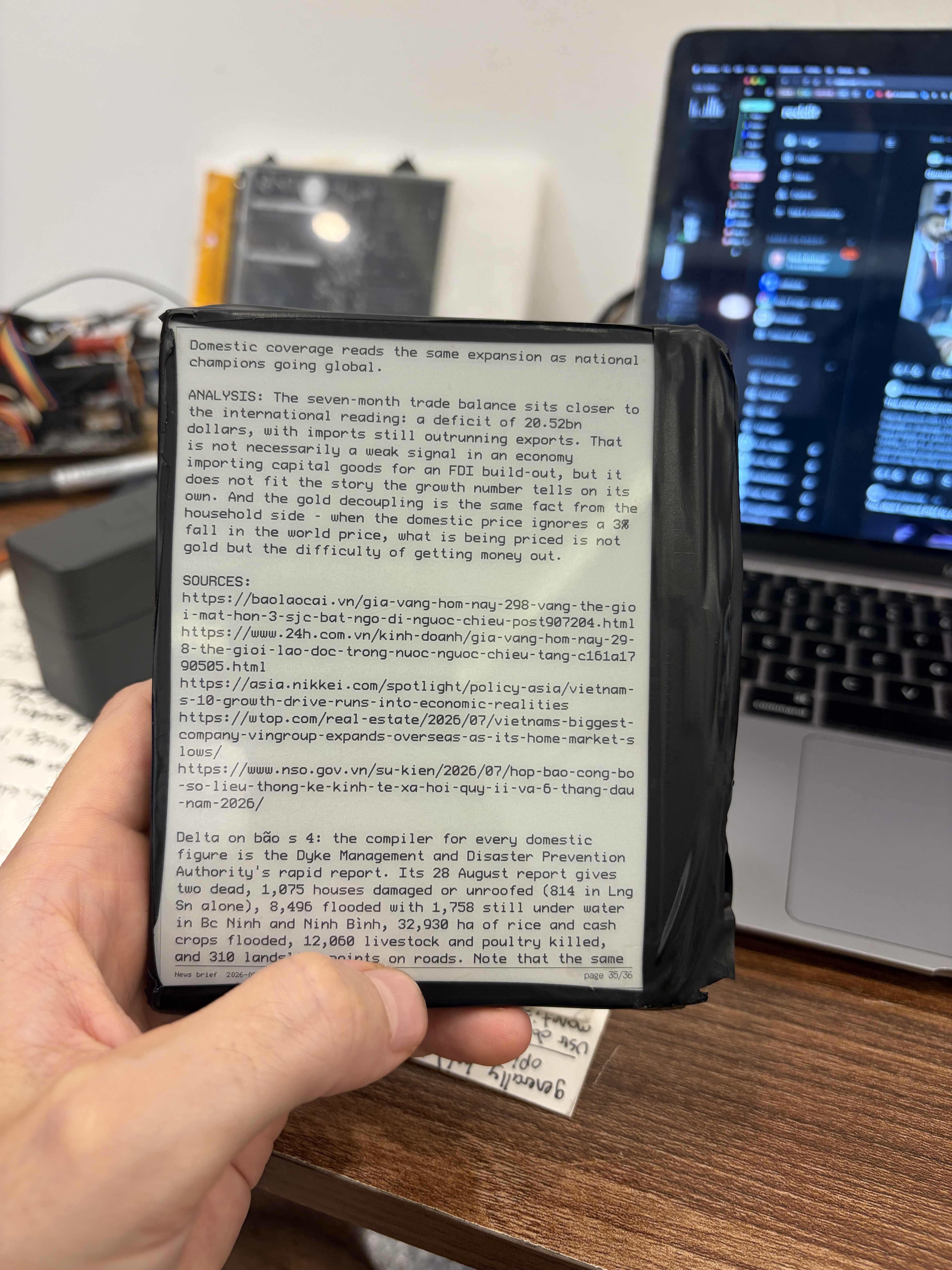
$30 e-reader at home + automating daily briefs on any subject
08/30/2026 at 12:13 • 0 comments![]()
Part 1: The hardware
You need four things: an ESP32-S3 dev board, an e-paper panel with its adapter board, a five-way button module, and a way to power it. Total cost lands between $35 and $60 depending on the panel you pick. The ESP32-S3 is the right microcontroller for this because it has WiFi built in, enough flash to store a few books, and a hardware SPI bus that drives the panel at full speed. Buy a board with 8 MB or 16 MB of flash if you can; the 4 MB boards work but leave little room for text. For the buttons, any five-way navigation module (up, down, left, right, center click) from the usual hobby suppliers will do, wired with one common leg to ground and five signal legs to free GPIO pins. Add a BME280 breakout if you want temperature and humidity on the status line; it is optional and costs a couple of dollars.
Ordering the display is where people get lost, so here are the variables that matter. Go to waveshare.com (or good-display.com, whose panels Waveshare resells) and filter on these: **size** (5.7 to 7.5 inches reads like a paperback; 4.2 inches is pocketable but cramped), **resolution** (aim for 800x480 or better, text below that looks jagged), **color** (plain black and white refreshes fastest; the three and four color panels take 10 to 20 seconds per page and are a poor fit for reading), **interface** (you want SPI, which every hobby panel uses), and **partial refresh support** (this is the one that decides whether page turns flash white for two seconds or update quietly in a few hundred milliseconds; check the product page for "partial refresh" or "fast refresh"). The panel ships as a bare glass with a flat ribbon cable, so you also need the matching adapter board (Waveshare calls it a driver HAT, Good Display calls it DESPI). Buy the panel and adapter together as a kit and confirm the adapter runs at 3.3 V. The panel I used is a Good Display GDEH0576T81, 5.76 inch, 920x680, black and white, on a DESPI-C02 adapter, and it has fast partial refresh.
Power is flexible because e-paper holds its image with no power at all, and the position in the book gets saved to flash on every page turn. That means the simplest build has no battery: plug a USB cable in, read, unplug, and the last page stays on the glass. If you want it portable, three AA cells in series (4.5 V) fed through a Schottky diode into the board's 5 V pin works well; the diode drops about 0.3 V and stops the board's USB supply from pushing current back into the cells when you plug in to reflash. A small lithium cell (500 to 1000 mAh) with a $2 charger and protection board is the tidier option and gives weeks of use per charge. Whatever you pick, solder the panel adapter's power wires directly instead of using Dupont jumper crimps, and put a 470 uF capacitor plus a 100 nF capacitor across the adapter's VCC and GND. E-paper pulls short bursts of current during a refresh, resistive jumpers let the rail sag, and a sagging rail will eventually corrupt or kill the panel controller. That lesson cost me a panel.
For the firmware, ask Claude to design it. Give it the exact panel part number, the adapter model, your board, and the pin map, and ask for a PlatformIO project using the GxEPD2 library with partial refresh, a five-button menu, a text paginator that runs on your computer and uploads pre-wrapped pages to the board's filesystem, and a WiFi sync step that downloads a text file from a URL. Ask for soldering instructions in the same conversation and it will walk you through the pin map one wire at a time. The case can be as simple as two pieces of cardboard with a window cut for the panel and a hole for the buttons, which is what mine is. A 3D printed shell is an evening of work if you have a printer, and if you do not, a two-piece design ordered from a cheap online CNC or print service runs about $15.
Part 2: The automated news brief
The reader gets interesting once it fetches content on its own. The setup has three pieces: a scheduled agent that...
Read more »
My Pages
Things I've Built
Loggr.info
A completely offline smart logbook. Users define [label agnostic] outcome goals, then write natural language journal entries. Loggr turns the entries into structured data and uses that to surface patterns and make lifestyle recommendations.
 Lutetium