
 Abraham
-
Unleash High‑Speed Embedded Innovation: Petros CH32H417M Alef Development Board
05/28/2026 at 05:18 • 0 commentsMeet the Petros CH32H417M Alef—a compact, powerful breakout board engineered for high‑speed data acquisition, embedded vision, and next‑gen IoT projects. Designed by XPU Laboratory and powered by Qinheng’s dual‑core RISC‑V MCU, it packs flagship performance into a Raspberry Pi Pico‑compatible form factor.
![]()
Core Powerhouse: CH32H417MEU6 MCU
At its heart lies the CH32H417MEU6 (QFN88), a dual‑core RISC‑V MCU:
- RISC‑V5F @ 400MHz + RISC‑V3F @ 144MHz
- 896KB SRAM + 960KB Flash
- USB 3.0 (5Gbps) with 430MB/s real‑world downstream speed
- 144MHz DVP interface for high‑resolution cameras
- Dual 12‑bit ADC (5Msps) + 10‑bit HSADC (20Msps)
- 10/100M Ethernet, USB 2.0, and SerDes connectivity
Compact & Compatible Design
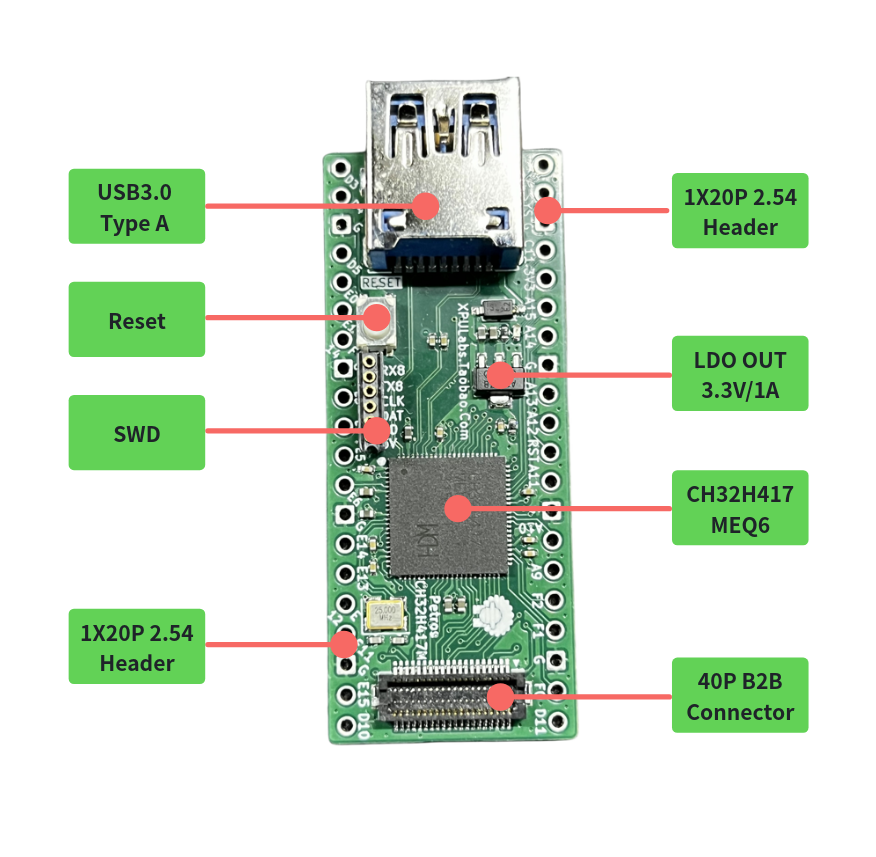
- Size: 52mm × 21mm, ultra‑compact
- 100% form‑factor compatible with Raspberry Pi RP2040 Pico
- All GPIO pins accessible for easy prototyping
- 40‑pin HRS DF12NB(3.0)‑40DP‑0.5V(51) board‑to‑board connector
- Exposes DVP, SPI, I2C, ADC for sensor expansion
![]()
Ready‑to‑Use Interfaces
- USB 3.0 Type‑A: For blazing‑fast data transfer and firmware download
- On‑board reset button
- SWD + UART6 debug ports
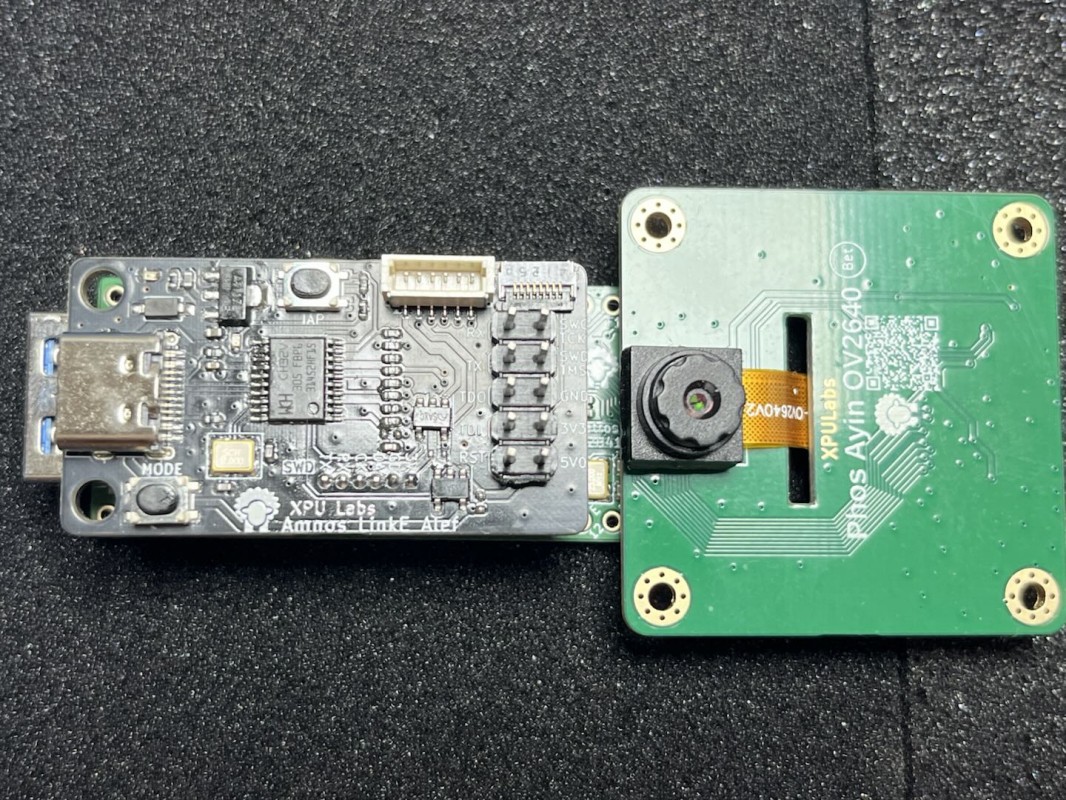
- Included Link‑E debugger: Plug‑and‑play, multi‑interface support
Vision & Sensor Expansion
The 40‑pin connector directly supports the Phos Ayin OV2640 camera module, enabling high‑speed image capture for vision applications like agricultural robotics, industrial inspection, and smart sensing.
Ideal Applications
- High‑speed data acquisition systems
- Embedded vision (DVP cameras)
- Industrial control & monitoring
- High‑performance IoT devices
- Dual‑core embedded projects
Why Choose Petros CH32H417M Alef?
- Unmatched speed: USB 3.0 + 400MHz RISC‑V core
- Pico‑compatible: Drop‑in replacement for RP2040 projects
- Camera‑ready: Native DVP for OV2640 and similar modules
- All‑in‑one: Debugger + cables included, out‑of‑the‑box development
Elevate your embedded projects with the Petros CH32H417M Alef—where dual‑core power meets USB 3.0 speed in a tiny, Pico‑friendly board.
Buy Now
-
CH32H417 USB3.0 Evaluation Board is Released, Bandwidth Up to 450MBps
11/04/2025 at 04:57 • 0 commentsCH32H417 is an interconnected general-purpose microcontroller designed based on QingKe RISC-V5F and RISC-V3F dual cores. CH32H417 integrates USB 3.2 Gen1 controller and transceiver, 100M Ethernet MAC and PHY, SerDes high-speed isolated transceiver, Type-C/PD controller and PHY, provides SD/EMMC controller, 500MBytes universal high-speed interface UHSIF, DVP, SWPMI, PIOC, FMC, DFSDM, LTDC, GPHA, DMA Controller, multi-timers, 8 UARTs, I3C, 4 groups of I2C, 2 groups of QSPI, 4 groups of SPI, 2 groups of I2S, 3 groups of CAN and other peripheral resources.
Built-in 5M sampling rate dual 12-bit ADC unit, 20M sampling rate 10-bit high-speed HSADC unit, 16-channel touch-key, dual DAC unit, 3 groups of OPA, voltage CMP and other analog resources, support 10M/100M Ethernet communication.
It supports USB 2.0 and USB 3.0, USB Host and USB Device, Type-C and PDUSB fast charging, SerDes high-speed isolation and remote transmission, and dual-core division of labor to improve the efficiency of network protocol processing and communication response speed.
![]() )
)WCH has recently launched the CH32H417 USB3.0 evaluation board. This board features exposed interfaces including a USB3.0 Type-A port, a 1000Mbps Ethernet port, USB2.0 Type-A & Type-C ports, and a debugging port. According to the video released by WCH, the bandwidth of the USB3.0 port reaches 450MBps. The board provides a variety of interfaces to support the development of various high-speed and low-speed applications.
![]()
The SDK for CH32H417 has been updated to Version 1.2. It also provides reference schematics for the evaluation board, as well as the chip’s datasheet and technical manual. Those in need can download the materials here.
The WCH CH32H417 development board can be purchased on AnalogLamb.Com for $19.99.
-
Kendryte K230 RISC-V64 Board - CANMV-K230
10/23/2023 at 04:52 • 0 commentsThe K230 chip is the latest generation SoC product in Canaan Technology's (NASDAQ: CAN) Kendryte® series of AIOT chips. The chip adopts a brand-new multi-heterogeneous unit acceleration computing architecture, integrates two RISC-V C908 computing cores, and has a built-in new generation KPU (Knowledge Process Unit) intelligent computing unit. Multi-precision AI computing power with INT8 and INT16. Supports general AI computing framework. The chip also has a variety of peripheral interfaces, as well as multiple scalar, vector, graphics, and other dedicated hardware acceleration units such as image 2D engine, AI 2D engine, 2.5D GPU, and 3D depth engine. K230 provides full-process computing acceleration for various computing tasks such as images, videos, audio, AI, etc. The chip has many features such as low latency, high performance, low power consumption, fast startup, and high security. K230 can be used in various smart hardware products, such as smart door locks, home smart security cameras, dictionary pens, payment recognition, 3D structured light vision modules, drones, interactive robots, smart home appliances, smart toys, and smart manufacturing, intelligent vehicle cockpit and many other fields.
![]()
![]()
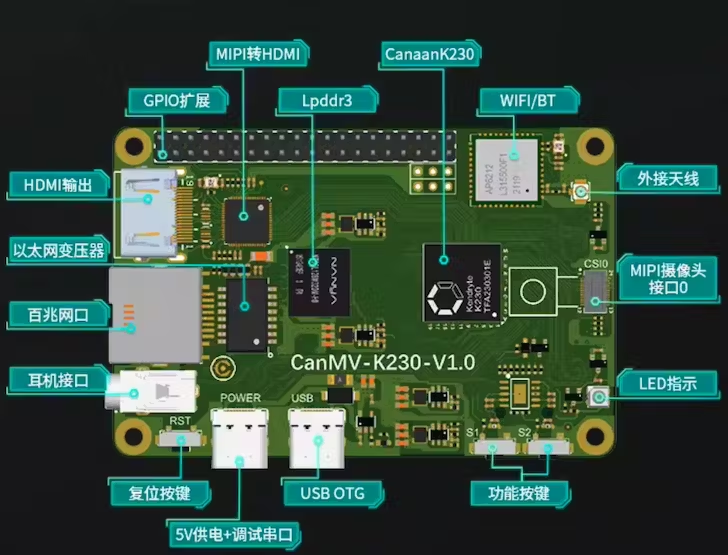
CanMV-K230 Board Features
- CPU: core1 - 64bit, RISC-V processor, 1.6GHz, supports RISC-V Vector Extension 1.0 specification with FPU, VPU; core0 - 64bit, RISC-V processor, 800MHz, supports RISC-V 64GCB instruction set;
- KPU: Support INT8 and INT16, TVM / TensorFlow / Pytorch / ONNX; Typical network performance: Resnet 50 ≥ 85fps @INT8; Mobilenet_v2 ≥ 670fps @INT8; YoloV5S ≥ 38fps @INT8;
- DPU: Using 3D structured light depth calculation; Typical performance is 1280*800@30fps
- VPU: Video encoding/decoding: H.264/H.265/JPEG/MJPEG, 4K@40fps/20fps
- Memory: 512MB DDR, TF Card Storage up to 1T, QSPI Flash
- Camera: 500M Camera *1, Max 3ch MIPI CSI input;
- Display: HDMI 1; MIPI DSI 1, Max 1920 * 1080@60fps
- USB: USB2.0 OTG * 1
- Ethernet: 100Mbps * 1
- Others: Audio Interface 1, Debug UART 2, I2C 4, PWM 5, GPIO * 29
- Board Size: 56 x 85mm
![]()
![]()
Development
https://github.com/kendryte/k230_docs
https://github.com/kendryte/k230_sdk
My Projects
My Pages
 )
)



Projects I Like & Follow
 Swaleh Owais
 Ivo Slanina
 Kumar, Abhishek
 microwavemont
 Fabien Royer
 Chris
Chris Dominic Robillard
 Alex Cordonnier
Monitor ambient light, temperature, barometric pressure and altitude via your browser.
 Dylan Bleier
 Jesse
Jesse tehaxor69
 Hari Wiguna
 CeDeROM
 Grégory Paul
 koo5
koo5