Close
0%
0%

BenchVolt PD

The multi-channel power supply (5 Channels up to 100W) solution designed to transform a standard USB port into a flexible energy source.

Similar projects worth following
The BenchVolt PD turns any USB Type-C port—whether from a phone charger, laptop , power bank or even phome —into a powerful, multi-channel bench supply in your pocket. Supporting USB Power Delivery up to 100 W (20 V, 5 A), it enables dynamic power negotiation and can simultaneously drive evaluation boards, chips, modules, 12 V hard drives, and many other devices—with adjustable outputs up to 32 V.

Project Introduction

The BenchVolt PD is more than just another power supply – it’s a compact, versatile, and open-source tool built for makers, engineers, and professionals who need flexibility at their bench or on the go.

Sometimes a single power supply simply isn’t enough. With BenchVolt PD, your everyday USB Type-C adapter or even a power bank can be transformed into a flexible, multi-channel power supply. That means you can safely power different voltage levels from a single device, all while keeping full control and protection.

Wouldn’t it make sense to replace multiple bulky supplies with one smart, portable box?

With support for USB Power Delivery (USB-PD) up to 100 W, the Power Box offers five independent output channels: three fixed outputs for common voltages(1.8V, 2.5V, 3.3V) and two adjustable channels(0.5V to 5V and 2.5V to 32V) capable of both precise voltage/current control and arbitrary waveform generation. With current protection, you can safely power multiple evaluation boards, test circuits, and development setups simultaneously – without worrying about overloading your supply.

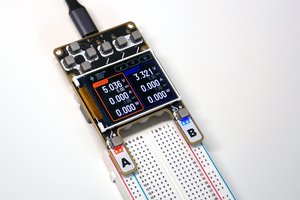
A bright TFT display keeps you informed with live voltage, current, and power readings per channel, while SCPI control support makes integration with test scripts and automated setups effortless. Pair it with a power bank and you suddenly have a portable power supply in your backpack.

Imagine dialing in 0–32 V straight from a USB port, setting current limits for sensitive prototypes, or generating custom waveforms on the fly – all from a single, pocket-sized device. For example, you no longer need a bulky 220 V supply just to power your hard drive at 12 V – if you’ve got USB with you, all the voltages you need are right there.

The BenchVolt PD is a complete development and testing companion for anyone working with electronics.

Features & Specifications

Power & Outputs

  • Five independent output channels with adjustable voltage and current
  • Fixed outputs: 3.3 V, 2.5 V, 1.8 V (up to 3 A each)
  • Adjustable Output 1: 0.5V – 5 V @ 3 A
  • Adjustable Output 2: 2.5V – 32 V @ 3A
  • Current protection & safe operation
  • 2.54 mm (100 mil) pin headers for powering multiple evaluation boards
  • Arbitrary waveform generation and predefined waveforms (Square, Sine, Triangle, Ramp) available on adjustable channels

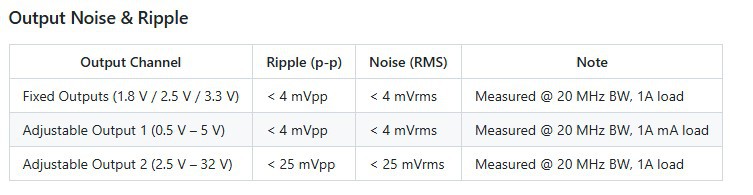
      Note: The fixed outputs and Adjustable Output 1 are LDO-driven, providing very low noise

      performance.
Arbitrary Function  

    • Number of Points: 1024
    • Resolution: 12-bit
    • Point Parameters: Dwell time and Voltage
    • Dwell Time Range: 4 ms to 16,384 ms

USB Power Delivery

  • USB-C input supporting PD sink mode
  • Up to 100 W USB-PD power

Control & Interface

  • 1.9" TFT display (170 × 320) for real-time voltage, current, and PD mode
  • Rotary encoder for fast menu navigation and 5 mV step adjustments
  • SCPI command support for remote programming
  • Python GUI for desktop control

Electronics & Firmware

  • Microcontroller: STM32F070
  • USB-PD controller: STUSB4500 (sink mode)
  • Configurable LDOs and boost converters for fine-tuned outputs
  • Overcurrent protection on all channels
  • Firmware upgradable via USB through the Python interface (no ST-LINK or external dongle required)

Physical

  • Dimensions: 160 × 75 × 40 mm (6.3 × 3.0 × 1.6 in)
  • Weight: ~500 g (17.6 oz)

Open Source 

  •  Python UI
  •  Firmware
  •  Schematics

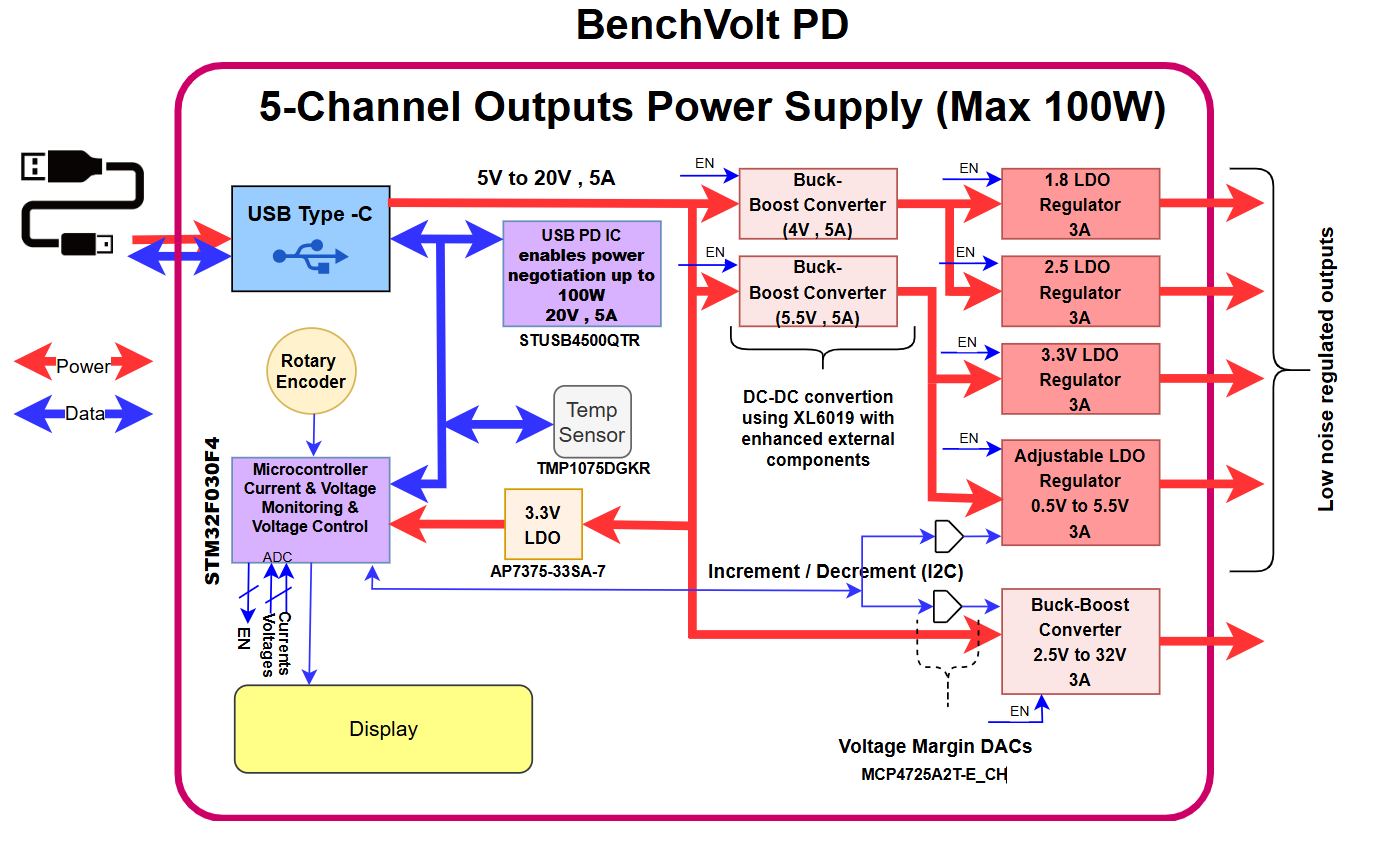
Block Diagram

How It Works;

When BenchVolt PD powered on, all regulators and converters start in the disabled state. The STM32 microcontroller first powers up and performs safety checks by monitoring temperature, current, and voltage. It then enables the DC-DC converters, followed by the linear regulators in sequence.

Throughout operation, the MCU continuously monitors system all parameters to maintain safe operating conditions.

An additional safety layer can be used by setting a power...

Read more »

power-box-animation1.gif

Graphics Interchange Format - 49.87 MB - 09/14/2025 at 19:55

Preview

power-box-pic3.jpg

JPEG Image - 8.63 MB - 09/14/2025 at 19:55

Preview

power-box-pic1.jpg

JPEG Image - 8.49 MB - 09/14/2025 at 19:55

Preview

power-box-pic2.jpg

JPEG Image - 11.48 MB - 09/14/2025 at 19:55

Preview

power-box-pic4.jpg

JPEG Image - 9.97 MB - 09/14/2025 at 19:55

Preview

View all 9 files

  • 1 × STUSB4500 Standalone USB PD controller for power sinking devices
  • 1 × MCP4725 12-Bit Digital-to-Analog Converter with EEPROM Memory in SOT-23-6
  • 1 × STM32F030F4 Microprocessors, Microcontrollers, DSPs / ARM, RISC-Based Microcontrollers
  • 3 × XL6019 180KHz 60V 5A Switching Current Boost DC/DC Converter XL6019
  • 1 × TMP1075 1°C I²C temperature sensor with performance upgrades to industry standard LM75 / TMP75

View all 7 components

View all 2 project logs

Enjoy this project?

Share

Discussions

EEEngineer4Ever wrote an hour ago point

Here is the first upgrade; BenchVolt PD is now significantly more efficient thanks to TI’s TPS55289 DC-DC converters. More improvements are on the way, so stay tuned!

https://www.crowdsupply.com/fusionxvision/benchvolt-pd/updates/from-prototype-to-final-design

  Are you sure? yes | no

EEEngineer4Ever wrote 10/28/2025 at 14:15 point

Added output ripple and noise measurement results.

  Are you sure? yes | no

EEEngineer4Ever wrote 10/06/2025 at 17:44 point

Hello everyone I happy to share that project is at the crowssupply now. 

If you like the project, you’ll be able to order a ready-to-use version or build it yourself from the shared files. I’ll also make bare PCBs available so anyone can order them cheaply and customize the design to their own needs.

BenchVolt PD on Crowd Supply
A 5-channel, 100 W open-source USB-PD power supply with current-limited fixed, adjustable, and waveform-capable outputs.

  Are you sure? yes | no

lohikarhu wrote 12/19/2024 at 01:24 point

Without actual evaluation of the power output, with good oscilloscope probing, and probing technique...it would be nice to see detailed schematics and preliminary evaluation results, in order to do a first level design review... 

  Are you sure? yes | no

EEEngineer4Ever wrote 12/19/2024 at 14:39 point

I will share all the results whenever I make some measurements and I will also share final  schematics soon. Thanks for your interest. 

  Are you sure? yes | no

GregP-Navdna wrote 12/18/2024 at 18:05 point

is it really that noisy or is that just place holder data on the graphs in the software while you continue to develop?

  Are you sure? yes | no

EEEngineer4Ever wrote 12/19/2024 at 14:40 point

Outputs are very stable as you said graph is at the animation mode while development is still on going

  Are you sure? yes | no

dkatsis wrote 12/18/2024 at 17:31 point

This is a great project, I would love to build it up myself and evaluate it as a bench supply for my own lab. Do you have the design files available?

  Are you sure? yes | no

EEEngineer4Ever wrote 12/19/2024 at 14:43 point

I will share the schematics and firmware. I am still making some modifications and trying to reduce the cost. Thanks for your interest.

  Are you sure? yes | no

EEEngineer4Ever wrote 12/14/2024 at 00:55 point

Hi everyone,

I’m excited to share my project, the USB PD Power Box, with you. My goal is to create a low-cost, portable power supply that can be used for a variety of purposes at home or in the lab. This project is completely open source, including hardware, firmware, and the GUI, so it’s accessible to everyone.

I’d love to get your feedback to help me improve it. Please share your thoughts about what you like, what you don’t like, and what could be improved or added. With your help, I can refine this design and make it even more useful for everyday electronics projects and professional applications alike.

Thank you for taking the time to check it out, and I’m looking forward to hearing your ideas!

  Are you sure? yes | no

Does this project spark your interest?

Become a member to follow this project and never miss any updates