gitzi
gitzi-
Arduino Nano ESP32 low-latency Wi-Fi display
07/04/2026 at 15:23 • 0 comments![]()
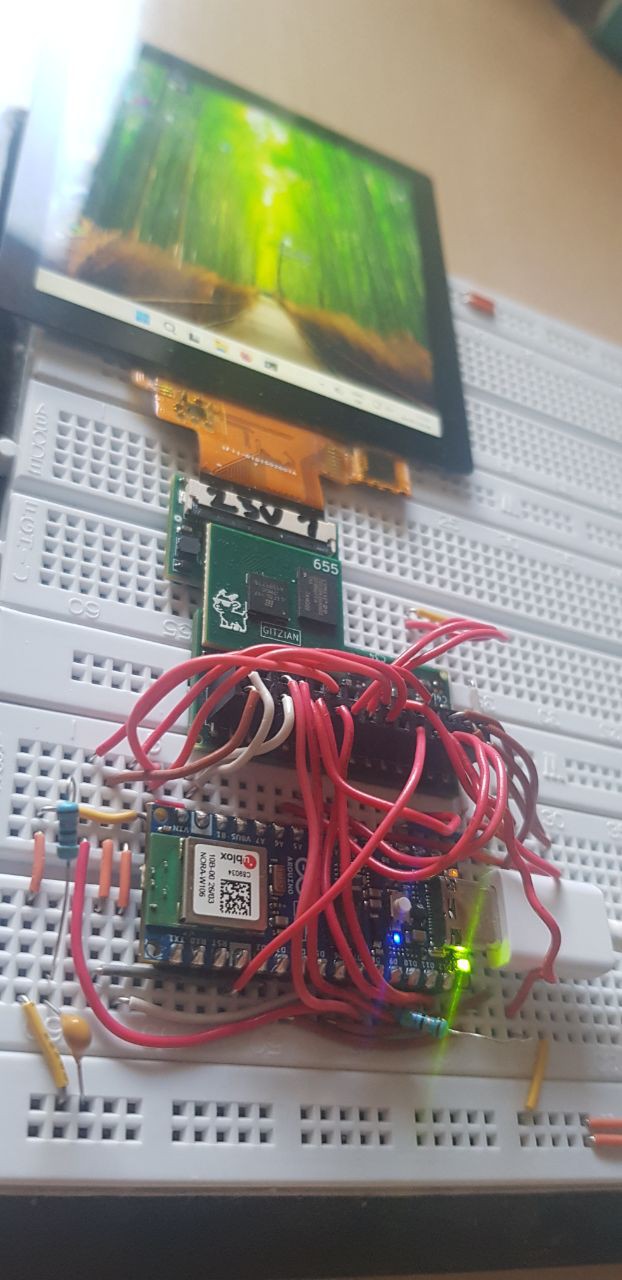
Trying to make things smaller and smaller without sacrificing too much frame rate. Tested my Raspi HAT with Arduino Nano. It streams flawlessly. Raspi Wifi throughput is of course higher but this is still impressive imo.
This little u-blox Wi-Fi module is absolutely enough to transport the encoded stream to my decoder. I will measure power consumption and realistic bandwidth compared to the Raspberry Pi soon.
I will also add the code and wiring instructions to the manuals here and my website soon.
-
Tindie listing stocked now
07/02/2026 at 12:51 • 0 commentsI hope my hobby resonates with some of you. I am also asking for feedback.
If you have a software-heavy project and need to offload computation for visual output, this is my solution for it.
Possible uses where fast response is crucial and you want to keep size and power consumption low:
- Cyberdecks
- Dashboards
- Visual control over a network
- Handheld terminals
- Art installations
- Compact remote desktops
- Custom small-screen interfaces
- Custom gaming decks
The host currently supports:
- Debian Trixie with KDE Plasma
- Windows 11
The accelerated path uses DirectX or OpenGL ES 3.1 capable systems, with GPU encoding ~3 ms per frame, for example on an Nvidia 1050 Ti. This was tested with two synchronized 720x720 displays running in parallel on same GPU - still plenty GPU resources left for rendering games or more displays. Software rendering is also possible if there is interest.
If you have a niche use case and need special support, feel free to reach out. I control the full pipeline, so I can add project-specific features such as custom APIs, niche display support, special control flows, or application-specific streaming behavior. I am fully GPU-vendor agnostic with this approach.
The hardware is kept flexible so you can adapt the kit, swap parts, or build your own device around it.
Buying a kit helps me continue work on the software and hardware side. Questions about the project are welcome. Any form of feedback is appreciated.
-
Multi-Screen Setup Experiments
07/01/2026 at 08:20 • 0 comments![]()
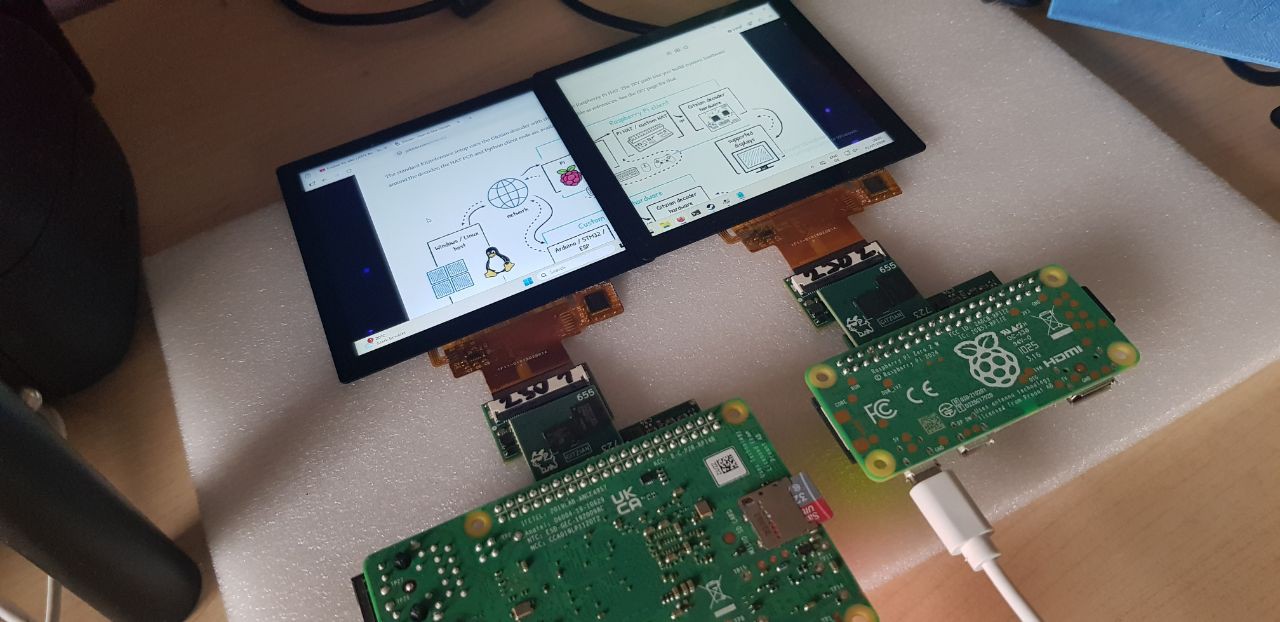
I wonder how far I can push screen extending with my Nvidia GTX 1050 Ti. These screens total 1440×720 pixels. GTA V was running, but at much lower settings than when using only one screen.
-
Software Stack Hardware Accelerated
06/26/2026 at 19:59 • 0 comments
The software side now has the hardware-accelerated streaming path in place through the Gitzian GPU Streamer.
The current setup has documented paths for Windows, Linux / KDE Plasma, Raspberry Pi clients, viewport streaming, virtual display setups, firmware updates, and recovery notes.
Gitzian is becoming a small-display platform: ready hardware, a documented host streamer, a Raspberry Pi client, downloads, open reference designs around the decoder, and clearer DIY entry points for people who want to build their own hardware around it.
The software side is hardware accelerated, the setup flow is documented, and the project is now structured as something people can use, hack, and extend.
This opens the door to compact remote desktops, control panels, handheld experiments, dashboards, communicator screens, multi-display setups, lab tools, embedded UIs, and other custom small-screen DIY projects.
Current focus:
more supported displays
multi-display experiments
simple hardware keyboard
-
Refined project and goals
02/20/2026 at 18:48 • 0 commentsThe system is already running smoothly in real-time streaming conditions — and this is before any serious optimization work has even started.
Right now the pipeline is still using early-stage encoder logic and unoptimized paths, yet frame delivery is stable, interaction is responsive, and overall behavior is already well within usable territory. This confirms that the architecture itself is sound and has plenty of performance headroom left once tuning begins.
At this stage I’m not chasing speed yet. The focus is validating stability, timing behavior, and pipeline correctness first. Optimization comes later, once the baseline is fully characterized.
Check out the video to see current performance as-is.
I refined the goals and head over to a full device with battery and a case.
-
PCB Design completed
02/11/2026 at 18:32 • 0 commentsPCB designed for current roadmap.
-
Power consumption: Surprisingly low at full brightness ≤ 1.5W
-
Form factor: Board footprint significantly reduced vs previous revision
-
Architecture: Split into 3 modular parts for on-demand exchange
-
Input: Network module (e.g., WiFi or RJ45)
-
Processing: Decoder
-
Output: Display driver (supports different display types)
-
Next steps:
-
Optimize network stream for full throughput
-
Perform latency testing
-
Implement touchscreen support
-
Publish results in the next few weeks
-
-
FPGA Decoder Milestone
10/11/2025 at 09:20 • 0 commentsSummary
- Initial FPGA implementation complete for the decoder path.
- Lattice STA and simulation confirm the pipeline meets the timing/perf budget for <20 ms/frame at 100 MHz.
- This meets the near-term performance target on the roadmap.
Next
- Start PCB design for field testing (bring-up + measurements).
Feedback welcome
If you have any questions, recommendations, or general feedback, don’t hesitate.
Hardware-Accelerated Display Streaming Decoder
"The display becomes a terminal. The computing happens elsewhere."