Close
0%
0%

Deriving 1 Hz from Candle Flame Oscillations

Using capacitive sensing to measure the oscillation of a candle flame and converting it to a 1 Hz clock

timTim
Similar projects worth following

Todays candles have been optimized not to flicker. But it turns out when we bundle three of them together, we can undo all of these optimizations and the resulting triplet will start to naturally oscillate. A fascinating fact is that the oscillation frequency is rather stable at ~9.9Hz as it depends mainly on gravity and diameter of the flame. 

We use a rather unusual approach based on capacitive sensing with a wire to detect this frequency and divide it down to a 1 Hz clock for a time base.

Link to project repository.

View the logs in order
  1. Candle Flicker is a Curious Thing - Can we control it?
  2. The Candle Flame Oscillator
  3. Detecting Flame Oscillations with a Wire
  4. Putting it all together to generate a 1 Hz clock

  • Putting it all together to generate a 1 Hz clock

    Tim08/12/2025 at 20:41 0 comments

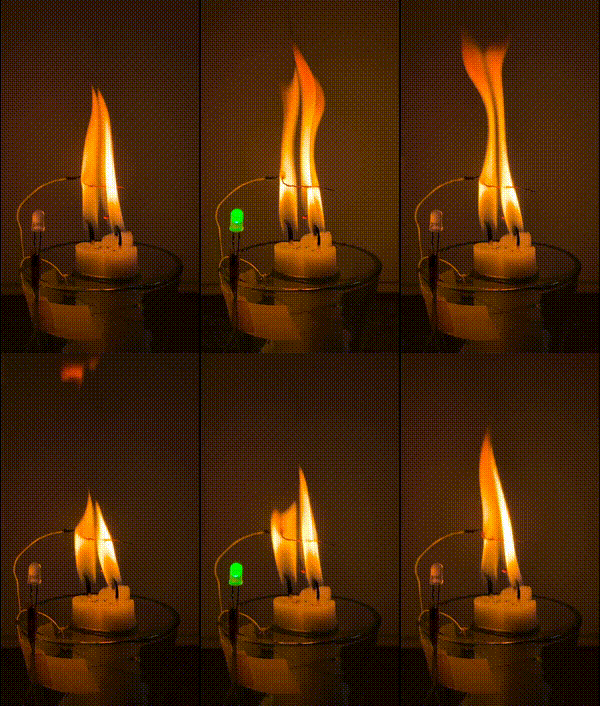
    So now we have a clock source of ~9.9 Hz and a way to extract a signal from it. First, let's marvel at the result! You can see the candle flickering at 10 Hz and the LED next to it blinking at 1 Hz! The framerate of the GIF is unfortunately limited, which causes some aliasing. You can see a higher framerate version on YouTube or the original file.

    Candle flame oscillating at ~10 Hz with LED blinking at 1 Hz

    Let's take a quick look at how to put this all together to extract a 1 Hz clock, as desired for the challenge. All code for analysis and the microcontroller can be found in the GitHub repository.

    Read more »

  • Detecting Flame Oscillations with a Wire

    Tim08/12/2025 at 18:27 0 comments

    Now that we have a source of stable oscillations—remind you, FROM FIRE—we need to convert them into an electrical signal.

    For my original investigations, I used an I²C-based light sensor to sample the light signal. This provides very high SNR, but is comparatively complex.

    Phototransistor

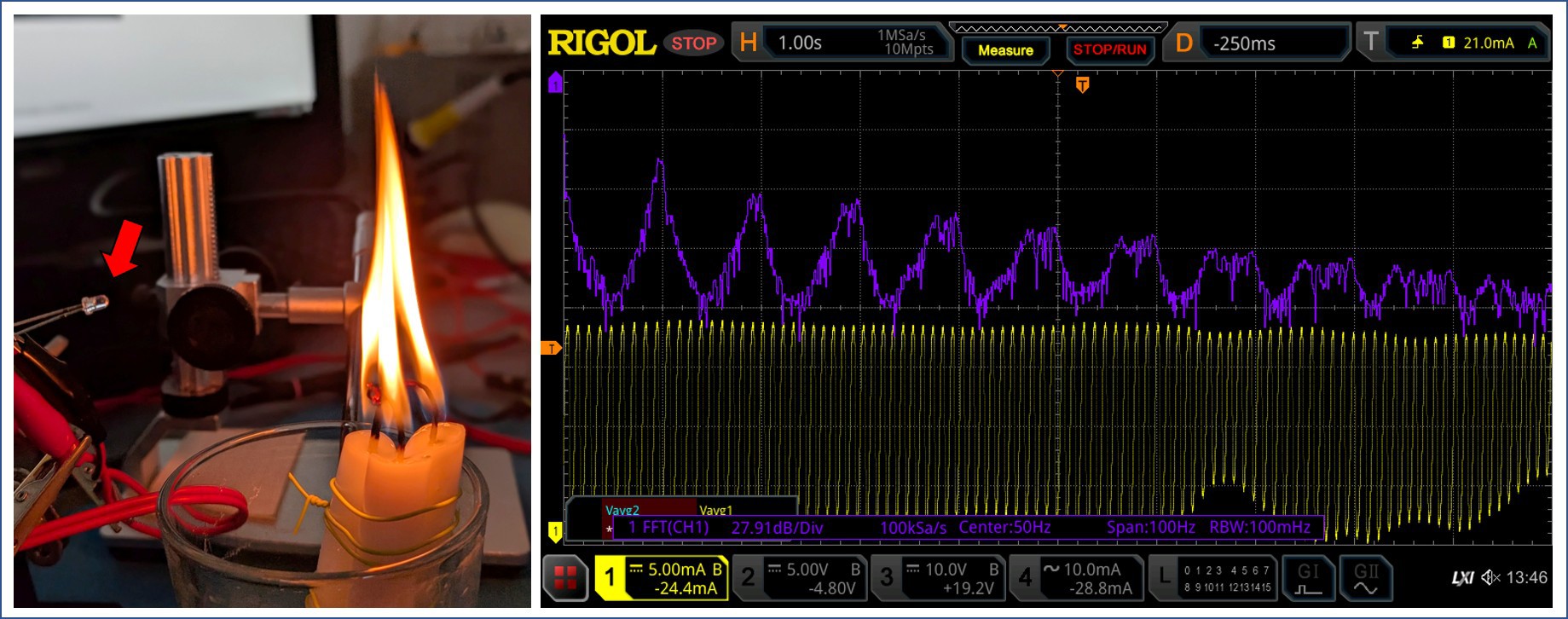
    Looking for a simpler solution, I tried using a phototransistor. This worked quite nicely. Below you can see the setup with a phototransistor in a 3mm wired package (arrow). Since the phototransistor has internal gain, it provides a much higher current than a photodiode and can be easily picked up without additional amplification.

    The phototransistor was connected via a sensing resistor to a constant voltage source, with the oscilloscope connected across the sensing resistor. The output signal was quite stable and showed a nice ~9.9 Hz oscillation.

    Phototransistor setup and measured data on the oscilloscope

    In the next step, this could be connected to an ADC input of a microcontroller to process the signal further.

    But who has a phototransistor in their parts bin anyway? There must be an even simpler solution.

    No Parts (Capacitive Sensing)

    Read more »

  • The Candle Flame Oscillator

    Tim08/12/2025 at 07:51 2 comments

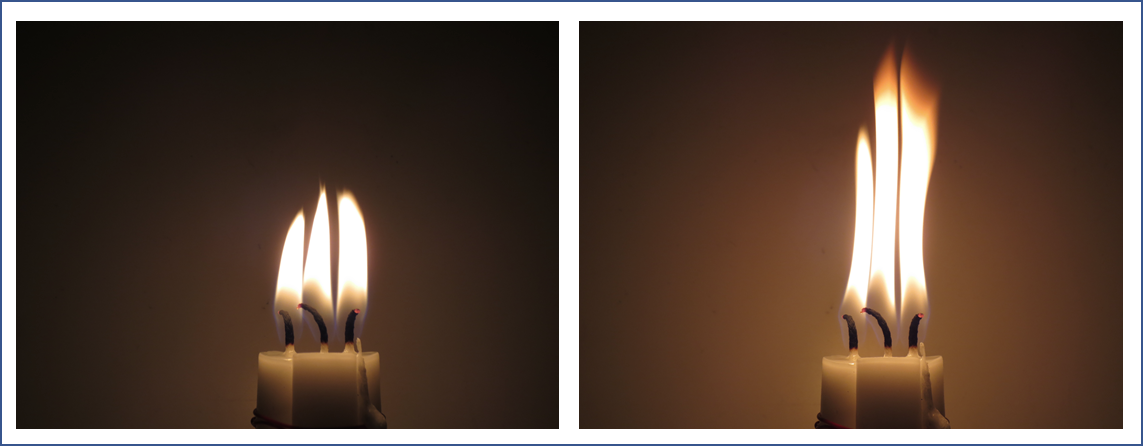
    So, what happens with our bundle of three candles? It will basically undo millennia of candle technology optimization to avoid candle flicker. If left alone in motionless air, the flames will suddenly start to rapidly change their height and begin to flicker. The image below shows two states in that cycle.

    Two states of the oscillation cycle in bundled candles
    Read more »

  • Candle Flicker is a Curious Thing - Can we control it?

    Tim08/12/2025 at 06:40 0 comments

    Candlelight is a curious thing. Candles seem to have a life of their own: the brightness wanders, they flicker, and they react to the faintest motion of air.

    There has always been an innate curiosity in understanding how candle flames work and behave. In recent years, people have also extensively sought to emulate this behavior with electronic light sources. I have also been fascinated by this and tried to understand real candles and how artificial candles work.

    Now, it's a curious thing that we try to emulate the imperfections of candles. What if I told you that candle makers have worked for centuries (and millennia) on optimizing candles NOT to flicker?

    In essence: The trick is that there is a very delicate balance in how much fuel (the molten candle wax) is fed into the flame. If there is too much, the candle starts to flicker even when undisturbed. This is controlled by how the wick is made.

    There is a particularly fascinating effect that has more recently been the subject of publications in high-profile scientific journals[1] [2]: When several candles are brought close to each other, they start to "communicate" and their behavior synchronizes.

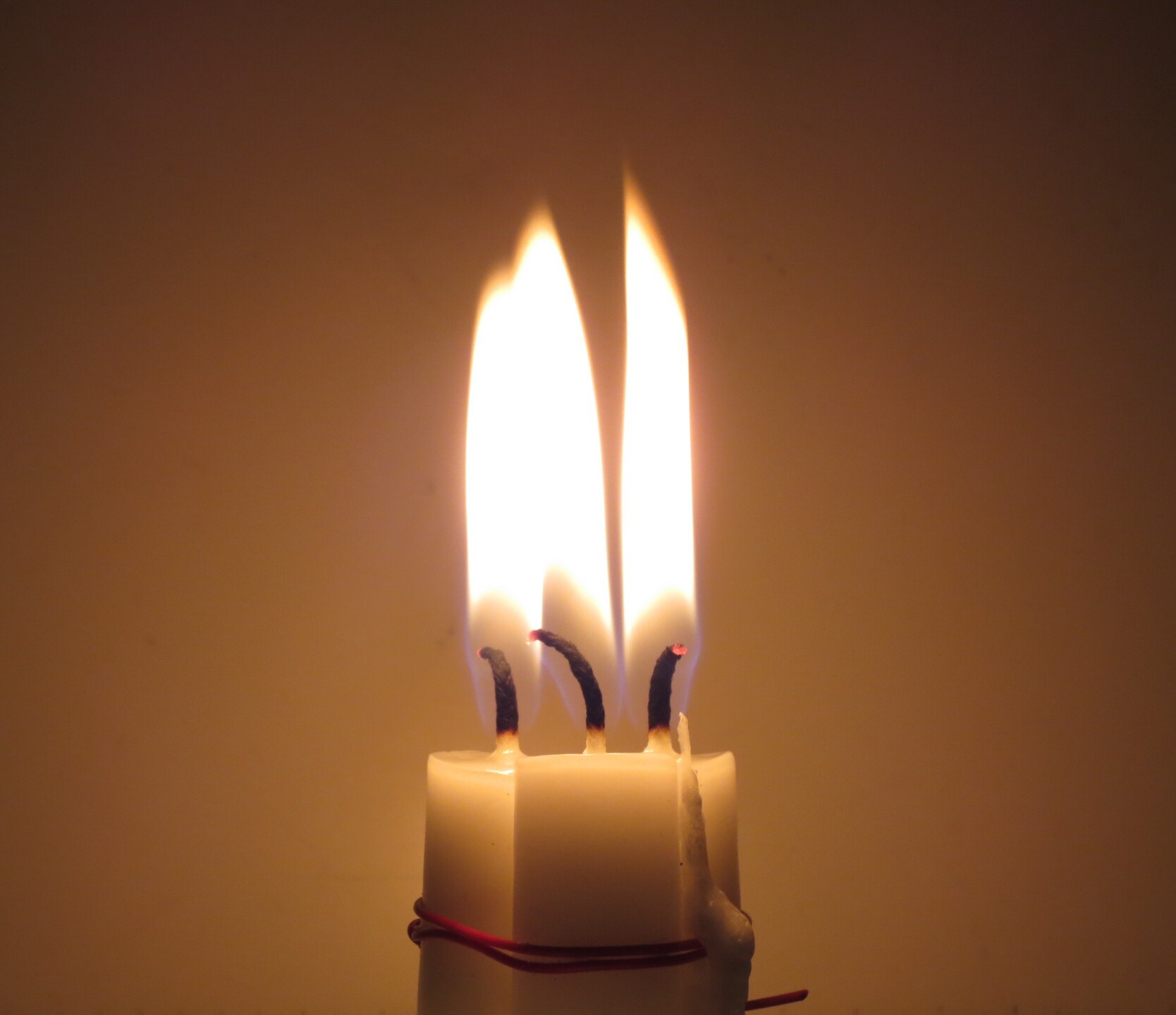
    The simplest way is to bundle three candles together - they will behave like a single large flame, as shown below.

    Read more »

View all 4 project logs

Enjoy this project?

Share

Discussions

Ruth Anne wrote 09/11/2025 at 09:30 point

Shocked by this project! Learned a lot from your sharing. Thanks a lot!

  Are you sure? yes | no

Ken Yap wrote 08/14/2025 at 00:12 point

Hahaha, very creative. 👍 Who would have thought.

If only those smugglers in historical novels had digital logic they wouldn't have to stick pins in candles to measure time. 😜

  Are you sure? yes | no

mihai.cuciuc wrote 08/13/2025 at 17:56 point

Love it! <bows respectfully>

  Are you sure? yes | no

Similar Projects

Does this project spark your interest?

Become a member to follow this project and never miss any updates