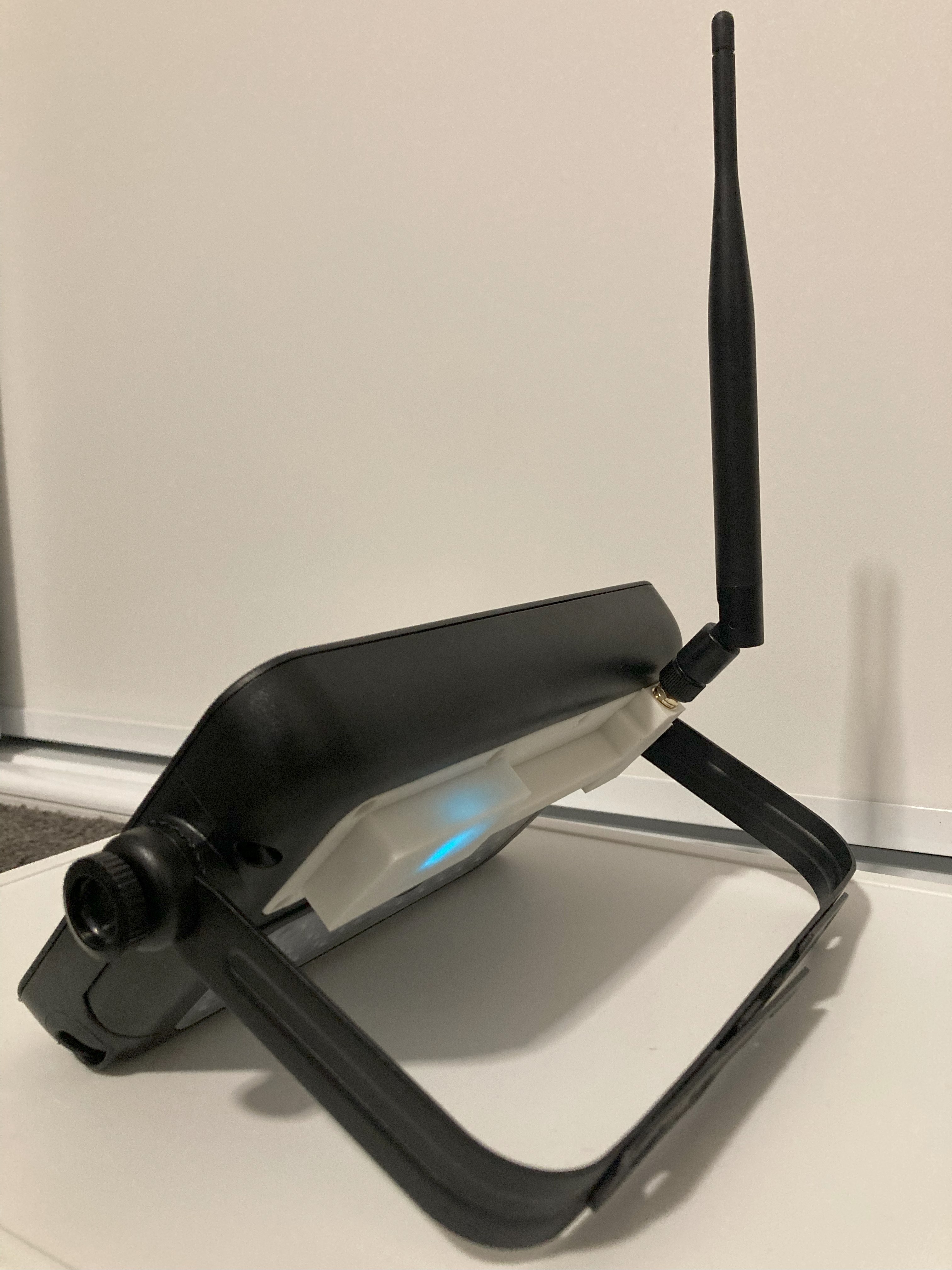
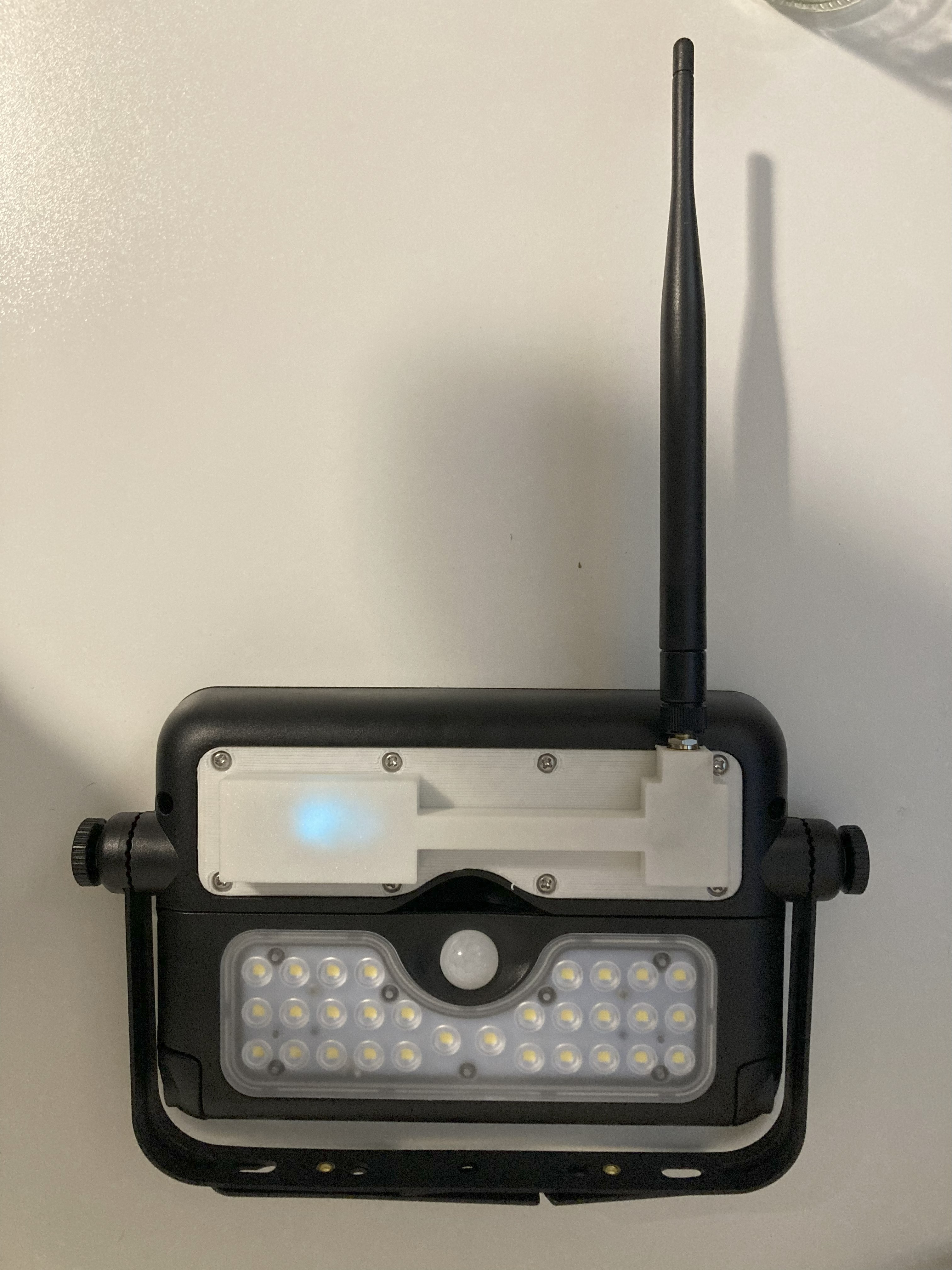
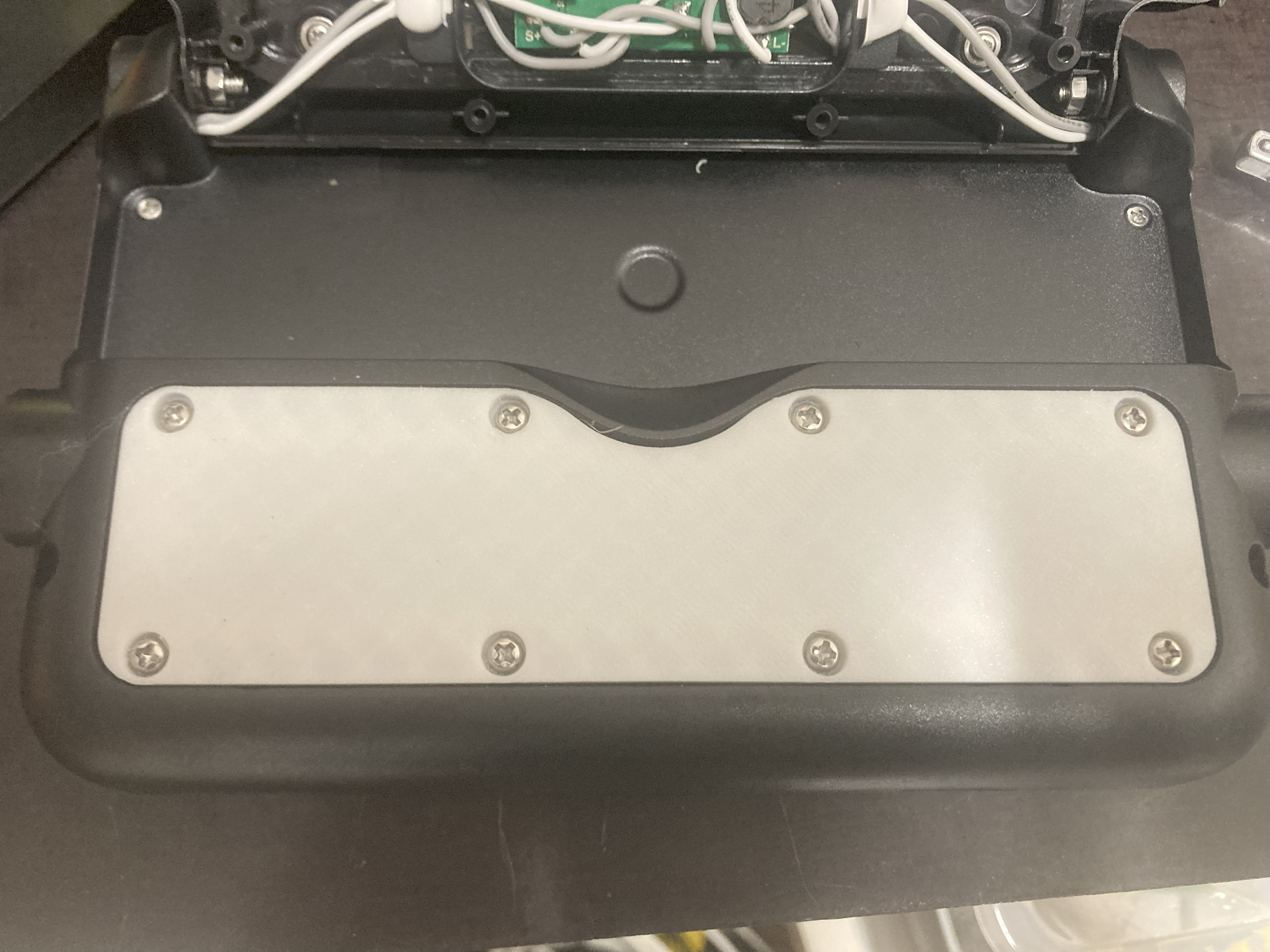
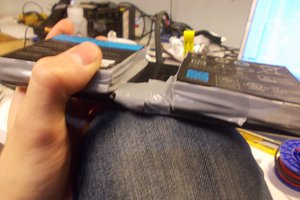
Bunnings is the most popular Australia hardware store and it often sells pretty neat gadgets at a terrific price. One such item is the Arlec LVS937BK, "Arlec 7W Integrated Solar Powered Sensor LED Floodlight" https://www.bunnings.com.au/arlec-7w-integrated-solar-powered-sensor-led-floodlight_p0604237. This solar lamp has a 3600mAh battery pack which is two 18650s in parallel, meaning that it's got a 3.7V battery which is compatible with many popular Meshtastic radios.
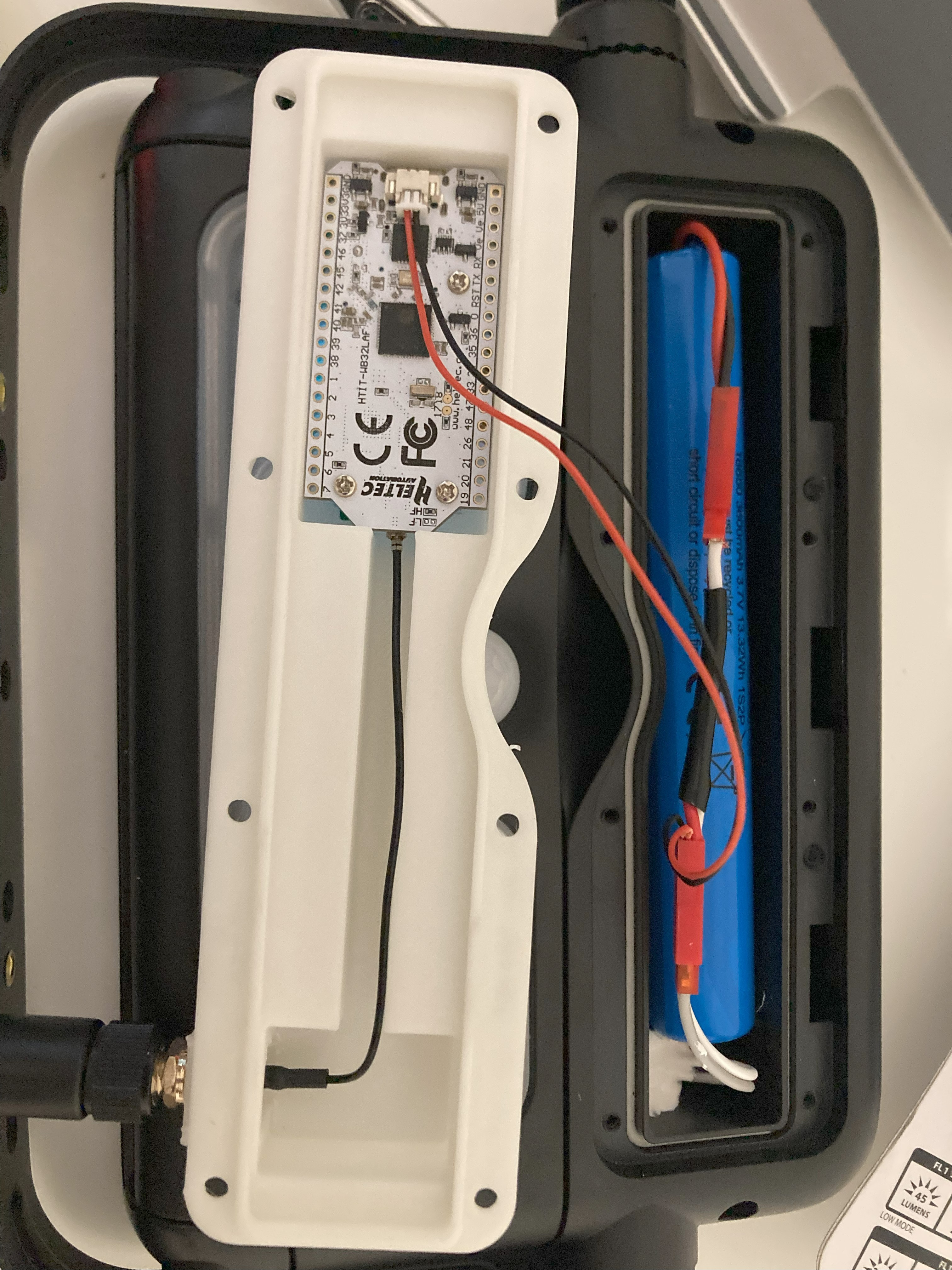
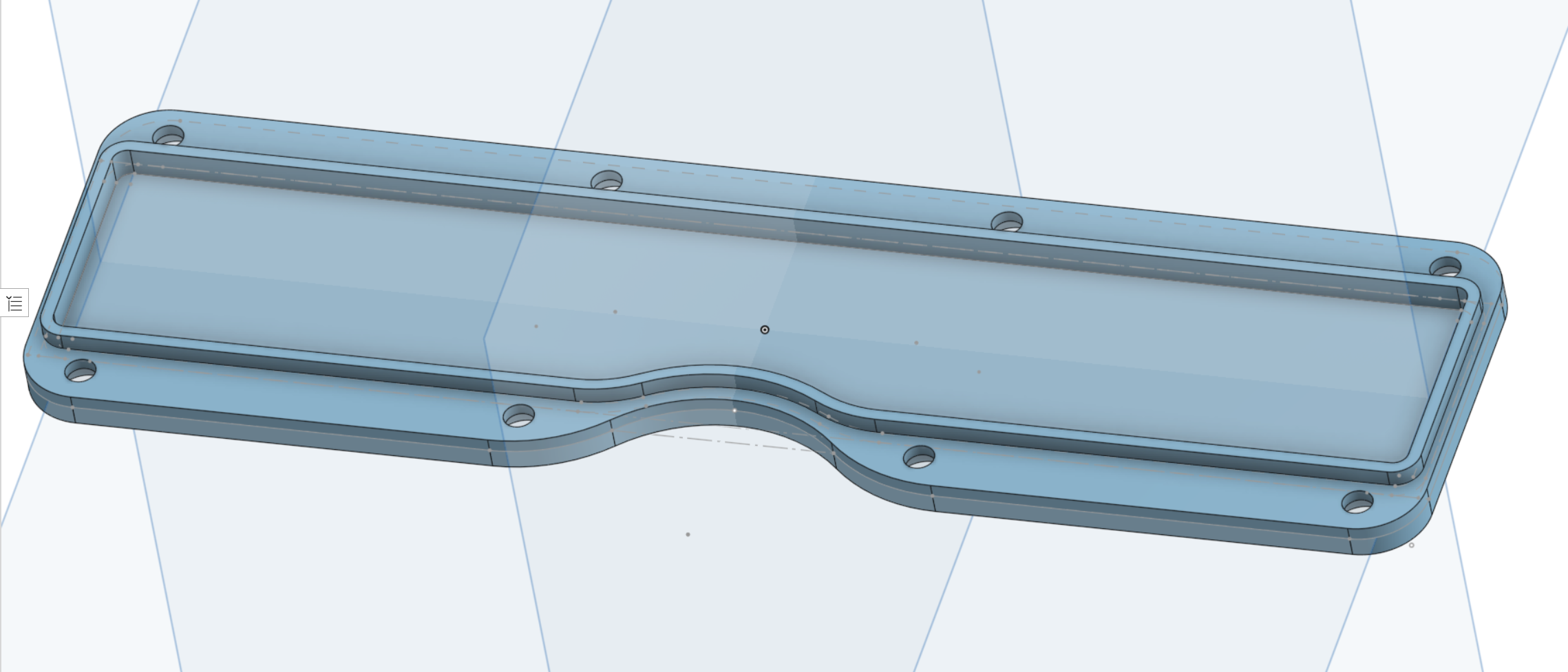
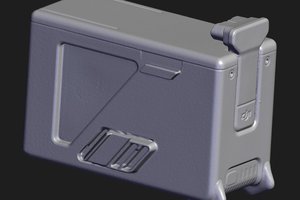
The plan is to design an enclosure to 3D print which will replace the existing battery cover, this enclosure will house the meshtastic radio and an SMA adapter. This also provides easy access to the battery. I'm hopeful I can fabricate a Y-cable, to connect the battery, the control board and the radio. This would mean I don't need to modify the case AT ALL just replace the battery cover, install the radio and antenna and connect the y-cable!
Files
battery_cover_v3.stl
V3 of the battery cover. This version has a slightly wider cavity for the radio and will now support a Heltec t114 also
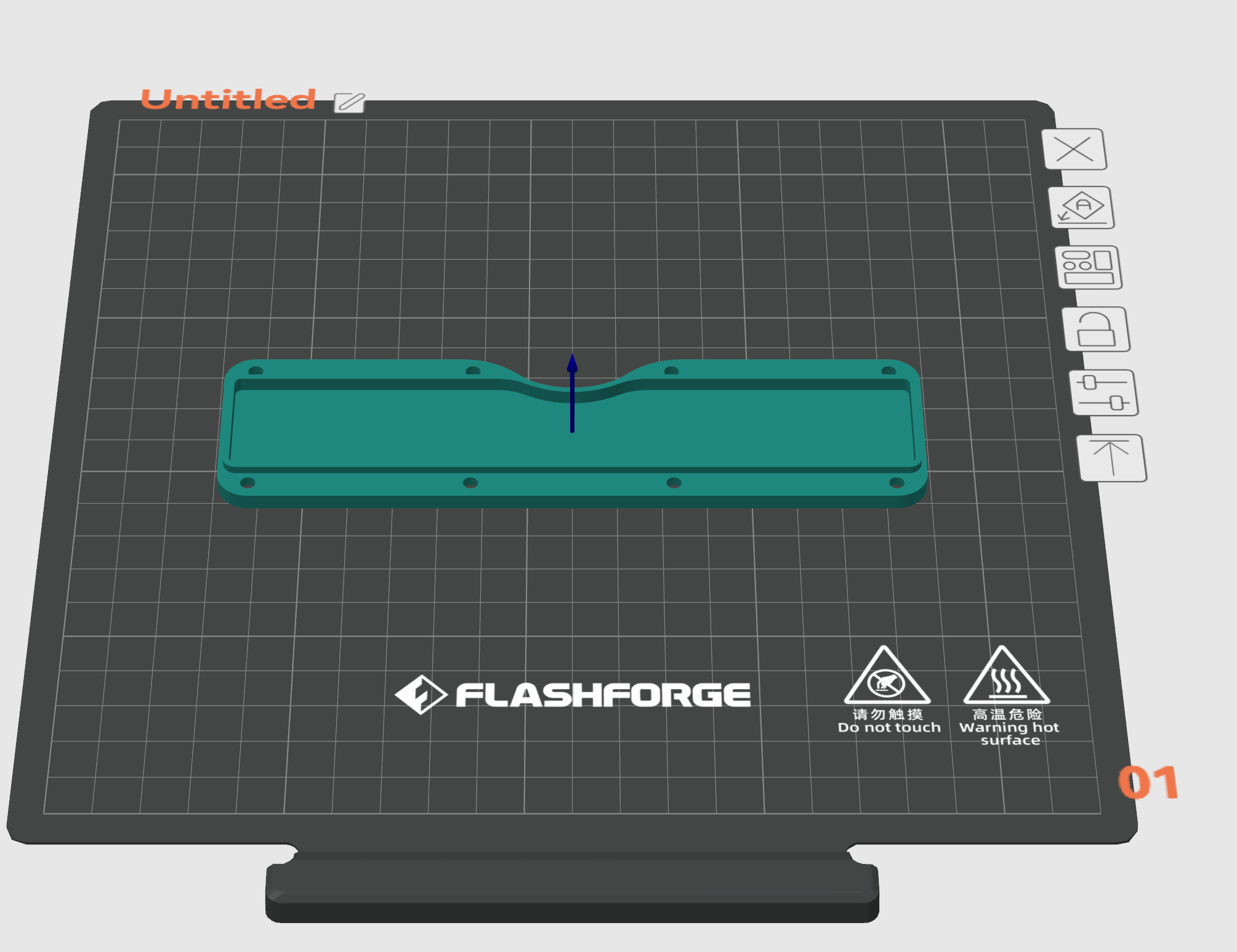
Print with the gasket flange facing up and use supports. You should be able to punch out the support material in the SMA adapter hole without too much hassle.
Standard Tesselated Geometry -
263.95 kB -
11/01/2025 at 02:44
V2 of the battery cover.
Print with the gasket flange facing up and use supports. You should be able to punch out the support material in the SMA adapter hole without too much hassle.
Standard Tesselated Geometry -
263.95 kB -
09/30/2025 at 10:55
After running this thing a few times, I noticed that it kept turning off. My best guess is that there was some kind of resettable thermal fuse somewhere near the battery.
I also noticed that I just wasn't getting appropriate battery life.
I've purchased a Heltec t114 now, no screen or GPS and have had the unit running continuously for 3 days in overcast conditions (with westerly sun, 1/2 day of solar) and in with the solar panel in vertical orientation at home and think I've for the right setup for a solar node I can release into the wild in Newcastle, Australia.
I noticed that the case was ever so slightly too narrow to accommodate the t114, so I've released a V3 of the design which is 3mm wider.
I was also getting delayed trying to be able to print the case in ASA, but decided to just use PETG instead which will give me better heat resistance than the PLA in the prototypes.
I really wasn't very happy with the first version, the SMA connector was coming out the side and was hitting the mounting bracket which was super annoying. I also screwed the back in with the antenna a bit loose. It was just all bad. Plus the battery kept running out because it's an Heltec V3!
I quickly went back to the drawing board making the following changes to the cover design:
- Change the orientation of the SMA connector
- Change the wiring channel to be full depth to simplify support printing
- Change the diameter of the SMA connector hole AND add a hex slot to prevent rotation
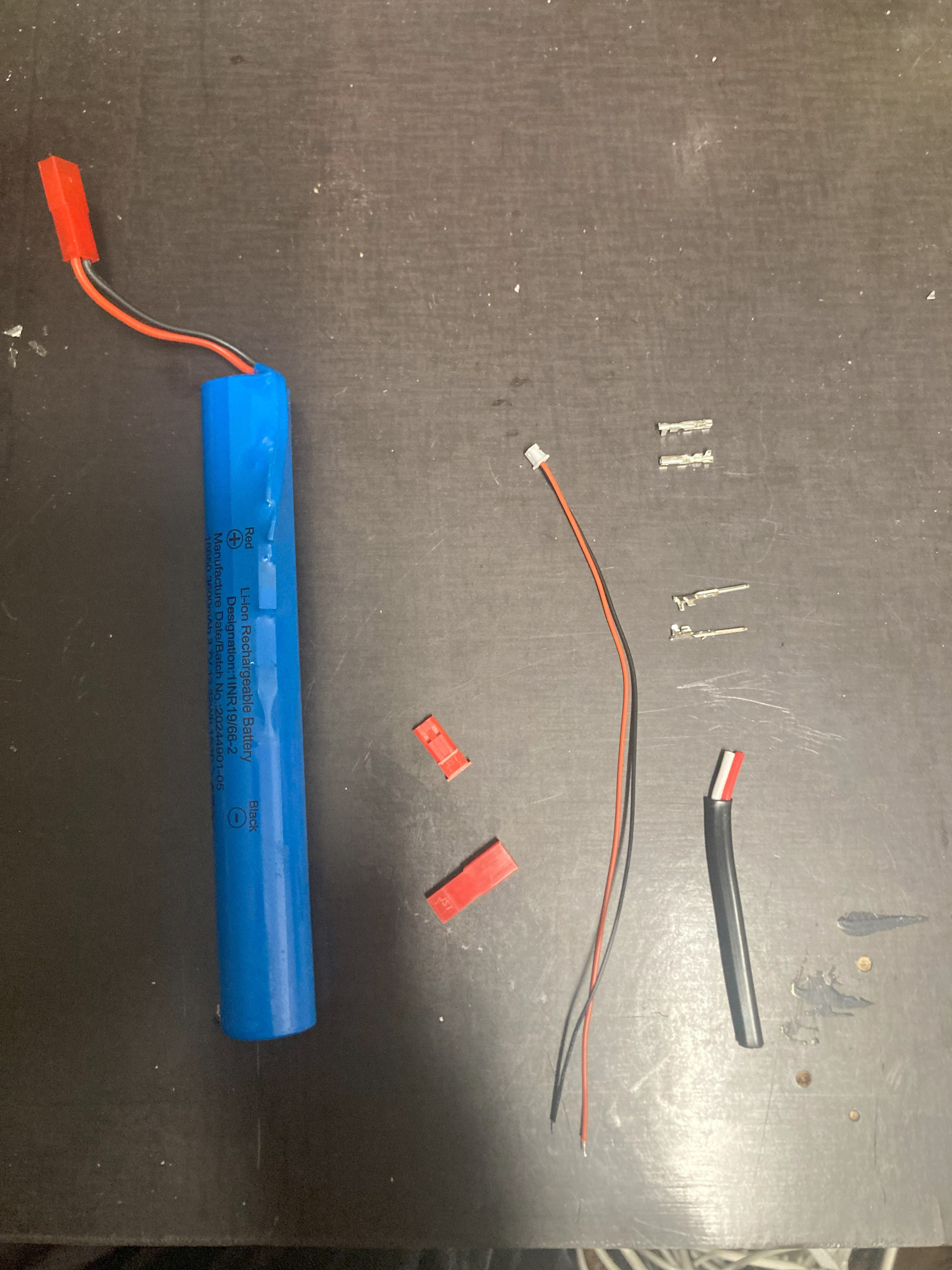
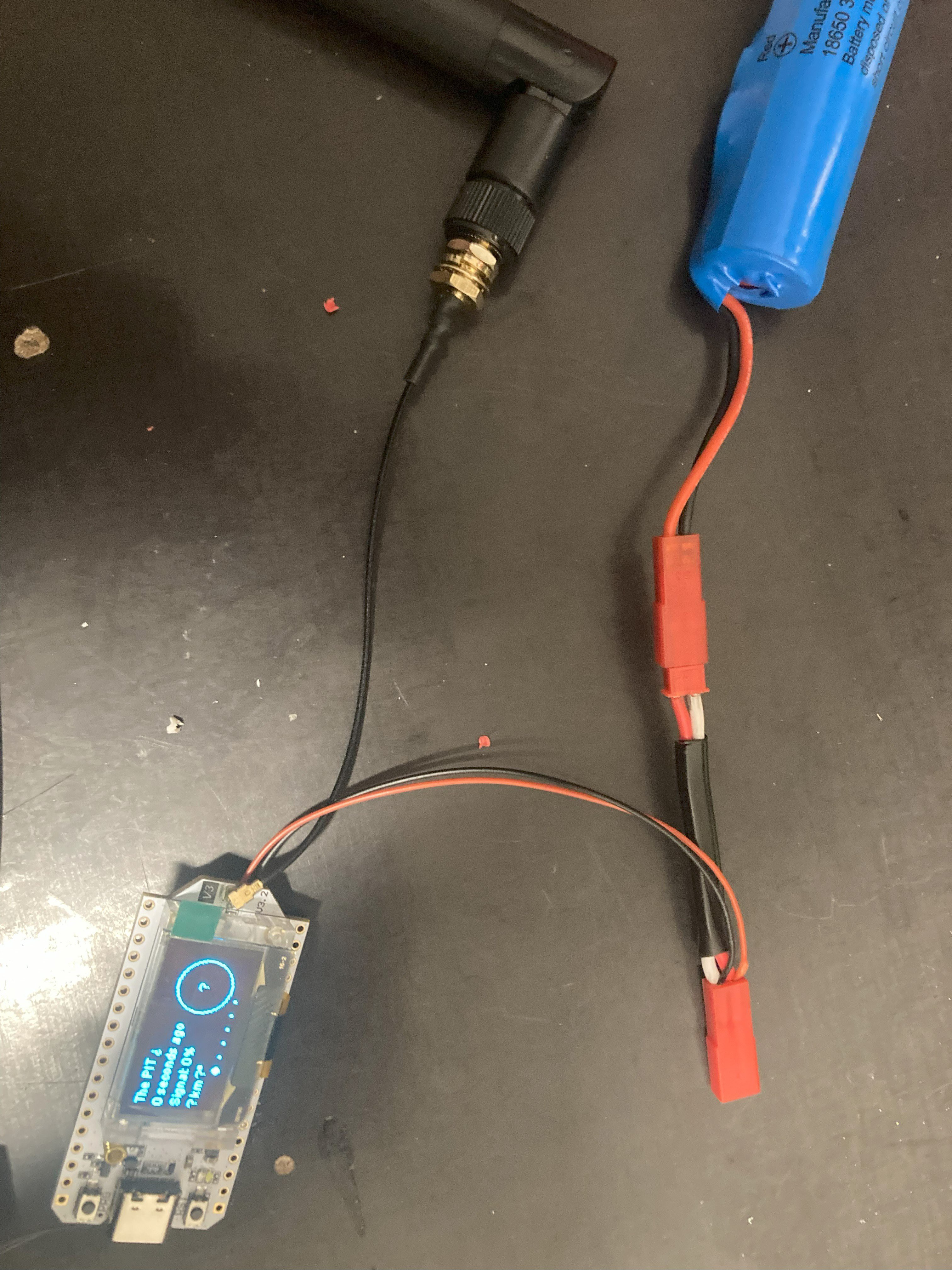
I was able to build up a working Y-cable from the JST connectors and a short piece of two-core wire, I recommend a slightly smaller gauge than what I used as it was a squeeze to fit the bridging wire AND the Heltec V3 battery connector wire into the same crimp!
BOM for the y-cable:
- Short length of two-core wire 28awg recommended?
- A JST connector pair - male+female and pins/sockets to match
- Heltec battery connector and wire assembly
Tools needed
- Wire stripper (may be ok with careful knife work
- Crimping tool
- Exacto/Stanley knife for cutting back the insulation
It was fairly easy to do with a crimping tool and a wire stripper. Care had to be given to ensure that pins had the correct orientation and that the polarities were also correct. As you can see my Heltec V3 powered up first go, indicating that I had adequate electrical connection and correct polarity, that said I'm yet to test out the charging circuit from the solar panel, I'll hopefully be able to try that tomorrow as I've also designed a quick first version of the battery cover replacement!
Housing design
The first version of the battery cover housing has been designed roughly and hopefully I can fit everything in and get a good seal onto the solar light case.
Did a test fit yesterday of the first version of the battery cover and was generally happy with the result although it made a mistake on the notch depth which was easily rectified in the model.