nobcha
-
Replace the cpu of the LC meter
06/03/2026 at 16:12 • 0 comments -
Video walkthrough: LC meter V7 — the first DPDT switch version
03/19/2026 at 12:23 • 0 commentsBefore V8, there was V7 — the first version to replace the relay with a DPDT switch. Here is a complete walkthrough video.
VIDEO
What the video covers:Overview and key specifications
Parts list before assembly
KiCad PCB design walkthrough
3-step calibration procedure
Measurement examples (inductance and capacitance)
Diagnostic screen (DIAG mode)V7 established the core concept of manual calibration with a DPDT switch. V8 then refined the sketch — reducing flash usage from 95% down to 80% and restructuring the code for readability.
If you are considering building your own, V8 is the recommended starting point:
👉 https://github.com/Nobcha/ARD_LCM_MANUAL -
"How does my DIY LC meter compare to a nanoVNA? — A practical inductance measurement shootout"
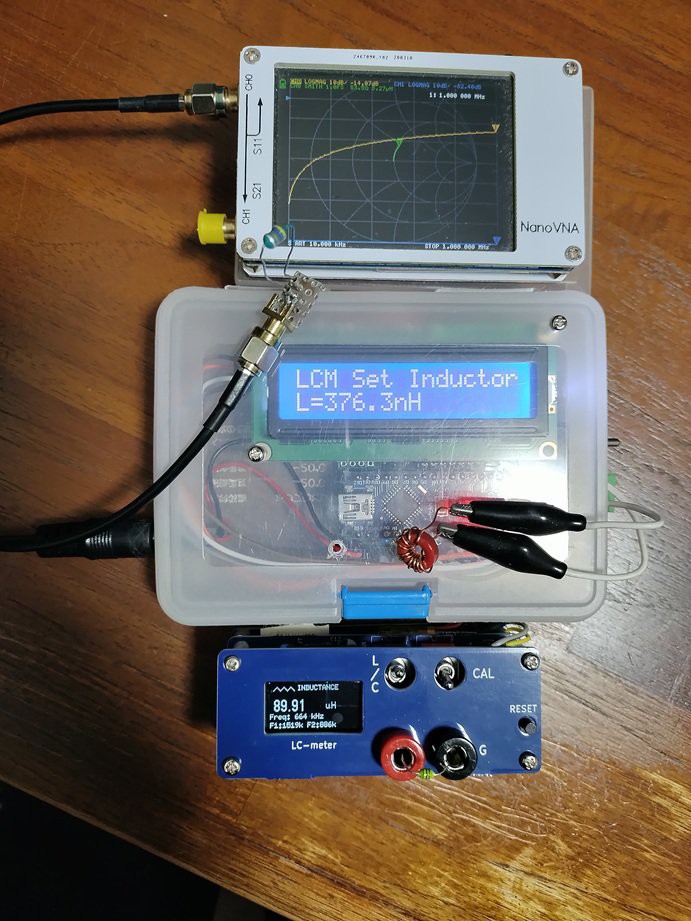
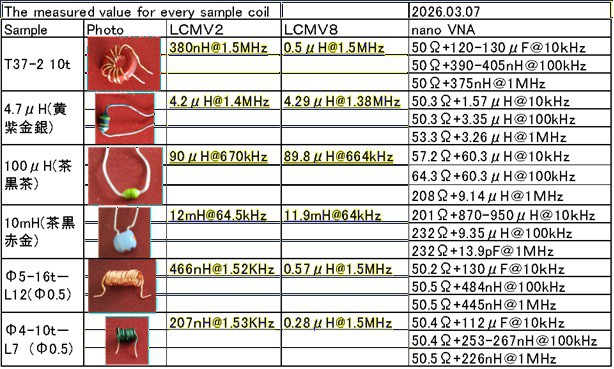
03/10/2026 at 14:10 • 0 commentsI originally assumed the nanoVNA would be the clear winner for inductance measurement. It's a vector network analyzer after all. So I ran a direct comparison using the same set of sample inductors across three methods: LC meter V2.4, LC meter V8, and nanoVNA with a 50Ω adapter (S11 measurement).
The setup
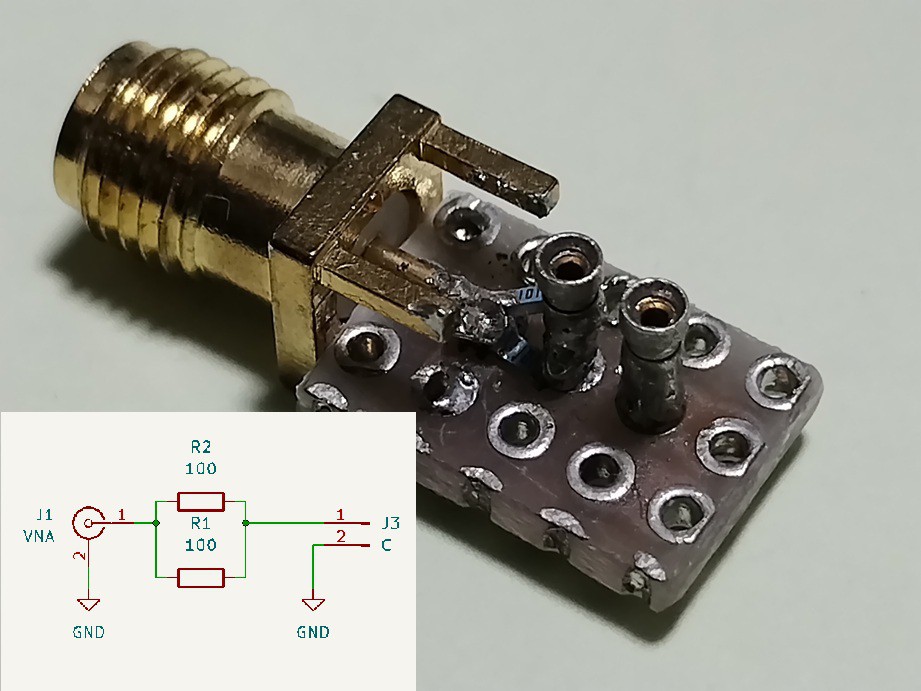
For nanoVNA measurements, I used a simple 50Ω adapter — a 100Ω chip resistor in parallel, placed in series with the inductor under test at the terminal. This shifts the Smith chart operating point toward the center for typical inductance values, improving readability.
The three instruments compared:LC meter V2.4 — Franklin oscillator (74HCU04) + Arduino Nano, relay-switched Cref
LC meter V8 — Franklin oscillator (74HCU04) + ATmega328P, DPDT-switch Cref, LIPO powered
nanoVNA — standalone S11 reading (no PC connection)![]()
![]()
Results summary
![]()
Several things stood out immediately:
The 10mH inductor could not be measured by the nanoVNA with this adapter configuration. The LC meters handled it without issue.
The 100μH inductor showed anomalous readings on the nanoVNA, likely due to self-resonance effects pushing the measurement point far from 50Ω — the adapter is simply not optimized for that impedance range.
Both LC meter versions agreed well with each other across most of the range.A key insight: readability vs. generality
The nanoVNA's Smith chart representation is powerful for distributed-circuit thinking — useful for antenna and transmission line work. But when designing at HF or VHF where coils are treated as lumped elements, a direct inductance reading in µH or nH is simply more actionable. You don't want to interpret a Smith chart position every time you're winding a toroidal coil for an ATU-100 or a band-pass filter.
In this sense, the LC meter wins on readability for everyday coil-winding and verification work.An honest limitation
Stray inductance in the measurement terminal wiring is not cancelled by the calibration procedure. This means accuracy degrades for very small inductances — the kind you'd encounter with a few turns of heavy wire on a small former. PCB layout optimization at the measurement terminals would help here.What this suggests for future development
There is one area where the current Franklin oscillator LC meter falls short: the oscillation frequency is fixed in the 1–2 MHz range by the tank circuit. Real-world air-core coils used at VHF (50MHz+) have frequency-dependent inductance — so a measurement at 1.5 MHz may not reflect the actual inductance at operating frequency.
A worthwhile improvement would be to offer a high-frequency tank circuit option — a separate terminal or switch position optimized for air-core coil measurement at higher oscillation frequencies (e.g., 10–30 MHz). This would make the instrument more relevant for VHF coil work. Something to explore in V9, perhaps.Full details
GitHub (V2.4): https://github.com/Nobcha/ArduinoLCM
http://chitose6thplant.web.fc2.com/LCM/Arduino_LCM_EXP.htm
GitHub (V7/V8): https://github.com/Nobcha/ARD_LCM_MANUAL
https://chitose6thplant.fc2.page/lc-meter-v7-dpdt-calibration-3-steps-layers-pcb-model/
Blog (Japanese, with measurement table): https://nobcha23.hatenablog.com/entry/2026/03/09/220241 -
Why I replaced the relay with a DPDT switch — and why manual calibration is a feature
03/09/2026 at 15:15 • 0 commentsIn earlier versions of this LC meter (up to V6), calibration was handled automatically by a relay. The relay would insert the reference capacitor into the tank circuit at the start of each measurement session. Simple, automatic — but not without problems.
Problems with the relay approach
Cost: small signal relays suitable for ~1.5 MHz switching are not cheap
Availability: sourcing a consistent relay across builds was annoying
The V7 solution: a 6P DPDT switch
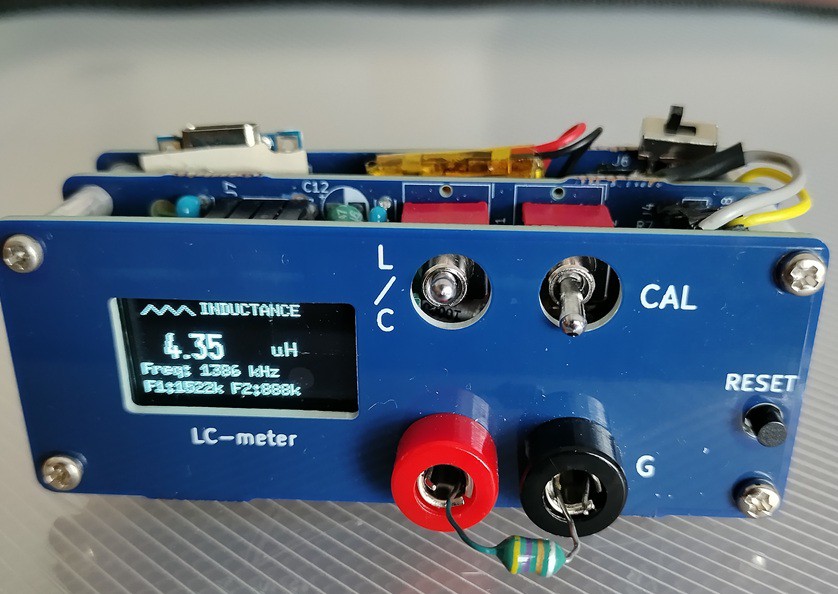
I replaced the relay with a readily available 6-pin double-pole double-throw (DPDT) switch. The switch physically inserts or removes the reference capacitor from the LC tank — the same function, but done by hand.
This makes calibration a conscious 3-step manual operation:
Set switch to CAL position
Press the calibration button — the sketch measures f1 and f2, solves for L and C of the tank
Set switch to MEASURE position — ready to use
"Manual calibration is a feature, not a bug"
Once you understand that calibration only needs to be done once per power-on (or when ambient temperature changes significantly), the manual switch becomes perfectly acceptable. In fact, it makes the measurement process more transparent — you always know exactly what state the circuit is in.
The sketch for V7 is available on GitHub, along with the KiCad PCB files and assembly manual (English and Japanese):
👉 https://github.com/Nobcha/ARD_LCM_MANUAL
A detailed build log is also on my blog:
👉 https://chitose6thplant.fc2.page/lc-meter-v7-dpdt-calibration-3-steps-layers-pcb-model/
One note on the PCB
The first version of the V7 PCB had three errors (OLED header pinout, R6/R7 silkscreen, ICSP header). These are documented in the repository as a "Mistake prevention list." A corrected schematic is also included.
Next up: V8, where the sketch was restructured to reduce flash usage from 95% down to 80%, making room for future improvements.
![]()
kpa radio ©nobcha
-
I added the OLED version
02/13/2026 at 09:30 • 0 commentsThe LCD is connected via I2C, so I replaced it with an OLED 128x64 and rewrote the sketch. I uploaded it to GITHUB as V6.4.
-
PCB pattern design
02/03/2026 at 16:04 • 0 commentsI used KiCAD and uploaded the Gerber files on GITHUB.
-
What SPICE shows about a Franklin oscillator
01/28/2026 at 11:54 • 0 commentsI used LTSpice analysis to verify that the Franklin oscillator circuit works with an LC tank circuit and an inverting amplifier using a 74HCU04.
-
I added the short history and the principle.
01/25/2026 at 09:21 • 0 commentsI found the history for this meter. I'm interested in the principle how to measure the values.
-
To derive the tank parameters (C1 and L1)
01/23/2026 at 14:11 • 0 commentsAt first, the tank parameters (C1 and L1) are derived by adding a known standard capacitor to the tank. Please refer the equation note.
-
nobcha
01/18/2026 at 13:42 • 0 commentsWhy a Franklin Oscillator, Not a Precision LC Meter.
Turning Impedance into Frequency: An LC Experiment
Arduino + Franklin oscillator