Close
0%
0%

Grapple Probe

An isolated firmware debugging probe

Similar projects worth following
331 views
A microcontroller debugger that's inexpensive, open source, simple to use, and not tied to any specific chip manufacturer.

Now on Crowd Supply: https://www.crowdsupply.com/grapple-control-systems/grappleprobe

- ARM CMSIS-DAP USB interface supported by most IDEs and debugging software.
- Standard 20 pin 2.54 mm pitch debug header supporting SWD/SWO and JTAG debugging interfaces.
- 8 pin 2.54 mm pitch COM header supporting uart and i2c.
- Regulated IO voltage between 1.8 and 3.3 V.
- Target voltage acts as an input to control the IO voltage.
- 400 V rms galvanic isolation between the usb port and debug/com ports.
- 2W of isolated power available to the target device.

Coming soon on Crowd Supply

Isolation

The Grapple Probe has isolation between USB and the DEBUG and COM ports in the capacity that the USB ground and DEBUG/COM port ground can be voltage biased up to 400V RMS continuously without damaging anything on the Grapple Probe.  Isolation is implemented on the USB side with an ADUM3160 to isolate the USB signals and a transformer with a transformer driver to isolate power.  These devices can handle up to 2500 V bias, but only for a limited amount of time, 1 minute.

Isolation is kind of a niche requirement, but it is important for this project because I was inspired to make this after damaging some components in another project I was working on due to a ground loop.  The project included controlling a 24V stepper motor while powering the controller from the same 24V voltage rail.  It had reverse polarity protection so I had my guard down about getting the polarity right when plugging in the power supply, but I had a debug probe connected and when the polarity was reversed the ground through the debug probe was connected directly to the 24V rail.  I ended up breaking a bunch of things, including the debug probe, and started thinking about what a debug probe that didn't propagate that mistake would look like.
  • 1 × RP2040
  • 1 × ADUM3160

  • Fixing a Bug

    Jonathan Herbst • 09/11/2026 at 02:18 • 0 comments

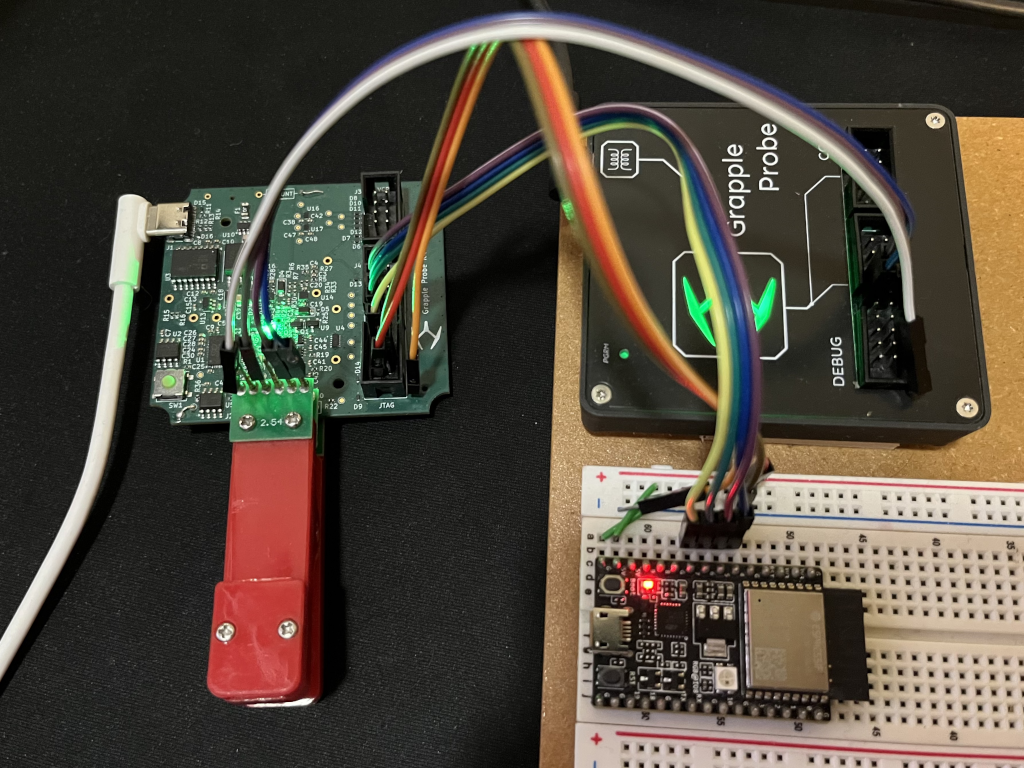
    I was attempting, for the first time, to program an esp32c3 with the Grapple Probe when I discovered a problem.  The Grapple Probe was resetting when I would try to connect to the esp with openocd.  This was absolutely a problem with the Grapple Probe, but a surprise to me since I've done JTAG debugging with STM32s and didn't have a reset.  So I pulled out a second Grapple Probe to debug the issue.

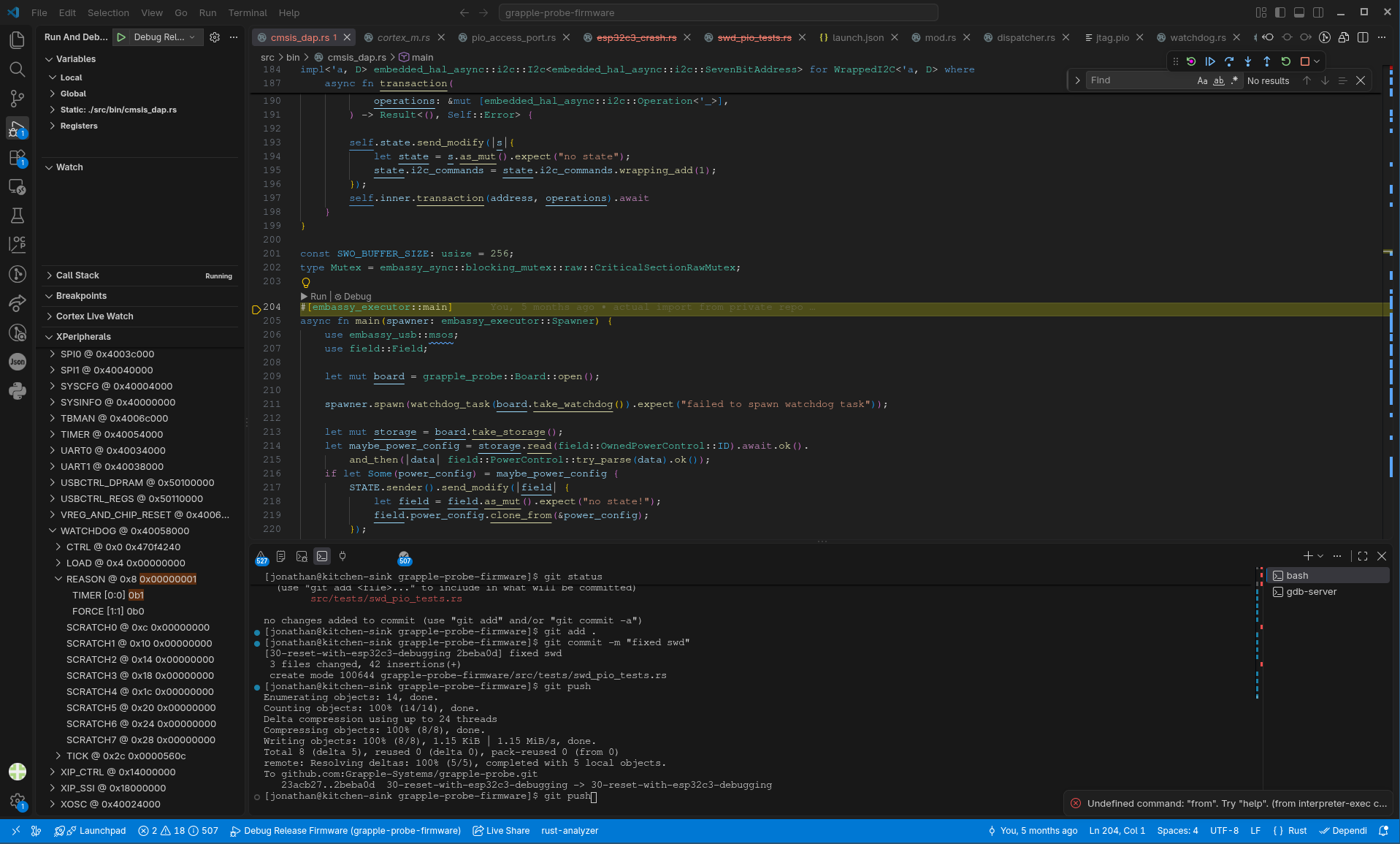
    I got it on the debugger with a debug version of the firmware loaded in gdb and... the bug doesn't happen.  I switched back to a release build and it does happen, great.  I'm not going to lie, my mind did go to a compiler bug, but that's so unlikely it's not even worth considering usually, so back to reality it must be a hard fault or an infinite loop condition.  Back to the debugger I rule out a hard fault by setting a break point in the hard fault handler and it doesn't trigger, and after a reset I can look in the REASON register of the watchdog peripheral and if it's set to something other than 0 the watchdog peripheral triggered the reset.  Sure enough it was the watchdog timer that was causing the reset so I disabled the watchdog, ran the test again, and found that the code was infinite looping where it interfaces with the PIOs on the RP2040 to control the JTAG protocol.

    If you're not aware of PIOs they are peripherals on an RP2040 which allow you to program just about any digital peripheral you want.  We use them on the Grapple Probe to create fast JTAG and SWD interfaces.  When you change the speed of JTAG or SWD on the Grapple Probe it changes the clock divider for the PIO so it can run faster or slower, but the clock for the processor keeps running at the same speed.  The bug happens with ESP32 and not STM32 JTAG, and only in release mode, openocd runs JTAG at 100 kHz for ESP32, which is pretty slow, so with the PIO running slow, 100 kHz, and the processor running fast, release mode, the synchronization bug presents itself.

    In my career I've found often the best way to deal with challenging bugs is to try to isolate them, so build a system to replicate the bug with the least moving parts possible.  When you have a full stack of software you're mind can wander to different parts of the system: interrupts, other tasks/threads, stack corruption, etc.  So I ran the firmware with probe-rs to get logs so I could find the CMSIS-DAP command that was causing the problem and created a firmware that would just run that command.  Problem replicated without anything else going on.

    This issue came down to some bad logic in my code that interfaces with the PIOs.  I was using clear_fifos before running a command, the problem here is if the PIO is slow enough the tx fifo would back up and the code on the processor wouldn't wait for the PIO to finish so it would clear the fifos when it started running the next command, but the PIO would interpret the command as data instead of a command since it's still in the previous command subroutine, then interpret data as a command and send the PIO to the wrong instruction.  Solving that problem revealed another problem where the PIO was sending an extra fifo push if the number of bits was an even multiple of 32, which was also happening on SWD, but I didn't catch it before because SWD reads are usually at least 33 bits because of the parity and turnaround.  Details in the pull request, happy to have this one under my belt and I hope this helps someone.

  • Crowd Supply

    Jonathan Herbst • 08/29/2026 at 15:35 • 0 comments

    We would like to actually build the Grapple Probe and have decided to go down the crowd funding route to build the first batch.  We've chosen Crowd Supply to help us crowd fund and yesterday the Grapple Probe went live.  The first stage the project is a "Coming Soon" state and we need to get enough subscribers to be able to get to the fund raising stage.  If you'd like to be able to buy a Grapple Probe you can help us get there by subscribing to our Crowd Supply project.

    https://www.crowdsupply.com/grapple-control-systems/grappleprobe

  • UPDI Support

    Jonathan Herbst • 08/23/2026 at 21:02 • 0 comments

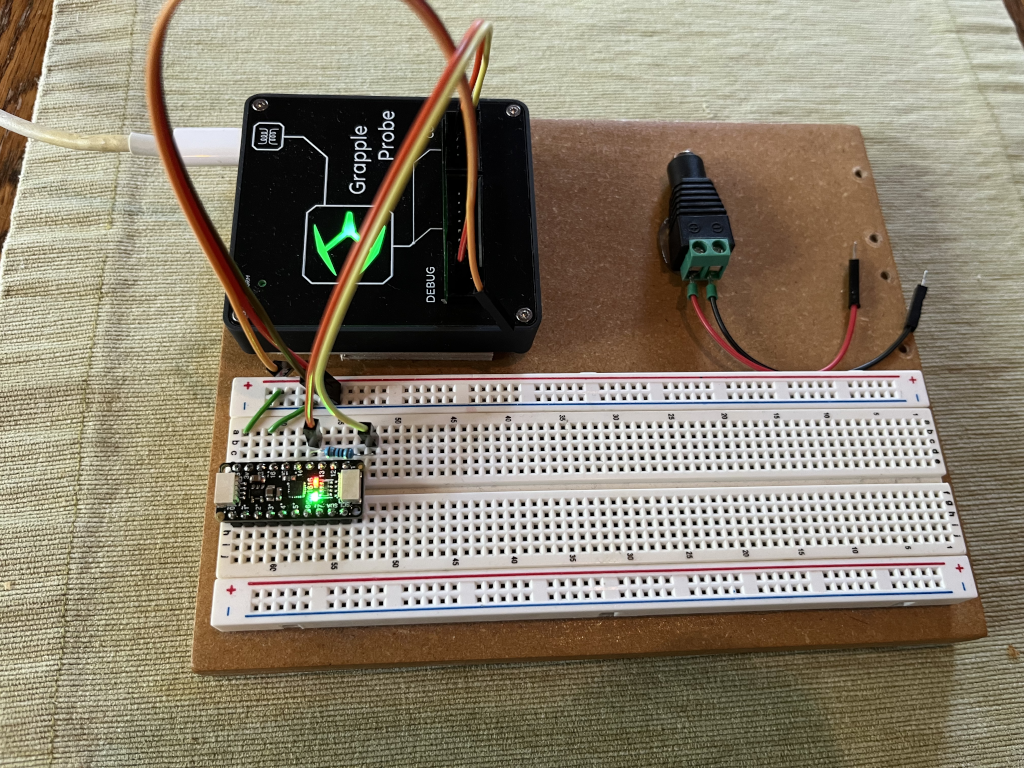
    Lately I've been working on UPDI support.  UPDI is a programming/debugging protocol for Microchip 8 bit microcontrollers.  It's relatively new, but it works over a half duplex uart, which means that transmit an receive happen over the same pin.  You can create a half duplex uart from a full duplex uart by connecting the TX and RX signals together with a resistor, 1 KOhm in the case of UPDI.

    The Grapple Probe has a full duplex uart on the COM connector.  I've been working with the uart to get it to program an ATTiny1616 using avrdude.  The major problem is that we don't support configuring anything other than the baud rate for the uart and keep the rest of the line coding as 8 databits, no parity, and 1 stop bit, but UPDI requires even parity and 2 stop bits.  We use rust embassy for the Grapple Probe, but the RP2040 uart driver only supports changing the baudrate once it has been instantiated.  I made a modification to the embassy-rp project so you can change all the line coding after the uart driver is instantiated, https://github.com/embassy-rs/embassy/pull/6792.  This will be coming to the firmware soon.

    I am admittedly not a big 8 bit mcu user since most of my career has been using 32 bit ARM mcus, but I would love to have good support for 8 bit mcus with the Grapple Probe.  If you are reading this and do a lot of work with Micorchip 8 bit mcus I would love to hear about what good support looks like for you, do you use avrdude? do you use MPLab? do you use the Arduino IDE? something else?  Do the mcus you use support UPDI?

  • Preorders are Open and OpenSauce was Great

    Jonathan Herbst • 07/28/2026 at 21:34 • 0 comments

    The Grapple Probe is available for preorder on our website!  You can order yours here https://grapple.systems/grapple-probe.

    We would like to make the Grapple Probe a real product so when we raise enough money through preorders we will make it to production.

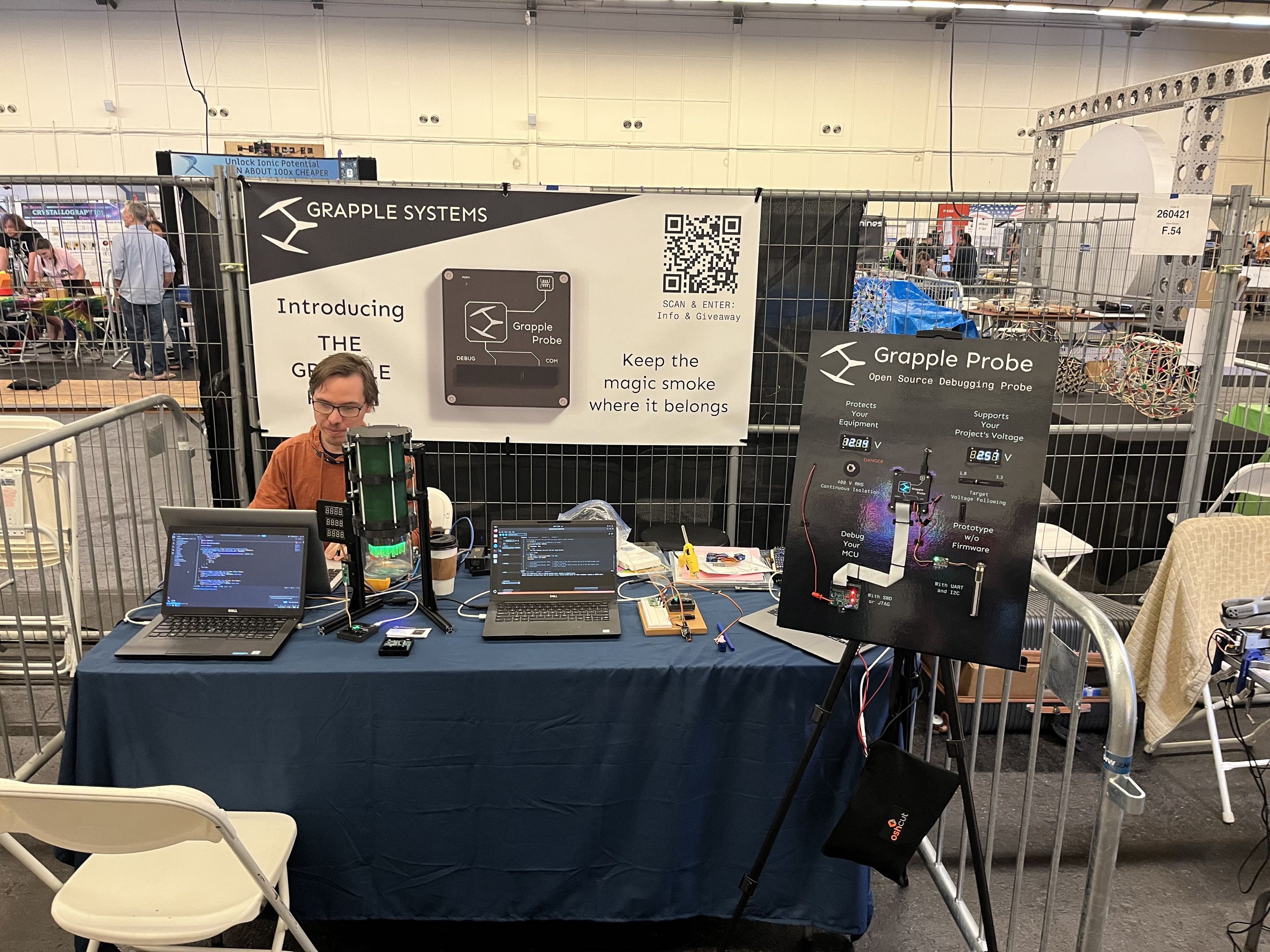
    We had a great time at OpenSauce 2026!! Got so see so many cool projects.  Our booth looked like this, and by the end my voice was almost destroyed, so sorry if you got me at the end when my voice was cracking.

    We unfortunately couldn't get the game, the cylinder with the glowing rods sticking down, working in time so it just served as an eye catcher to attract people.  It worked and it was really cool anyway.  The computer in the middle was showing a live firmware debugging demo with a Raspberry Pi Pico, a potentiometer, and hobby servo.  I brought a bunch other sensors and switches in case someone wanted to try one out and build something, but it didn't seem like the crowd was interested in sitting down and doing that, so it just stayed as the pot/servo demo the whole time.

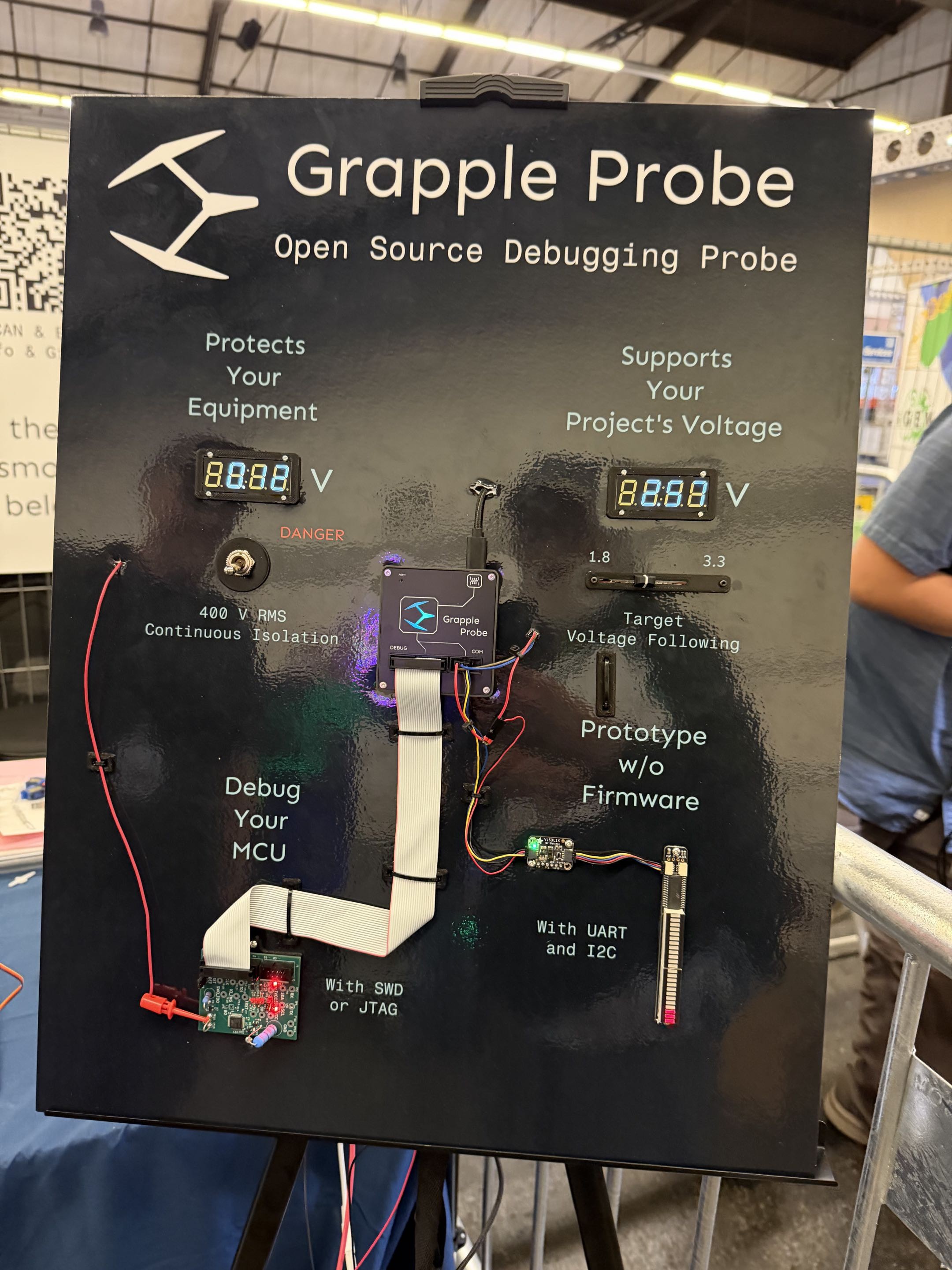
    The poster did a lot of work.  It had a grapple probe in the center connected to a computer behind that was actively debugging a board we made for doing FCC precertification testing.  The switch on the top left, the DANGER switch, put an isolated 12 V across the ground for the target and the USB ground.  The slider on the top right fed a voltage between 1.8 and 3.3 V to the Grapple Probe to show off target voltage following and the Probe changing it's LED color as the target voltage changed.  On the bottom right there was a little I2C demo with a laser time of flight sensor and a vertical display.  The computer behind the poster read the distance from the sensor and commanded to display to light up more LEDs the closer your hand was to the sensor.

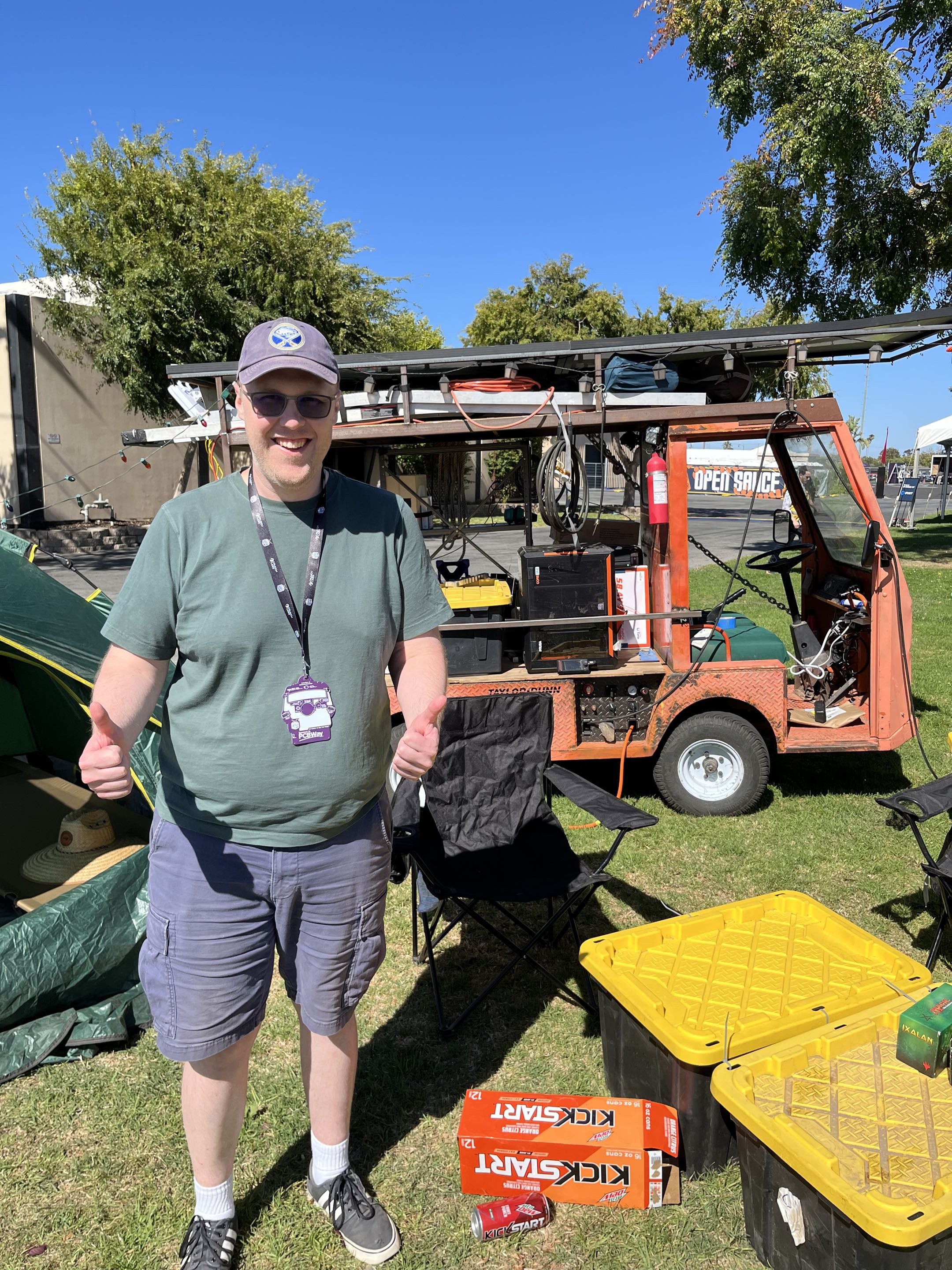
    I got to see the Taylor-Dunn from William Osman's "farm"!

  • Open Source

    Jonathan Herbst • 07/15/2026 at 16:50 • 0 comments

    We've just released our software and firmware publicly.  You can find it at https://github.com/Grapple-Systems/grapple-probe.  The firmware portion is licensed under GPLv3, and the tools and libraries are licensed with MIT or Apache.  Looking forward to feedback, contributions, forks, etc.!!

    I'm a big fan of using Rust for embedded development, and the firmware is written completely in Rust using the embassy framework.  I believe that Rust was inadvertently made for embedded software because of the memory safety features and how much control you have over memory. At the same time using Embassy makes it really easy to get started on Raspberry Pi MCUs, STM32s, and other platforms, and scale to some pretty complicated projects like the Grapple Probe!

  • We're going to OPEN SAUCE!

    Jonathan Herbst • 07/13/2026 at 23:02 • 0 comments

    That's right, we're going to OPEN SAUCE!  We've been spending the past month working on our booth, we're going to have a display showing off a good part of the features, a game where you'll have to use a Grapple Probe to play, and an area where you'll be able to try out a Grapple Probe with some hardware and build a project of your own.  So if you're going to Open Sauce, come check out our Grapple Systems booth, meet the team, and try one out for yourself!

  • Alpha Products Ready for Testing

    Jonathan Herbst • 03/12/2026 at 21:05 • 0 comments

    We're to the point where we're ready to send some first version Grapple Probes out to some lucky recipients.  We now have some documentation on our website! https://grapple.systems/docs/grapple-probe. And I made some boxes to put them in with a QR code that links to the documentation.

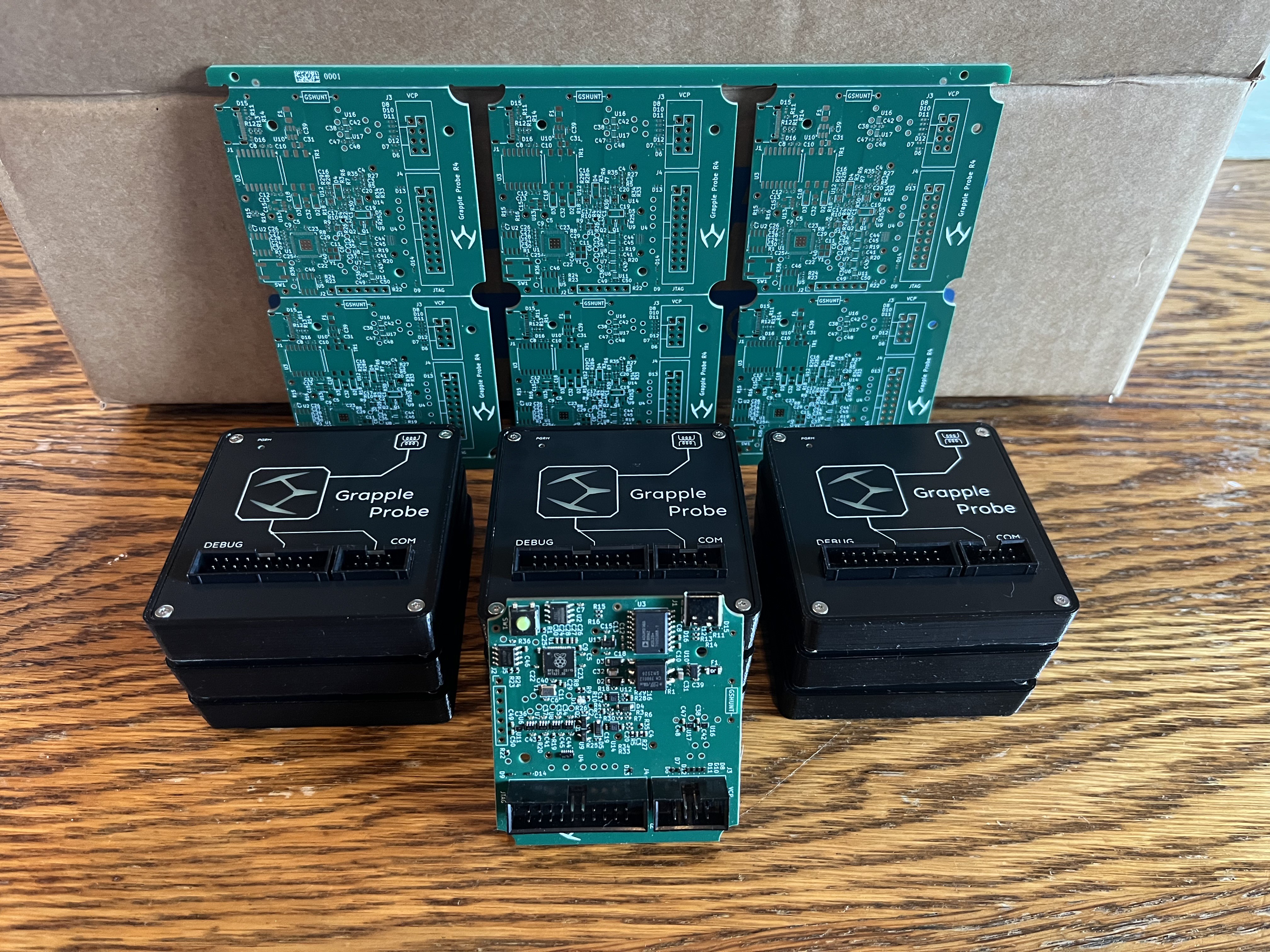
    9 Grapple Probes ready to give to a few alpha testers.

    I used a template I found online to print out some boxes for each of the Probes on card stock.


View all 7 project logs

Enjoy this project?

Share

Discussions

Similar Projects

Does this project spark your interest?

Become a member to follow this project and never miss any updates