
-
Power Supply Capacitors: How to Choose, Place, and Debug Them on a PCB
5 days ago • 0 commentsA power supply can look electrically correct on a schematic and still behave badly on the bench.
The regulator may have the right input voltage. The output may measure exactly 5 V or 3.3 V with a multimeter. Every component may match the BOM. Yet the board can reboot when a radio transmits, produce unexpected ripple, fail an EMC test, or become unstable only under a particular load.
Very often, power supply capacitors are part of the explanation.
They are not simply passive components added to “smooth the voltage.” Their capacitance, ESR, ESL, voltage rating, dielectric, package size, temperature behavior, and PCB placement all influence how a power supply responds to real electrical events.
That becomes especially important on modern PCBs, where switching regulators, high-speed processors, wireless modules, motor drivers, sensors, and power amplifiers can create fast and unpredictable current transients.
This article takes a practical PCB-level look at power supply capacitors: what they actually do, why one capacitor is rarely enough, how capacitor characteristics change in real circuits, and what to check when a supposedly well-designed power rail does not behave as expected.

What Are Power Supply Capacitors Actually Doing?
The basic job of a capacitor in a power supply is to store electrical energy and release it when required.
But that simple description hides several different functions.
A typical power rail may use capacitors for:
- Input voltage stabilization
- Output voltage filtering
- Ripple reduction
- Transient response
- High-frequency noise suppression
- Energy storage
- Decoupling between loads and the power source
- Control-loop stability
These functions overlap, but they are not identical.
For example, a large electrolytic capacitor might be excellent at storing energy for relatively slow load changes. It is not necessarily the best component for suppressing a very fast transient at an IC power pin.
Conversely, a small ceramic capacitor can respond extremely quickly, but its effective capacitance may be substantially lower than the number printed on the datasheet.
That is why practical power distribution networks often use multiple capacitor technologies and values rather than searching for one “perfect” capacitor.
Bulk Capacitance vs. High-Frequency Decoupling
One useful way to understand power supply capacitors is to divide their jobs by frequency.
Bulk capacitors
Large electrolytic, polymer, or tantalum capacitors provide relatively high energy storage.
They can help handle:
- Large load changes
- Low-frequency ripple
- Cable-induced voltage fluctuations
- Converter input current pulsation
- Power rail energy requirements
For example, a motor controller may experience substantial current variation when a motor accelerates. A nearby bulk capacitor can provide part of that transient current without forcing the upstream supply and PCB traces to respond instantaneously.
Ceramic capacitors
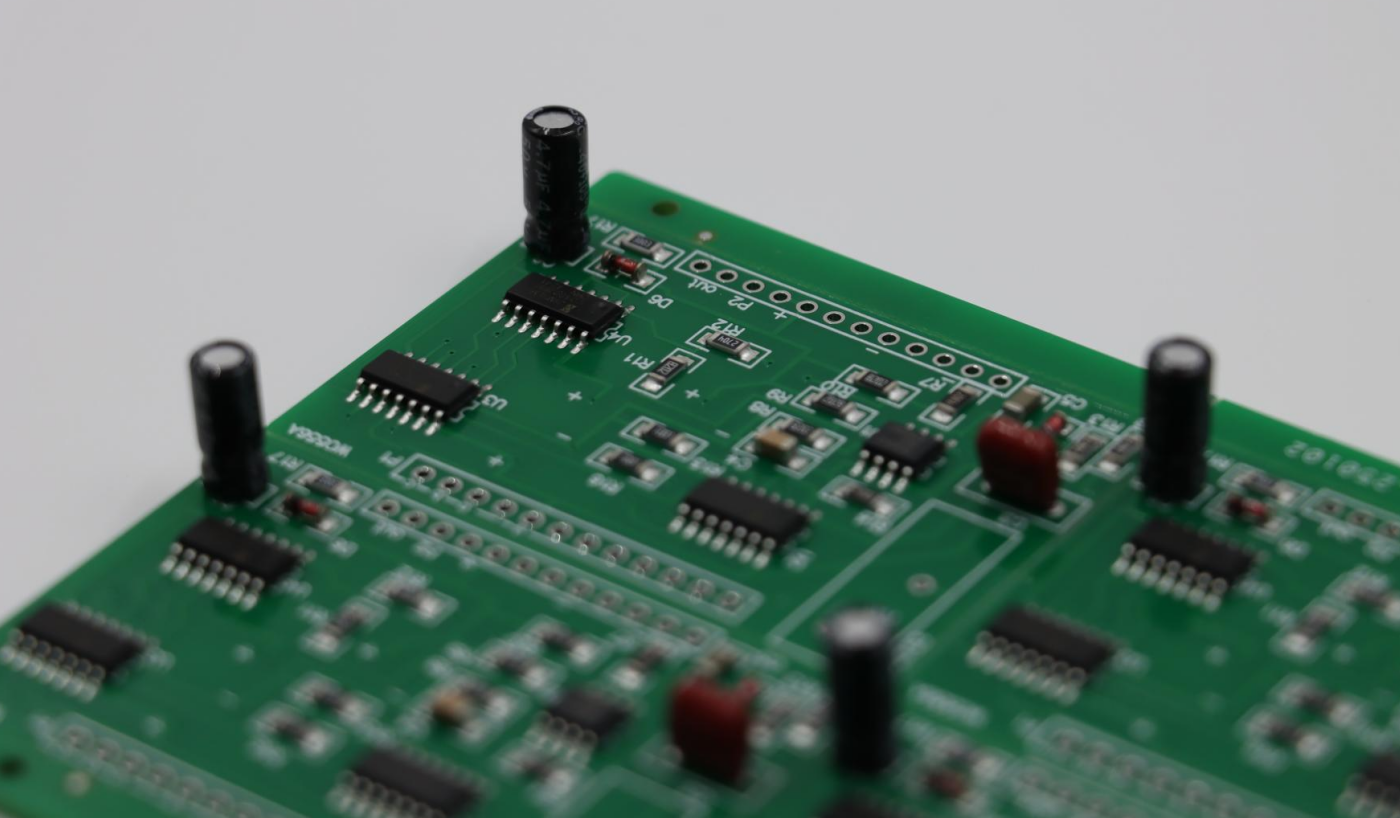
MLCCs are commonly used closer to switching regulators and ICs because their low ESR and low ESL allow them to respond effectively to high-frequency current changes.
A 100 nF ceramic capacitor placed directly beside an IC power pin is doing a very different job from a 470 µF bulk capacitor located elsewhere on the board.
The two should not necessarily be viewed as competing components.
They form different parts of the power distribution network.
Why multiple values are common
A practical rail might contain:
- A bulk capacitor near the power-entry point
- Additional bulk capacitance near a regulator
- Several µF of ceramic capacitance around the regulator
- Smaller ceramic capacitors close to individual ICs
- Very small capacitors for particularly fast switching currents
However, adding capacitors indiscriminately is not automatically an improvement. The interaction between capacitance,...
Read more » -
Ceramic Capacitor: How This Tiny Component Shapes Modern PCB Performance
08/21/2026 at 09:13 • 0 commentsA ceramic capacitor may be one of the smallest components on a printed circuit board, but its influence on circuit behavior is anything but small. From suppressing high-frequency noise to stabilizing power rails, ceramic capacitors are fundamental to modern electronics.
They appear everywhere: smartphones, automotive electronics, industrial controllers, networking equipment, power supplies, IoT devices, and high-speed computing hardware. Yet choosing a ceramic capacitor is not simply a matter of finding a capacitance value that matches the schematic. Package size, dielectric material, voltage rating, DC bias, temperature, ESR, ESL, mounting location, and PCB layout can all affect how the capacitor performs in an actual circuit.
For engineers working with increasingly compact and electrically demanding designs, understanding ceramic capacitors means understanding the interaction between the component, the circuit, and the PCB itself.
 for electronic circuit applications")
What Is a Ceramic Capacitor?
A ceramic capacitor is a passive electronic component that stores electrical energy using a ceramic dielectric between conductive electrodes.
Unlike electrolytic capacitors, ceramic capacitors generally do not use a liquid electrolyte. Their solid ceramic dielectric allows manufacturers to produce extremely small components with relatively low parasitic resistance and inductance.
The basic structure consists of:
- Ceramic dielectric layers
- Internal metal electrodes
- External terminations
- Protective body material
In modern electronics, the most common form is the multilayer ceramic capacitor (MLCC). Multiple ceramic dielectric layers and electrodes are stacked together inside a compact package. Increasing the number of active layers allows manufacturers to achieve higher capacitance without dramatically increasing the physical size.
That structure explains why an MLCC can deliver substantial electrical performance while occupying only a few square millimeters of PCB area.
Why Ceramic Capacitors Are So Widely Used
The popularity of ceramic capacitors comes from a combination of electrical and manufacturing advantages.
Low ESR and ESL
Ceramic capacitors generally have low equivalent series resistance (ESR) and low equivalent series inductance (ESL). As a result, they can respond quickly to transient changes in current.
This characteristic makes them particularly useful for:
- Power supply decoupling
- IC bypassing
- High-frequency noise suppression
- Switching regulator circuits
- Digital logic power rails
For example, when a processor suddenly changes its current demand, the power distribution network can experience a transient voltage disturbance. A properly placed ceramic capacitor can provide a short local current path, reducing the magnitude of that disturbance.
Compact Form Factor
MLCCs are available in extremely small packages, including common surface-mount sizes such as 0201, 0402, 0603, and 0805.
Therefore, designers can place multiple capacitors around an IC without consuming significant board space.
This is especially important for smartphones, wearables, automotive modules, compact industrial electronics, and other applications where PCB real estate is limited.
High-Frequency Performance
Ceramic capacitors are particularly useful at higher frequencies because their parasitic characteristics can be relatively low compared with many other capacitor technologies.
However, this does not mean every ceramic capacitor behaves identically across all frequencies. The capacitor's self-resonant frequency, package geometry, dielectric, mounting configuration, and PCB layout all influence its actual impedance.
That distinction becomes increasingly important as operating frequencies rise.
Ceramic Capacitor Dielectrics: Why the Material Matters
One of the most important decisions when selecting a ceramic capacitor is the dielectric type.
Two broad categories are especially important in practical PCB design: ...
Read more » -
10k Resistors: The “Default” Value That Keeps Showing Up in Real-World Electronics
08/14/2026 at 10:06 • 0 commentsIf you have spent any time designing or repairing electronic circuits, you have probably encountered a 10k resistor.
It appears in schematics almost casually: a 10 kΩ pull-up here, a voltage divider there, perhaps another one connected to a capacitor, transistor, sensor, or microcontroller pin. Because 10k is so common, it is easy to treat it as a generic resistor value rather than a component with specific electrical consequences.
That is exactly where things get interesting.
A 10k resistor is not simply “a resistor with a convenient value.” Depending on where it is placed, it can determine whether a digital input has a stable logic state, whether an RC circuit responds quickly enough, how much current flows through a sensor interface, or how much power a voltage divider wastes.
This guide looks at 10k resistors from a practical circuit-design perspective: what the value actually means, why engineers use it so often, where it works well, and where choosing 10k can create problems.

What Does a 10k Resistor Actually Mean?
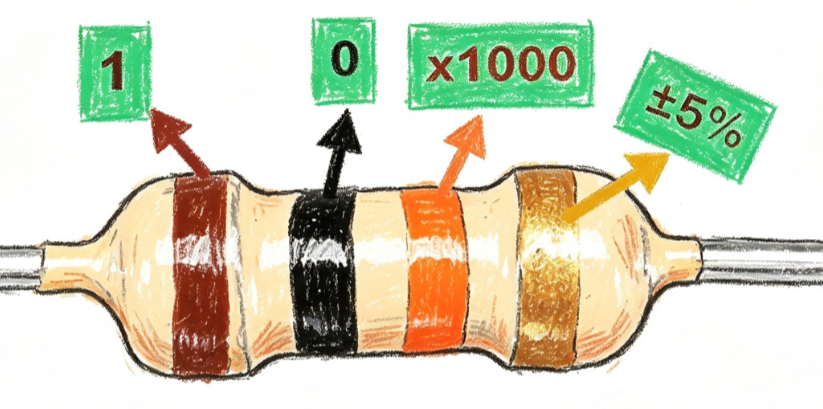
The notation 10k means 10 kilohms, or:
10kΩ = 10,000Ω
Resistance describes how strongly a component opposes electrical current. According to Ohm's law:
V = I × R
Therefore:
I = V / R
For example, if 5 V is applied across a 10kΩ resistor:
I = 5 V / 10,000 Ω = 0.5 mA
At 3.3 V:
I = 3.3 V / 10,000 Ω = 0.33 mA
Those currents are relatively small, which is one major reason 10kΩ is useful in low-power electronic circuits.
The resistor's power dissipation can also be calculated:
P = V² / R
With 5 V across a 10kΩ resistor:
P = 25 / 10,000 = 2.5 mW
So a typical 1/8 W or 1/4 W resistor has plenty of power-handling margin in this situation.
However, the voltage across the resistor matters. A 10k resistor connected directly across a much higher voltage can dissipate substantially more power.
Why Is 10kΩ Such a Common Resistor Value?
There is no special physical property that makes exactly 10kΩ the “correct” resistance for electronics.
Its popularity comes from a useful balance.
A resistor that is too low in value can consume unnecessary current. A resistor that is too high can become more susceptible to leakage currents, noise, interference, and input impedance effects.
10kΩ often sits comfortably between those extremes.
That makes it particularly useful for circuits where the resistor primarily establishes a voltage or logic state rather than carrying significant load current.
Common applications include:
- Digital input pull-ups
- Digital input pull-downs
- Voltage dividers
- Reset circuits
- Transistor bias networks
- Sensor interfaces
- RC timing networks
- Analog input conditioning
- Button circuits
- Configuration straps
Because the same value works in many different situations, 10k resistors have become something of a standard toolbox component.
10k Pull-Up Resistors: One of the Most Common Uses
One of the first places to encounter a 10k resistor is a pull-up resistor.
Suppose a microcontroller input can either be connected to ground by a switch or left disconnected.
Without a pull-up, the input can become floating when the switch is open. A floating CMOS input may interpret electrical noise as unpredictable logic transitions.
Adding a 10k resistor between the input and the positive supply solves the problem.
VCC
|
[10k]
|
+------ MCU input
|
Switch
|
GND
When the switch is open, the 10k resistor pulls the input toward VCC.
When the switch closes, the input is connected to ground.
The resistor therefore creates a predictable default state without continuously forcing a large current through the switch.
For a 5 V circuit, closing the switch produces approximately:
I = 5 V / 10kΩ = 0.5 mA
That is small enough for many ordinary digital interfaces.
... Read more »
 Eric Tsai
 U.S. Water Rockets
 Lutetium
 Luke Beno
 Rui Santos
 Michiel Spithoven
 adambrx
 Afrdt
Afrdt NASCO
NASCO pRoFiT
 Jaime García
 Colby Johnson
 Marius Taciuc
 Boian Mitov
 Cedric Honnet