photondreams
-
Some fun with stable diffusion
05/16/2025 at 03:59 • 0 commentsAI image generation is a great way to put a picture on a idea. Sometimes it's VERY bad, but oftentimes I find it inspiring. I had some fun trying to conjure up a project picture for this one and I thought it might be interesting to compare some prompts and the results I got.
First Iteration
"A vintage macintosh plus, in black, with a color image of a persimmon fruit on the screen".
![]() ROFL, absolutely terrible. Totally NOT what I had in mind. But this one actually had the color image of the fruit on the screen which I would not get again. Interesting...
ROFL, absolutely terrible. Totally NOT what I had in mind. But this one actually had the color image of the fruit on the screen which I would not get again. Interesting...Second Iteration
"A vintage macintosh plus computer with a black case, with a color image of a persimmon fruit on the screen".
![]() Kinda getting there? The shape of the machine is more like it, the detached keyboard is good. The "pale green when off" and very bulbous CRT looks 70s like though. I guess the fruit is ON the screen alright... Let's get another one with the same prompt and compare.
Kinda getting there? The shape of the machine is more like it, the detached keyboard is good. The "pale green when off" and very bulbous CRT looks 70s like though. I guess the fruit is ON the screen alright... Let's get another one with the same prompt and compare.Third Iteration
"A vintage macintosh plus computer with a black case, with a color image of a persimmon fruit on the screen".
![]() Whoa that one is a bit too close for comfort. I guess the Twiggy Mac Prototype just popped out of the training set! It's somehow totally IT and totally NOT IT at the same time. Lets try something else.
Whoa that one is a bit too close for comfort. I guess the Twiggy Mac Prototype just popped out of the training set! It's somehow totally IT and totally NOT IT at the same time. Lets try something else.Fourth Iteration
"A vintage japanese computer from 1986 with a black case, displaying a color image of a persimmon fruit on the screen".
![]() Kinda cool. Not what I had in mind but I get it. The mouse is HUGE. Let's try the same one again.
Kinda cool. Not what I had in mind but I get it. The mouse is HUGE. Let's try the same one again.Fifth Iteration
"A vintage japanese computer from 1986 with a black case, displaying a color image of a persimmon fruit on the screen".
![]() Cool again. The fruit dissolved into the case? There is something MSX-ish about the keyboard shape. I wonder what the weird peripheral is. Perhaps 1986 is too beige? I want black like the X68000 dammit. Well that came out in 1987 so...
Cool again. The fruit dissolved into the case? There is something MSX-ish about the keyboard shape. I wonder what the weird peripheral is. Perhaps 1986 is too beige? I want black like the X68000 dammit. Well that came out in 1987 so...Sixth Iteration
"A black japanese computer from 1987 displaying a color image of a persimmon fruit on a macintosh-like screen".
![]() That's it. By far my favorite. Maybe if we try again it will get even better?
That's it. By far my favorite. Maybe if we try again it will get even better?Seventh Iteration
"A black japanese computer from 1987 displaying a color image of a persimmon fruit on a macintosh-like screen"
![]() Holy mother of yikes! I can't even... I think that's enough... I'll keep the other one!
Holy mother of yikes! I can't even... I think that's enough... I'll keep the other one! -
Were the chips available? DMAC
05/13/2025 at 01:07 • 0 commentsFor this project I want to use the 12.5MHz 4-channel HD63450 DMA Controller.
MC68450/HD68450
![]()
The original MC68450L is a large, complex and expensive chip that is severely pin-constrained in the original DIP64 package. Significant external logic is required to demultiplex and control the bus, which had been avoided in the 68000 using the same package.
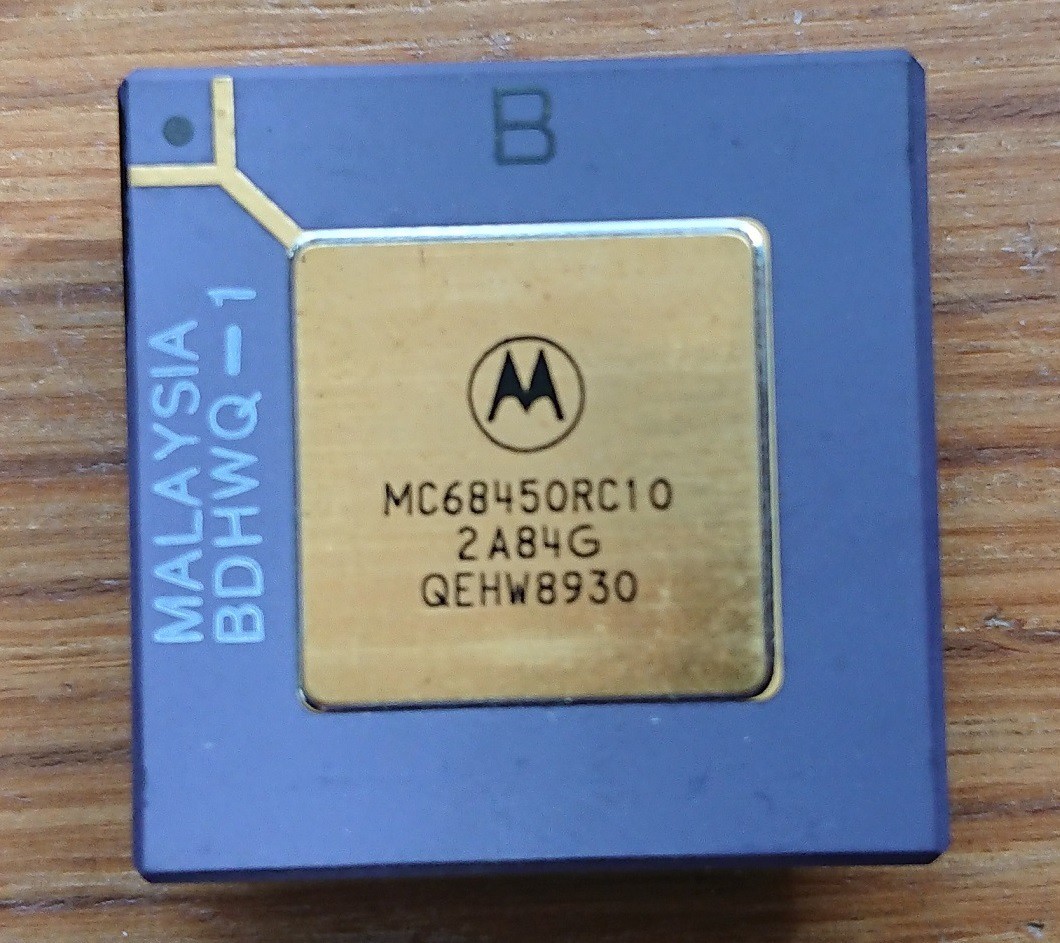
The 68450 is more space-efficient in the 68pin PGA package which uses up about 1/3 the board space (but still needs the support logic) :
![]()
12.5MHz versions of the NMOS 68450 may or may not have existed. They are listed as "under development" in the 1985 Hitachi Microcomputer Data Book, and are mentionned in Section 7 "Ordering Information" of the 1986 Motorola Datasheet, but no data is present in the timing section. 10MHz is probably as fast as the NMOS versions were made.
HD63450
I don't know for certain when the CMOS HD63450 was released. It is not present in the 1985 Data Book, but is listed with full details in the August, 1987 Data Book, including mention of the -12 speed grade and cheaper plastic DIP64, Shrink-Dip 64 and PLCC68 packages. No timing info for the -12 however in that datasheet.
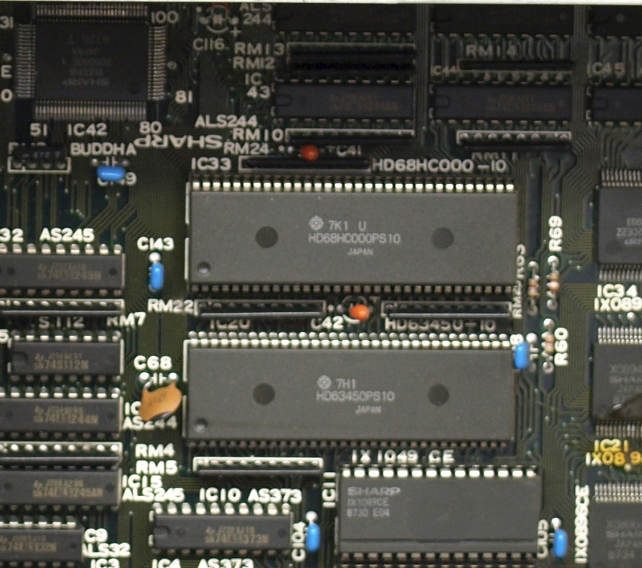
A 10MHz, shrink-DIP version was used in the Sharp X68000, first released March 28, 1987. That machine also used the CMOS HD68HC000 CPU in the same package and speed. The design of the X68000 made cooling difficult, it made a lot of sense to take advantage of the greatly reduced power dissipation of CMOS.
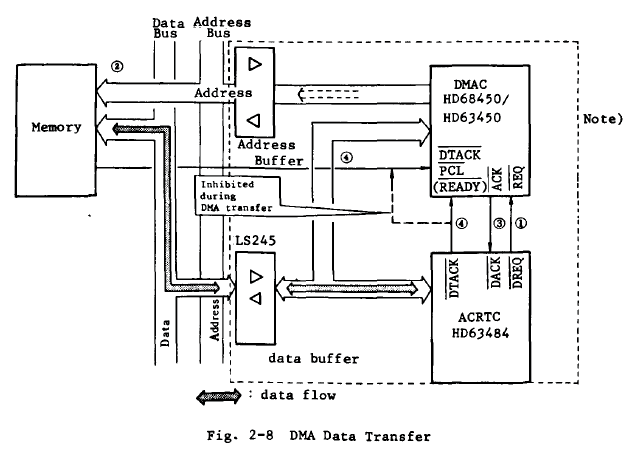
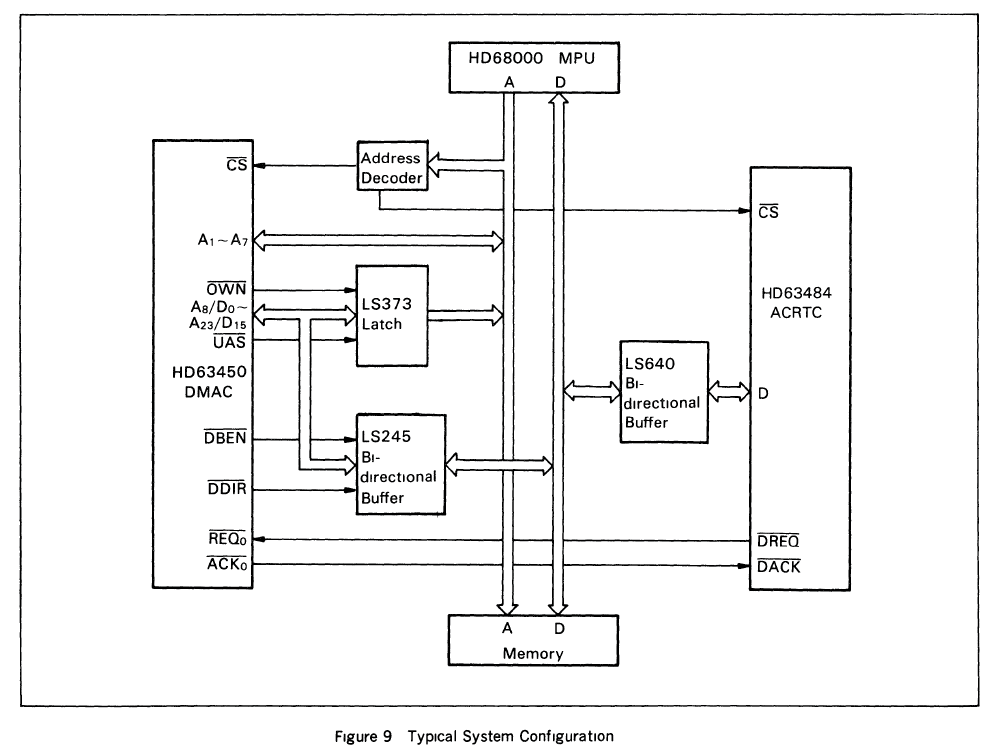
Hitachi did put some emphasis on the combined use of the HD63450 and the HD63484 graphics controller, as evidenced by this figure from the 1987 datasheet :
A similar figure is also shown in the HD63484 manual. I can't explain why they show LS640 INVERTING buffers between the '484 and the data bus, the data lines on the '484 are not inverted. A similar figure in the ACRTC Application Note 1986 shows '245 in that position.
Conclusion
Since I cannot demonstrate that the HD63450Y12 or CP12 was available by the end of 1986, I will add a jumper to the board to select between the CPU clock (12.5MHz) and the ADPCM chip clock (8MHz) for the DMAC. This way original NMOS chips and lower speed -8 and -10 can also be used. -
Were the chips available? CPU
05/08/2025 at 14:54 • 0 commentsFinding out which chips were available when is not always easy. Vintage pricing information is even harder to get.
Sometimes we get lucky and datasheets or manuals have dates, but not always. Fortunately betwen bitsavers and archive.org we have access to a treasure trove of period magazines that can help us.
In this episode, the main CPU, Hitachi HD68000-12 or Motorola MC68000L12.
The 12.5MHz Motorola chip was released in 1982, as the first update to the 68000 lineup since the 1979 introduction. The next (and final) speed bump to 16MHz only occured on April 5 1988, the same day the 33MHz 68020 was announced. (press release)
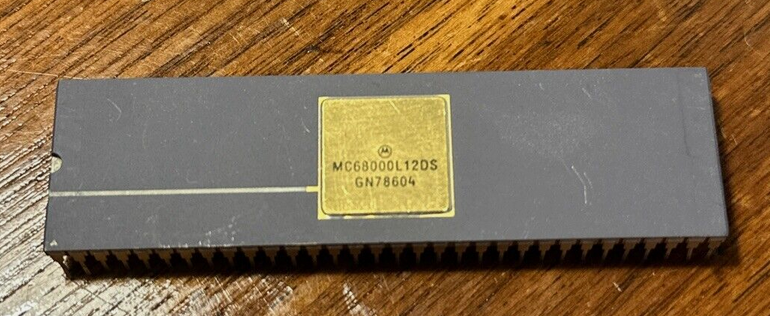
I happen to own a beautiful MC68000L12 dated 1986 so I know for a fact you could get them in time for Amagaki.
![]()
According to the old 1983 datasheet, page 9-2, the DS suffix on that particular chip indicates Level III "Better" Processing. MIL standard temperature cycling, high-temperature testing and burn-in conditions equivalent to 168 hours at +125 degrees C. YIKES!
But what about the Hitachi version?
Hitachi was already a second source for Motorola 6800 and 6809 by the time the 68000 launched and were an early second source for it. They helped Motorola with their CMOS process for the 68020 and co-developed the CMOS 68HC000.
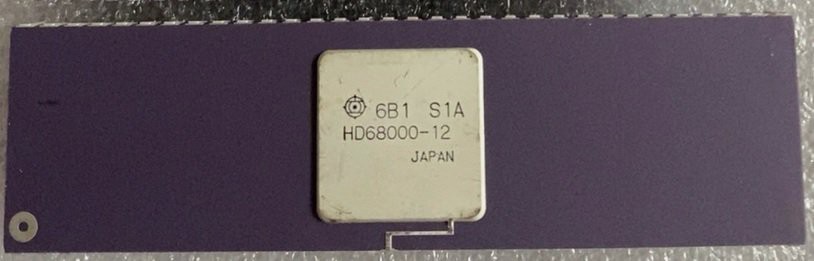
The HD68000-12 is described in the 1985 Hitachi Microcomputer Data Book, so it's legit for our project as well.
This is what they look like :
![]()
A different take on the ceramic package, but still awesome. Nothing is more cool than having all your DIP ICs in formation around the HUGE 68k like a carrier battlegroup!
But certainly, something so cool as a top-speed ceramic 68000 must have been expensive at the time?
Turns out, not so much...
By 1986 the mighty 68020 was available in quantity and was battling it out with the 286 and the new, game-changing 386. The 68012 was obsolete, the 68010 was uninteresting but still somewhat expensive and the 68000 was downright cheap.
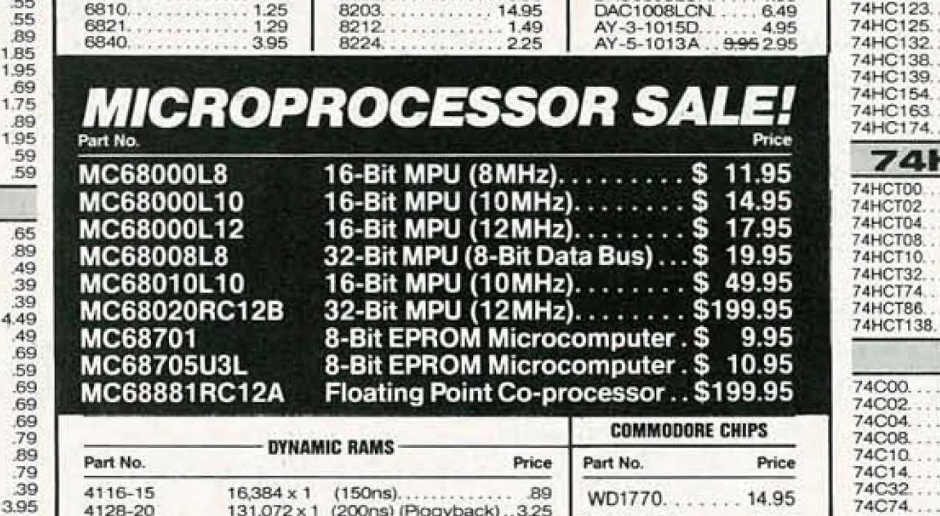
Here is a closeup of an old Jameco(!) price list I found at the back of this 1987 issue of Radio Electronics (page 110).
![]()
$17.95 US dollars for a ceramic 12.5MHz 68000, in single quantity, sold to tinkerers and hobbyists in october 1987. 68010 is 3 times the price, 68020 and FPU are out of reach.
In the same magazine, JDR microdevices sells 8088s for $6.95, NEC V20 and V30 for $10.95 and $13.95, the 286 for $129.95.
Conclusion
Unfortunately, there is no way to get exact, medium volume pricing for late 1986 but I think it is reasonable to establish the Jameco price as an acceptable estimate.
Our CPU of choice was therefore available and probably cost-effective for our design.
Amagaki, the Macintosh killer
The Macintosh was a big success in Japan, what if a homegrown competitor had appeared?
 ROFL, absolutely terrible. Totally NOT what I had in mind. But this one actually had the color image of the fruit on the screen which I would not get again. Interesting...
 Kinda getting there? The shape of the machine is more like it, the detached keyboard is good. The "pale green when off" and very bulbous CRT looks 70s like though. I guess the fruit is ON the screen alright... Let's get another one with the same prompt and compare.
 Whoa that one is a bit too close for comfort. I guess the
  Kinda cool. Not what I had in mind but I get it. The mouse is HUGE. Let's try the same one again.
 Cool again. The fruit dissolved into the case? There is something MSX-ish about the keyboard shape. I wonder what the weird peripheral is. Perhaps 1986 is too beige? I want black like the X68000 dammit. Well that came out in 1987 so...
 That's it. By far my favorite. Maybe if we try again it will get even better?
 Holy mother of yikes! I can't even... I think that's enough... I'll keep the other one!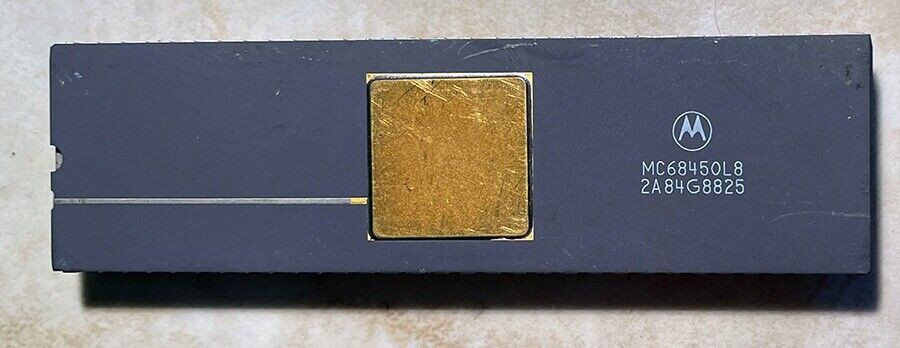
 A similar figure is also shown in the HD63484 manual. I can't explain why they show LS640 INVERTING buffers between the '484 and the data bus, the data lines on the '484 are not inverted. A similar figure in the ACRTC Application Note 1986 shows '245 in that position.