• Handy: Building a Robotic Hand from Scratch (Part 1)

    Gabriel29 minutes ago 0 comments

    If you're just joining, here's the short version: Handy is a tendon-driven, fully 3D-printed robotic hand I'm building from scratch. This post covers what it is, why it's built the way it is, and where things stand right now.

    What it is

    Handy is loosely based on the InMoov v2/i2 hand. I started from that design as a reference, then reworked the joints and drive mechanism instead of printing it stock. Each finger closes when a length of fishing line, standing in for a tendon, gets wound in by a small winch motor. Slack the line and an elastic band pulls the finger back open. Same basic mechanics as your own hand, just fishing line instead of flexor tendons and a servo instead of a forearm muscle.

    Why it's built this way

    Cost efficiency is the constraint everything else answers to. Tendon-driven over direct-drive, elastic return instead of extension springs, fishing line instead of purpose-built cabling, SG90 servos I already had instead of buying something better suited to the job, all the same reasoning. It's also why the motor and joint setup keeps changing. I'm finding out what the cheap parts can and can't do as I go.

    Two things it needs to do

    1. Roll a coin across the knuckles: four fingers lifting and dropping it in sequence, timed so it doesn't fall off.
    2. Sign in ASL: distinct, recognizable letter shapes, not just open and closed.

    Both need tighter per-finger control than a basic gripper, which is most of why the control system is getting as much attention as the mechanical build. I'm going to mainly focus on point #1, because I think its a good challenge.

    Where it stands

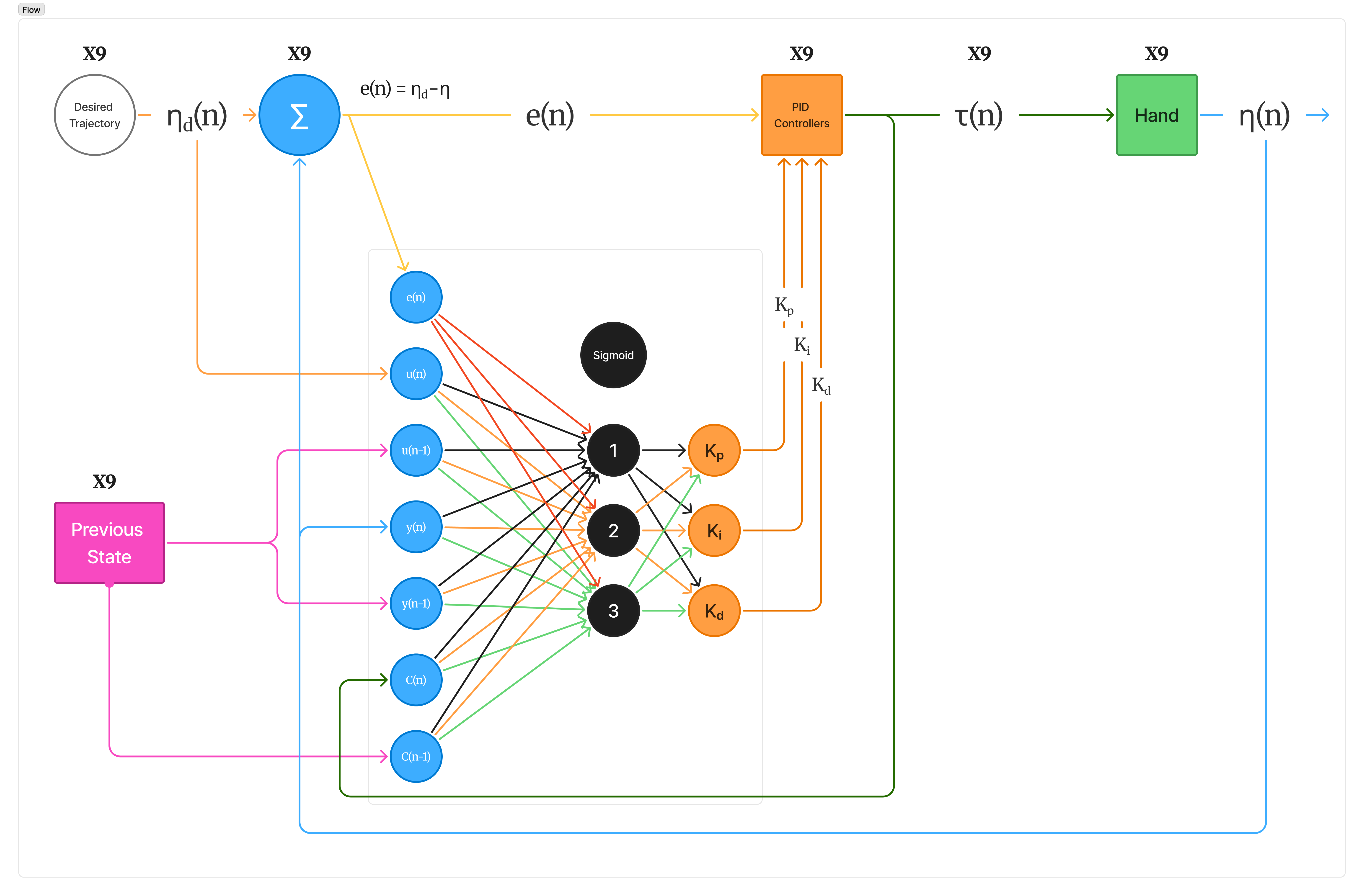
    Two tracks running in parallel right now. On the mechanical side, the hand is rigged in Blender. Nothing's been printed yet for this version. I wanted the joints and drive mechanism right in simulation first. On the control side, the rigged model exports into MuJoCo and runs through Gymnasium, where I'm building out reinforcement learning to actually drive the hand. Each finger gets its own motor and its own control loop, with a neural network on top tuning those loops rather than driving the fingers directly. More on that later.