 stemforge.phil

STORY of the HYPER S3 ROCKET and the STEM FORGE Rockets & Engineering Challenge
A water rocket's whole flight is over in a handful of seconds: launch, apogee, parachute, touchdown. Blink and you've missed the data.
As a technology and engineering teacher, I wanted my students to see every one of those seconds. I wanted an immersive water-rocket challenge with data logging, onboard sensors, and automated parachute deployment. No commercial option fit the bill. Everything was too restrictive, too expensive, or lacked safety & customizability.
So I did what any maker-educator would do. I consulted fellow engineering teachers, researched rocketry physics and telemetry, and designed a custom flight-computer PCB from scratch.
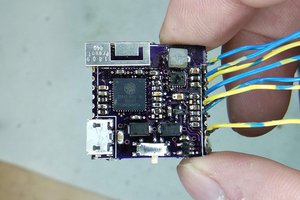
The result is the HYPER S3 ROCKET: a 4 gram, 20 mm × 33 mm ESP32-S3 board built around four ideas:
- Power: a dual-core 240 MHz ESP32-S3 and a 2 A, 3.3 V buck-boost rail that keeps the processor alive when servos and radios surge, charged from USB-C or a solar panel.
- Protect: a hardware "double safety vault" that guards the battery on both charge and discharge, even if your code crashes.
- Precise: a nano-power MEMS real-time clock, an optional 10-DoF motion and altitude sensor array, and a fast 4-bit MicroSD logger.
- Portable: small and light enough to ride inside a soda-bottle nose cone, or solder flat onto your own board as a castellated module.
It was engineered for water-rocket telemetry, but it packs a serious punch for any battery and solar project your students dream up.
This project page is a structured guide for anyone interested in the STEMFORGE Rockets & Engineering Challenge, and for anyone who wants to learn to build with microcontrollers, batteries and solar panels.
Contents:
1. The Problem Statement
2. Under the Hood: Electronics and Hardware Flexibility
3. Mechanisms & 3D Printing
4. Simulating & Testing
5. Conclusion & Crowd Funding
6. References
1. The Problem Statement
In the STEMFORGE Rockets & Engineering Challenge, students work in teams of three or four to prototype a complete aerospace solution. Following the engineering process, each team must conceptualize, manufacture, launch, and land a high-performance water rocket. Think Mars lander, built from a soda bottle.
Projects are evaluated on three pillars:
- Performance: maximum acceleration and peak altitude.
- Aesthetics: a sleek, functional, aerodynamic design.
- Recovery: a multi-stage sequence that separates the payload module, deploys a parachute, and lands the core module upright.
⚠️ NOTE: To ensure structural integrity, the pressure of the launch bottle must strictly not exceed 65 psi.
2. Under the Hood: Electronics & Hardware Flexibility
A water rocket shakes, spins, gets wet and lands hard, and the electronics inside still have to tell the truth. Most hobby ESP32 and LiPo boards charge a battery and hope for the best. The HYPER S3 ROCKET was designed around what happens when things go wrong.
A flight, as the hardware sees it
- On the pad: the battery is topped up over USB-C or solar, the real-time clock is running, and the board can sleep in deep-sleep mode on its 14 RTC-domain pins until something wakes it.
- Boost: the IMU captures acceleration and spin, and the 4-bit MicroSD interface keeps up with the data rate.
- Apogee: the barometric altimeter and IMU give your firmware what it needs to decide when to activate the release servo, and the 2 A rail means a servo surge doesn't reset your processor.
- Landing: logging continues through touchdown, every sample timestamped, and the whole flight is waiting on the card when you plug in USB-C.

The "Double Safety Vault": premium power & battery protection Unlike standard hobby boards, this PCB was built with protection layers that other LiPo development boards ignore:
- Two independent layers of battery protection: the BQ25188 charger manages every charge & discharge cycle, and a separate hardware eFuse, voltage supervisor and comparator...
 Jarrett
 mikrotron
 John Opsahl
 Mike Cochrane