Close
0%
0%

miniMAC - Not an Ethernet Transceiver

custom(izable) circuit for sending some megabytes over differential pairs.

Similar projects worth following
This is not Ethernet, though (initially) quite inspired by Fast Ethernet (100Base-TX) and using the same medium (RJ45/CAT5 or better) and magnetics. Or just plain matched impedance diffpair, I will not judge.

It should provide mostly equivalent performance but does not require all the IEEE 802.3xyz hoop-jumping: it could be implemented in a cheap FPGA (Ice45 ? A3P250?), TinyTapeout or even a Pi pico or something.

As it progresses, it looks more like a poor man's Fibre Channel over Cat5 but with strong error detection and low latency.

Applications are wherever you need to deport devices up to a dozen of meters with standard cabling (or circuit traces), such as sensors, sound, pictures... at a few megabytes per second (when RS485 won't cut it and you require electrical isolation).

The project evolves towards a MAC+PHY+AFE triad, no autoMDI, with minimal analog magic and some digital trickery. Actual line trilevel coding is not yet definitive, so nibble will likely change.

20251113: Architecture update

20250525: spinning #miniPHY off.

.

miniMAC is an extension and application of #PEAC Pisano with End-Around Carry algorithm because the PEAC algorithm replaces the checksum, the scrambler and the 4b/5b table usually employed by 100Base-TX, see

166. Line encoding with PEAC : OK
167. Line encoding with PEAC: it's alive
168. PEACLS error detection (and correction?)
169. TODO: scan

Application is for embedded/custom data transfers over RJ45/Cat5 UTP/STP where the whole TCP/IP stack is not required and a simple FPGA/microcontroller are more than enough.

.

A PAM3-based + gPEAC18 version is currently in development. The GrayPar layer is still evolving, helps detecting more errors, faster, optimising the descrambler's work. There is no error correction but detection is solid and fast, allowing almost immediate retransmit of the most recent data, thus optimising actual bandwidth in difficult environments (like industrial, automotive...).

 
-o-O-0-O-o-
 

Logs:
1. Let's start.
2. Tinkering with CircuitJS
3. AGC
4. Serial vs Parallel
5. Sender-side droop/wander prevention with MLT-3
6. Double parity
7. Flipping
8. a Quasi-Popcount
9. gPEAC again
10. Popcount
11. the bi-flipper topology
12. Ternary encoding
13. The whole flip+parity extension stage
14. Should 4 be flipped...
15. Popcount (better)
16. Run Length Limitation, reduced
17. Making it work
18. Protect the flip bits
19. Error detection
20. Modulation, simplified for now - NRZi
21. Architecture
22. Ternarity and more
23. SU(3)
24. mod3
25. mod3bis
26. Bidir PEAC+ParPop
27. Two lanes
28. Bidir ParPop : OK
29. Protocol
30. DPLL-1
31. I need a name.
32. Reversible PEAC scrambler
33. TMDS
34. PEAC treillis
35. PEAC Reversibility achieved
36. Bidirectional pipeline
37. Dual-lane version: easy
38. DPLL-2
39. Line compensations
40. Maximum avalanche time
41. Transition minimisation
42. The "same" symbol
43. PAM3 and the bi-Trits
44. The ParRot
45. Constellation 2
46. The spreader
47. Gray parity
48. One more bit...
49. Larger words
50. The new parity circuit
51. Permutations
52. Permutations 2
53. The last parity
54. Control Word Sequence
55. Rebuild
56. Detection latency and buffer depth
57. Burst errors
58. Protocol revision
59. MAC & PHYs
60. The error model of PEAC scramblers
61. Shared PEAC
62. Sub-protocol: QSDE
63. miniPHY
64. New pipeline
65. GrayPar17
66. ADD3-EAC
67. Move the NOTs
68. Fewer burst errors
69. spurious errors
70. Stats with GrayPar17 and PEAC16x2
71. Not XOR, not ADD, then what ?
72. Add, Sub and errors
73. Multi-bit errors
74. Galois fields ?
75. Better markers
76. Better stats
77. buffer prefix
78. gPEAC18
79. A matter of channels...
80. Architecture (summer edition)
81. Unit swap
82. Unit swap (2)
83. Extended control words
84. GrayPar18
85. Article
86. A variable-strength adaptive parity
87. New pipeline
88. New pipeline (2)
89. GrayPar18: 5+5+5+3
90. ParGray: it's reversible!
91. New modulo.
92. Nested Gray Parity Loops
93. New new modulo.
94. Error detection: how it fits in the protocol
95. Meanwhile: Koopman
96. Modular adder
97. Coding space
98. Architecture update
99. Parallel bus
100. C/D in the middle
101. gPEAC: the circuit
102. gPEAC circuit correction
103. New new new modulo.
104. Orbit length invariance
105. gPEAC: the (other) circuuit
106. gPEAC18 descrambler (la suite)
107. Bus Inversion
108. Error correction
109.
110.
111.
112.
113.
114.
115.
116.
117.
118.
119.
.

For the older obsolete "NRZi" version, as of 20250325 we had:

  • A pretty good 16-bit scrambler with a very long period, no risk of crash and parallel implementation : easier operation, lower power and works at f/10.
  • The scrambled word has 2 additional marker bits for flagging the data vs control words, also providing a "sticky" checksum flag.
  • The parity/flip stage performs pop count on the 2 halves, at F/20, extracting a parity flag that alters the data markers, and flips whole bytes when the number of set bits is lower than 4.

Result :

  • The units mostly are identical for transmit and receive, so they can be shared, alternate the function. (20250401 :...
Read more »

gPEAC18_VHDL.20251208.tgz

Scrambler and descrambler in C work in RTL style

x-compressed-tar - 46.50 kB - 12/08/2025 at 00:51

Download

parpop_20251123.tgz

ParPop circuits for 6 and 8 bits

x-compressed-tar - 30.42 kB - 11/23/2025 at 06:37

Download

gPEAC18_VHDL.20251115.tar.gz

gPEAC18 scrambler and descrambler (valid in C)

gzip - 36.12 kB - 11/15/2025 at 17:41

Download

gPEAC18_VHDL.20251113.tar.gz

high level version of the gPEAC18 scrambler works with ints only.

gzip - 20.52 kB - 11/14/2025 at 04:19

Download

dr-mag-08b0-1x1t-36-f.pdf

datasheet for "MagJack" Pulse J3011G21DNLT (10/100Base-T)

Adobe Portable Document Format - 432.15 kB - 05/24/2025 at 19:16

Preview

View all 23 files

  • Scrambler and descrambler: almost ready

    Yann Guidon / YGDESan hour ago 0 comments

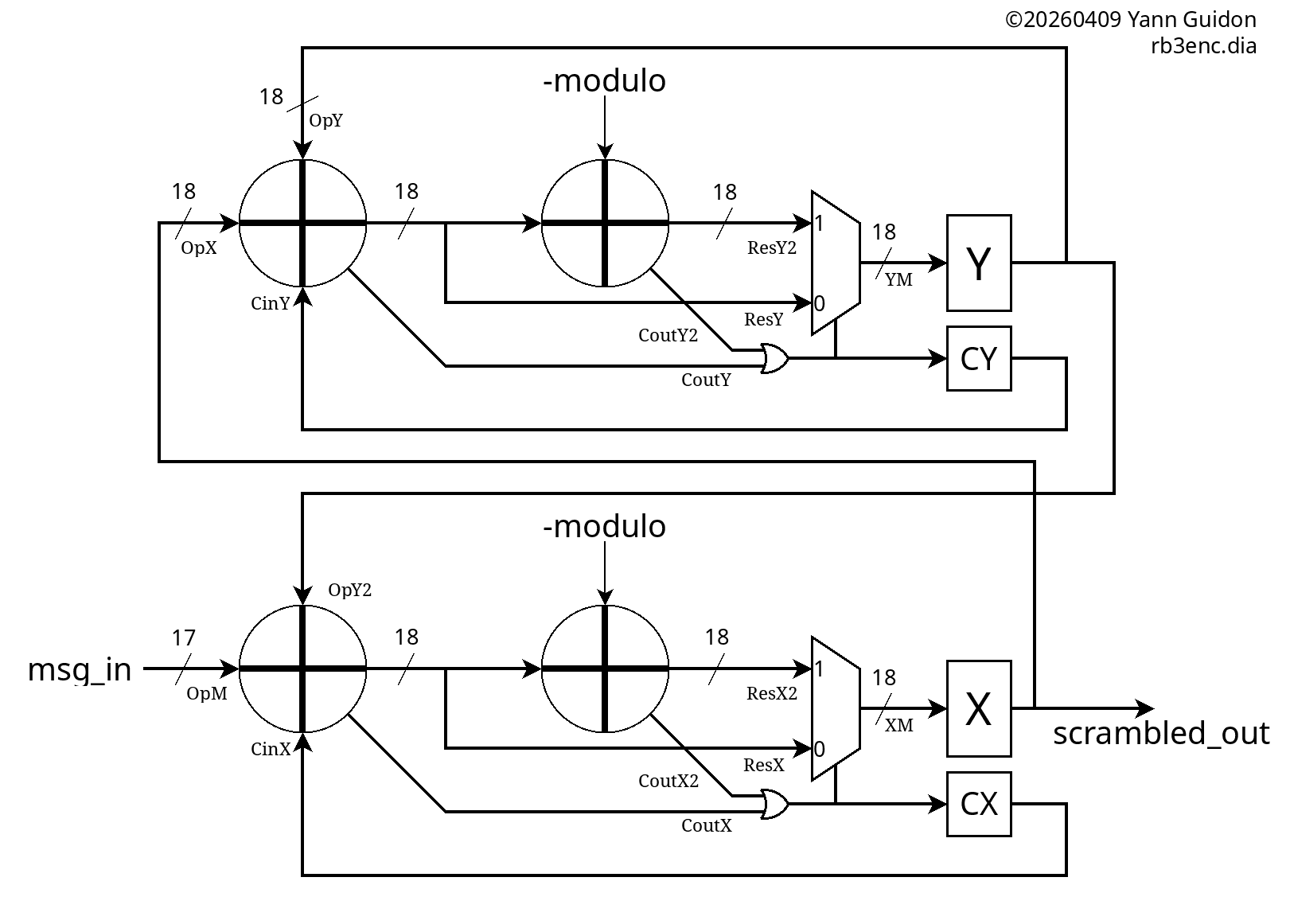
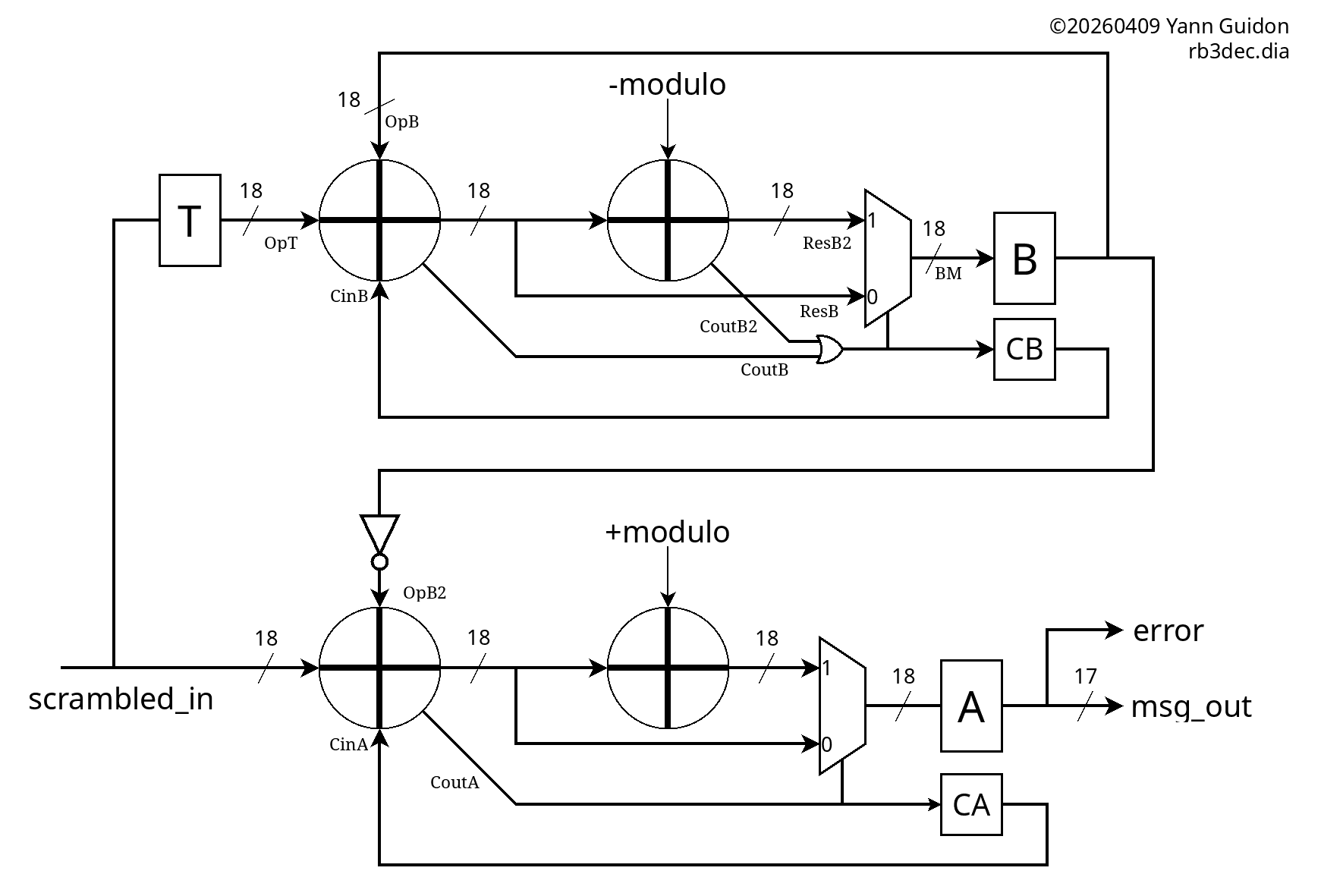
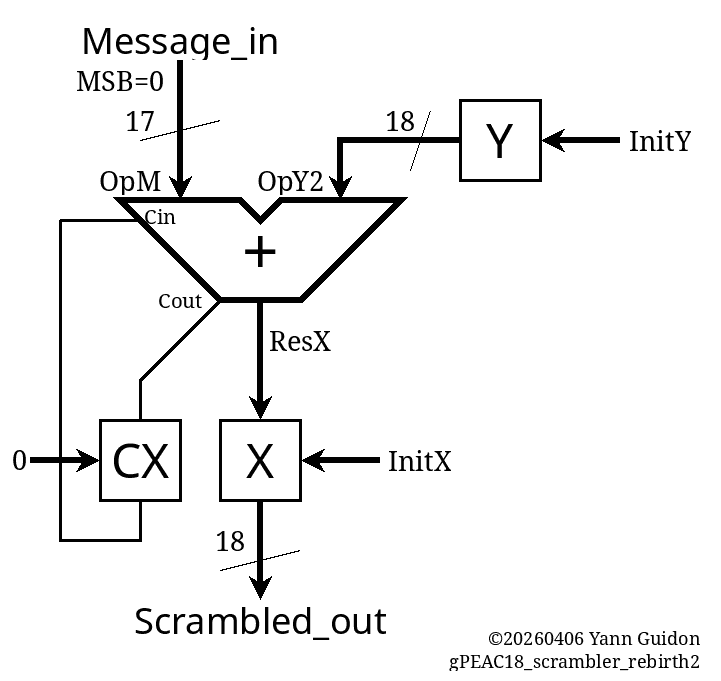
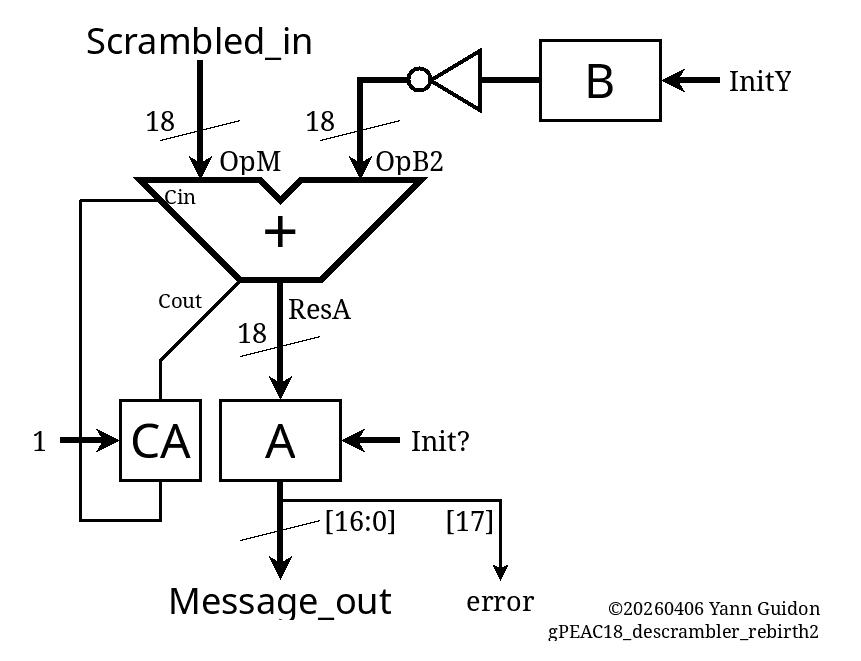
    I have prototyped the scrambler and descrambler in C up to the RTL coding style, and updated the diagrams:

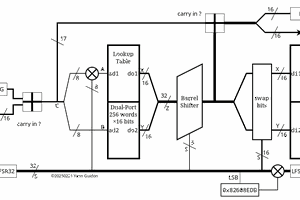
    I was too lazy to represent the carry bits separately.

    The source code is there. Now I just have to translate it to VHDL.

  • Scrambler (clearer)

    Yann Guidon / YGDES5 days ago 0 comments

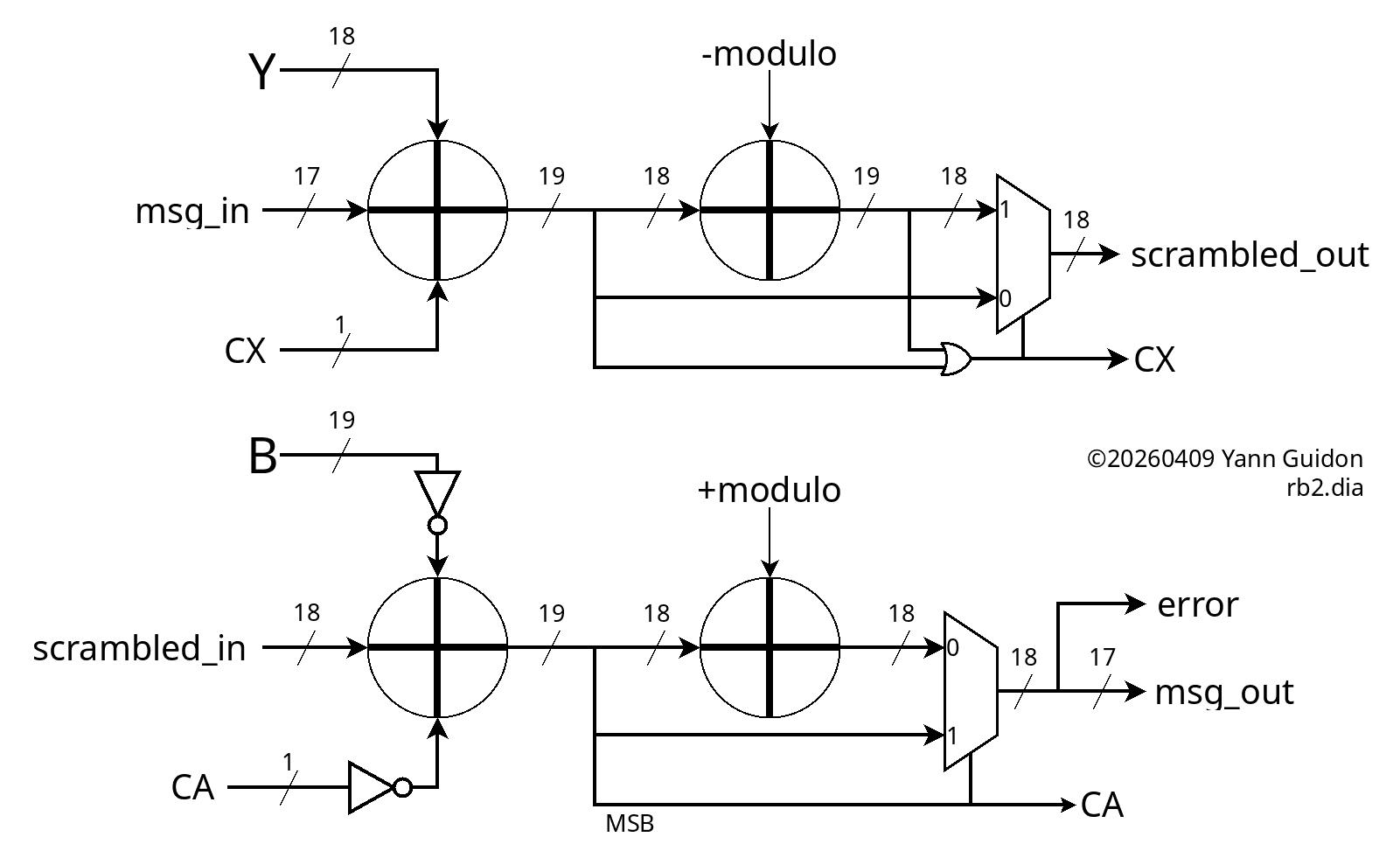
    The new diagram is here:

    It's not changed but more precise, since the bus widths were not clear enough.

    • X contains 19 bits, as it is a concatenation of the 18 data bits (fitting the modulus) and the carry bit.
    • The adder is 18+18+1 bits, outputting 19 bits (including carry out).

    Another "trick" is that the carry bit from X does not need to be ANDed with the phase since it MUST be 0 at the end of phase 0. It can only be 1 at phase 1. (That change is not yet applied to the Y path)

    _____________________________________________________________

    Yeah, forget that, I messed up again. The ANDN must be restored...

    There is something else to consider : the carry !

    The adder is 18-bit wide, and unlike the C code, it truncates the input such that the 2nd cycle does not propagate or keep the carry out of phase 0. Actually, the carry should be "sticky" (ORed) during the phase 1.

    This is not represented here, and although putting everything in the X / Y registers simplified the overall algorithm, it confuses the schematic and RTL code. The next revision should address this.

  • Error correction

    Yann Guidon / YGDES11/30/2025 at 14:50 0 comments

    tl;dr: it's a job for the miniPHY.

    __________________

    .

    Optimising bandwidth in a noisy environment is a difficult problem, that Shannon and others have fought for decades.

    There is this compromise, or dilemma, of detection versus correction : detection takes half the size of correction and since the miniMAC works as point-to-point with low latency, retransmit seems to be the simplest and lowest-effort strategy. For now the miniMAC is optimised for early detection with only 1/9th of bandwidth overhead.

    This is adapted when there is relatively low noise. miniMAC should still work with moderate noise though. So I'm shopping for a low-density error correction layer, which could go between the PHY and the MAC. Maybe this could be dynamically bypassed and/or optional, so it becomes active when the error rate exceeds a certain level, because it would eat bandwidth too.

    What bandwidth would be OK ? Another 1/8th gets us into the Hamming SECDED territory (64+8=72 bits) but it can correct only one bit per block. However, the line code might use multi-bit symbols with a mapping that maximises error diffusion, to speed up detection, so the slightest blip would alter several bits and be unrecoverable.

    Some sort of parallel Hamming code would use 8 nibbles for every 64 nibble. That's too much latency. Reed-Solomon would be worse. Hopefully a flavour of Viterbi or Treillis (TCM) could work. Not sure if Turbo-Codes, LDPC or similar could be practical.

    5-bit nibbles open the door for some trickery in GF(31), and 3-bit nibbles let us play in GF(7).

    But in the end FEC/ECC buys us some margin, maybe a 2× or 3× fewer retransmits until things really break down, at the cost of

    • Less bandwidth (The fewer retransmits are compounded by the extra bit overhead)
    • More latency (the ECC requires another buffer)
    • More circuits (more memory, more complexity)

    The other fun parts are

    • The bandwidth loss of FEC would be equivalent to reducing the transmit rate, which would also reduce the error rate (not the same ratio but still)
    • Low bandwidth loss from ECC would require longer buffers, which in turn increases latency and reduce retransmit rate

     => The gain-cost ratio of FEC is not great! A simpler and almost equivalent method would be

    • Adjusting / Slowing down the clock frequency (dynamic scaling)
    • Reducing the effective bitrate by switching the GCR table

    But errors occur and the retransmit algo might not be enough in the cases that interest us. A light touch of FEC is good to detect when things are about to get bad and still work at a decent performance. But as noted above, a "light" (low overhead) FEC requires long buffers and gets in the way of fast retransmission.

    The gPEAC18 descrambler has a detection latency of about 8 words (128 bits) and Hamming SECDED can correct 2 bit errors at most in this timeframe. That's not much and the recovered data risks being smushed and destroyed even more, in case of failure, which would do the same "error amplification" work as GrayPar. I don't know yet how much correction is possible in about 128 bits...

    Anyway https://arxiv.org/pdf/cs/0504020v2 reminds use that block codes are less efficient than convolutional codes.

    I had been trying to understand why in practice convolutional codes were generally superior
    to block codes, so I studied Andy’s paper with great interest. I realized that the path-merging
    property of convolutional codes could be depicted in what I called a trellis diagram, to contrast
    with the then-conventional tree diagram used in the analysis of sequential decoding. It was then
    only a small step to see that the Viterbi algorithm was an exact recursive algorithm for finding
    the shortest path through a trellis, and thus was actually an optimum trellis decoder. I believe
    that at that point I called Andy, and told him that he had been too modest when he asserted
    that the VA was “asymptotically optimum.”

    .

    Now, let's have another look at Wikipedia:

    Read more »

  • Bus Inversion

    Yann Guidon / YGDES11/22/2025 at 03:01 0 comments

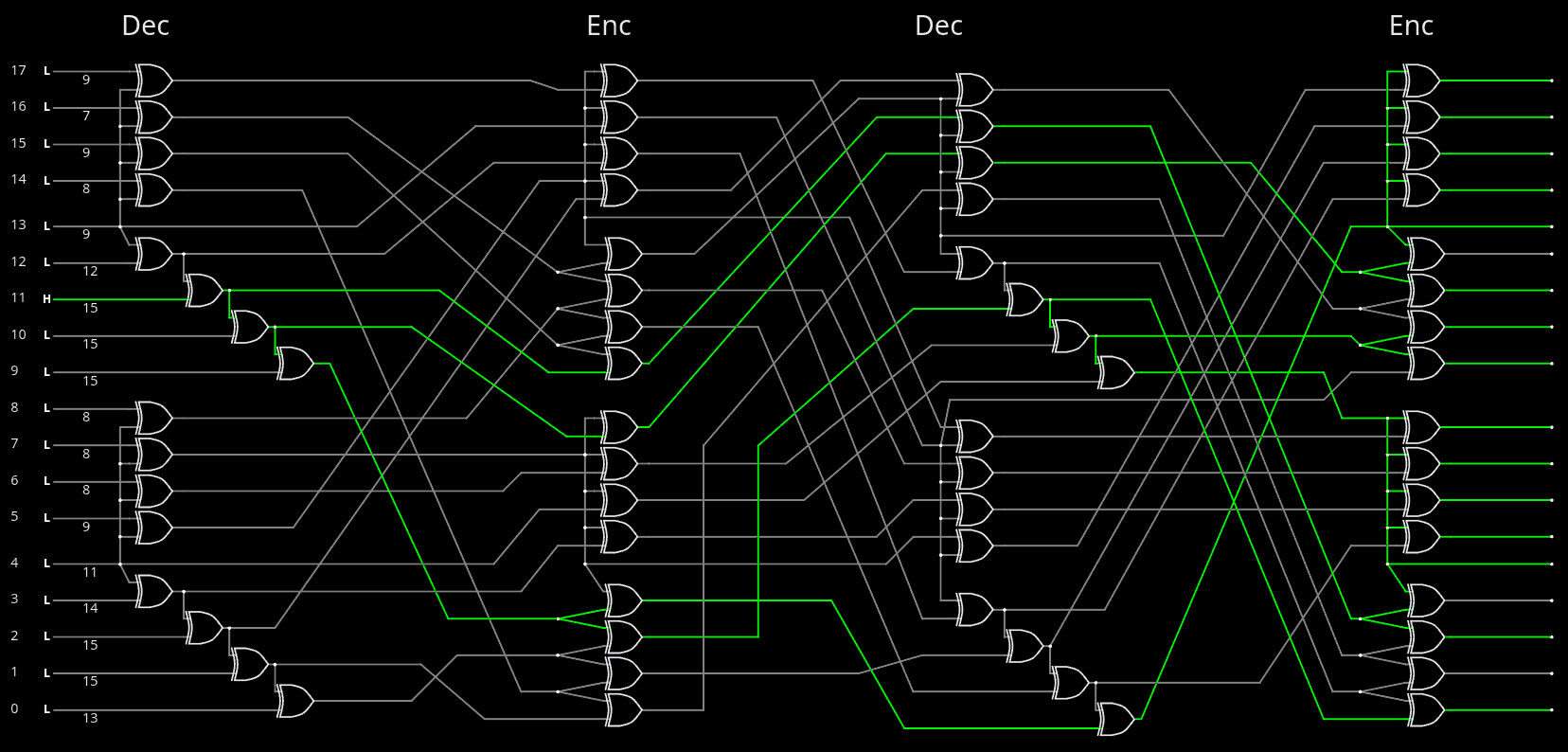
    In 99. Parallel bus I used the simple case of 6 bits per word and it's pretty simple.

    In 16. Run Length Limitation, reduced I used a 8-bit word and I got the circuit wrong. I just realised I needed to invert the input data before the popcount, so it could work correctly on a parallel bus and have 4 or less bits set at one time.

    The new circuit is there :

    Add the NRZ/NRZI flipflops and you got a TMPI (Transistion-Minimised Parallel Interface).

    The updated version of the 6-bit circuit is there:

    The source code for the 6-bit and 8-bit versions are available in parpop_20251123.tgz

  • gPEAC18 descrambler (la suite)

    Yann Guidon / YGDES11/14/2025 at 04:02 0 comments

    The scrambler works but the last log 105. gPEAC: the circuit (2) found a problem with the descrambler: there can not be two carry inputs in the accumulation (decumulation ?) phase.

    However this is an issue IF I try to follow the mantra of "have only adders". The second phase (adjust modulo) IS actually a subtraction ! So the descrambler can use a subtracter during both phase. It's time to update the diagram and the algo. But this would work only if the subtracter is not made of an adder with inverted carry input.

    For faster execution but mostly for easier implementation (because VHDL does not permit boolean operations), a C version seems required.

    -------------------

    The port to C is doing well, at least for the scrambler.

    Tne descrambler code is in the same bloc so the registers must have different names, I have chosen A, B, C, D and T.

    Log 34. PEAC treillis helps for the init values again.

    From the scrambler side:

    • Do0 = Di0 + InitX
    • Do1 = Di1 + InitX + InitY
    • Do2 = Di2 + Do0 + InitX + InitY
              = Di2 + Di0 + 2×InitX + InitY

    From the descrambler side:

    • Di0 = Do0 - InitX
    • Di1 = Do1 - (InitX + InitY)
    • Di2 = Do2 - (Do0 + InitX + InitY) 
             = Do2 - (Di0 + 2×InitX + InitY)

    ==>

      A not initialised, B = INIT_X,  T = INIT_Y.

    Now, gPEAC18_codec.c works:

    #include <stdint.h>
    #include <inttypes.h>
    #include <stdio.h>
    
    #define MODULUS (258114)
    #define ADJUST  (262144-MODULUS)
    #define INIT_X   (56247) // "01101101110110111"
    #define INIT_Y  (111981) // "11011010101101101"
    
    int main() {
      uint64_t cycles = 0;
      int Msg = 12345,
       // scrambler
          X = INIT_X,
          Y = INIT_Y,
          X2, X3, Y2, V=0, W=0,
       // descrambler
          A, B = INIT_Y,
          B2, C=0, D=0,
          T = INIT_X;
    
      for (int j=0; j<670; j++) {
        for (int i=0; i<100000000; i++) {
    /////////////////////////////// Scrambler
          // phase0 : accumulation/Fibonacci on 19 bits + carry in
          X2 = Msg + Y + V;
          Y2 =   X + Y + W;
          X = X2;
          Y = Y2;
    
          // phase1 : modulo
          X3 = X2 + ADJUST;
          Y2 = Y  + ADJUST;
    
          V = X3 >> 18;
          W = Y2 >> 18;
    
          if (V) { X = X3 & 262143; }
          if (W) { Y = Y2 & 262143; }
    
    /////////////////////////////// Descrambling
          if (X >= MODULUS) {
            printf("\n   X OVERFLOW !!\n");
            goto the_end;
          }
    
          // phase0 : decumulation
          A = X - (C + B);
          B = T +  D + B ;
          T = X;
    
          // phase1 : modulo
          C = (A >> 18) & 1;
          if (C) { A = (A - ADJUST)& 262143; }
    
          B2 = B + ADJUST;
          D =  B2 >> 18;
          if (D) { B = B2 & 262143; }
    
          cycles++;
          if (X == INIT_X) {
            if (Y == INIT_Y) {
              goto the_end;
            }
          }
          if (A != Msg) {
            printf("\n A=%05X != Msg !\n", A);
            goto the_end;
          }
        }
        printf("%" PRId64 ": %05X  %05X\n", cycles, X, Y);
      }
    the_end:
      printf("\n%" PRId64 ": X=%05X  Y=%05X\n", cycles, X, Y);
      return 0;
    }

    The subtraction expression can be modified to an addition:

    A = X - (C + B);
      = X + 1+ ~(C + B);
      = X + ~B + (C^1); 
    

    so B and C are simply booleanly complemented and the carry input is simplified.

    Pfew.

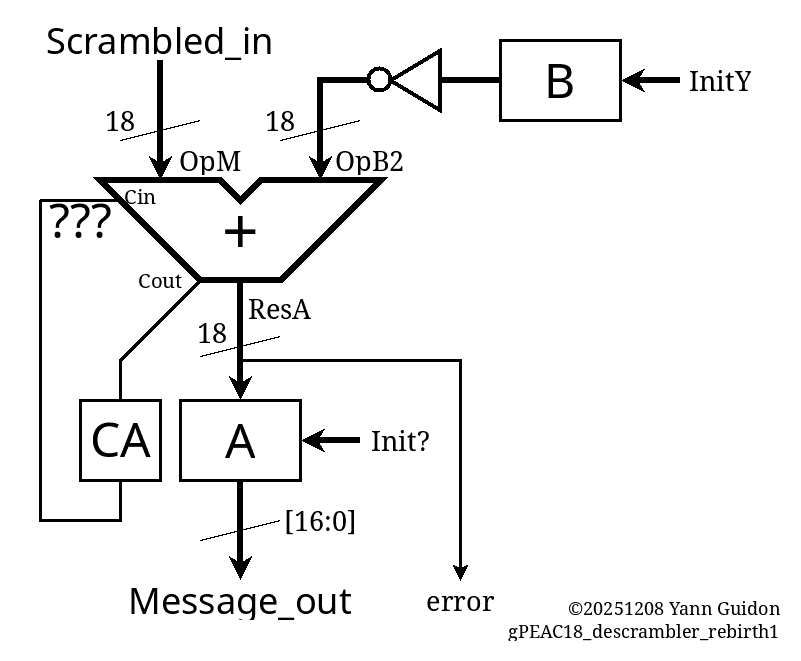
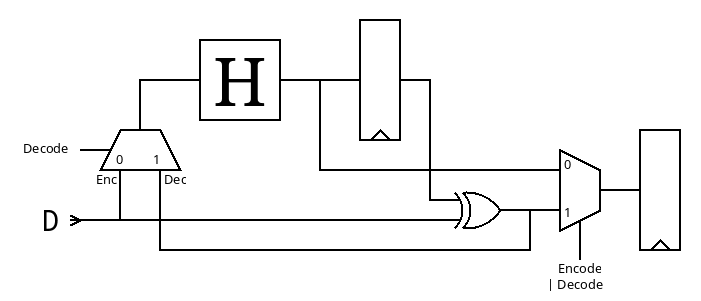
    The diagram below shows the subtle changes with the handling of the carry signals:

    .

    Now the circuit must be folded back into a single pair of adders and 2 cycles, hence more MUX.

    The easiest place to start is the B pipeline which is almost a copy of the scrambler, except with an additional T register. The adder inputs are easy to allocate : one addend is B (with or without carry in), the other is MUX(T, Cst).

    The left side (message decumulating) is more peculiar. The operands of the adder are

    • (Scrambled_In, Cst) + ( /Y, A)
    • (Scrambled_In, A) + ( /Y, Cst)

    There is no advantage to either, since there is only one constant.

    And here is the result:

    Not represented : Reset and Phase signals.

    .

  • gPEAC: the (other) circuit

    Yann Guidon / YGDES11/13/2025 at 01:32 0 comments

    After a few logs where the scrambler is rebuilt from the ground up,
    101. gPEAC: the circuit
    102. gPEAC circuit correction
    103. New new new modulo.
    Now is the time to address the descrambler.

    Log 6. Double parity presented PEAC_LineDescrambler.png:

    The circuit is still relevant but the naming has evolved a bit since (the names X & Y have been swapped), and C and D flags are now merged with the X & Y registers.

    It gets messy pretty fast and the treillis from 34. PEAC treillis helps me keep some sanity.

    .

    1)

    The first thing to do is check the validity of the input with the following circuit:

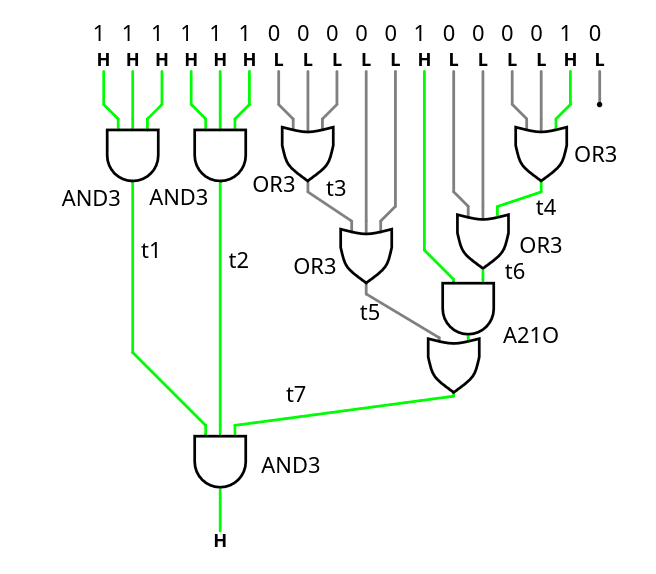
    This only catches about 1.5% of the errors but it's a quick and easy job. These errors would still be detected by gPEAC but several cycles later.

    2)

    Then there is the subtraction. And it gets a bit messier, since it adds a new 19-bit register because the result is not available immediately, let's rename it X (tied to Message_Out). X and its subtracter must go through 2 cycles:

    1. phase0 => X[18:0] := X[18] + Scrambled_In[17:0] - Y[17:0]
    2. phase1 => u[18:0] := X[18:0] + Cst
      if u[18]==1 then X[17:0] := u[17:0]

    So X has a valid output value at the next cycle, but on in ever cycle so a transparent latch or a parallel one would be required, and X[17] should be 0 (or it's an error).

    3)

    And now, the Y part.

    The first thing to consider is that Scrambled_In is delayed by one full cycle (two phases). So that would be register T.

    Then the register Y accumulates the delayed T modulo M. This is a bit like a parallel pipeline running along with the X pipeline. The 2 cycles are similar:

    1. phase0 => Y[18:0] := Y[18] + T[17:0] + Y[17:0],
      T[17:0] = Scrambled_In[17:0]
    2. phase1 => v[18:0] := Y[18:0] + Cst
      if v[18]==1 then Y[17:0] := v[17:0]

    And this time, there is no crossing or geometrical flipping, as shown in the unrolled/pipelined diagram below:

    There is another issue to solve : the carry input of the X subtractor, since -Y requires Cin to be 1, but it's already controlled by X[18]. And it's not easy to debug in plain VHDL which does not provide boolean operations.

    .

    .

    So the structural differences with the scrambler is that the descrambler

    - uses subtraction

    - requires an additional register T.

  • Orbit length invariance

    Yann Guidon / YGDES11/12/2025 at 20:27 0 comments

    Testing the new modulus, I check the effect of a constant input message.

    Msg=0:

    66000000000  X=36663    Y=131746                        
    66100000000  X=159181    Y=42180                        
    66200000000  X=56730    Y=127039                        
    66300000000  X=93853    Y=158451                        
    66400000000  X=36243    Y=165031                        
    66500000000  X=71790    Y=65041                        
    66600000000  X=80476    Y=43666                        
    66623095107     done !

    Msg=1:

    66000000000  X=236773    Y=175058                        
    66100000000  X=143693    Y=108851                        
    66200000000  X=227833    Y=190930                        
    66300000000  X=246629    Y=237951                        
    66400000000  X=151749    Y=33828                        
    66500000000  X=162761    Y=46437                        
    66600000000  X=16165    Y=215837                        
    66623095107     done !
    

    Msg=2:

    66000000000  X=178770    Y=218371                        
    66100000000  X=128206    Y=175522                        
    66200000000  X=140823    Y=254822                        
    66300000000  X=141292    Y=59338                        
    66400000000  X=9141    Y=160740                        
    66500000000  X=253732    Y=27833                        
    66600000000  X=209968    Y=129893                        
    66623095107     done ! 

    Msg=3:

    66000000000  X=120766    Y=3570                        
    66100000000  X=112718    Y=242193                        
    66200000000  X=53813    Y=60600                        
    66300000000  X=35955    Y=138839                        
    66400000000  X=124647    Y=29537                        
    66500000000  X=86588    Y=9230                        
    66600000000  X=145657    Y=43950                        
    66623095107     done !

    The orbit lengths are the same, it just goes through different points.

    This proves that the "quiescent value" does not matter. I can stick to 0, any other value would be more complex to handle and wouldn't change the efficiency.

  • New new new modulo.

    Yann Guidon / YGDES11/12/2025 at 07:24 0 comments

    This time it must be perfect.

    I had picked the wrong numbers in the full list of moduli, and I have fixed it in https://hackaday.io/project/178998-peac-pisano-with-end-around-carry-algorithm/files

    The new archive is https://cdn.hackaday.io/files/1789987658250432/gPEAC.000002-1000615.perfect.txt.gz

    So let's select numbers below 262144, with 4 to 6 MSB=1

    head -n 7236 gPEAC.000002-1000615.perfect.txt > gPEAC_perfect_262k.txt
    tail -n 1000 gPEAC_perfect_262k.txt > gPEAC_perfect_262k.1000.txt

    then add:

    obase=2

    at the start of  gPEAC_perfect_262k.1000.txt

    The other issue is that they are all even so the LSBs should be 010.

    $ cat gPEAC_perfect_262k.1000.txt |bc|grep '010$' |grep -v '101'|grep -v '1001'
    111000000000000010
    111000011111100010
    111000100010000010
    111100000001100010
    111100001000100010  <= 3 segments
    111100001110000010
    111100001111100010
    111110000111100010
    111111000000000010  <= 1 segment
    111111000001000010  <= 2 segments
    111111000111100010
    111111110001000010  <=
    

    We have a few candidates!

    111111000001000010 = 258114 = 3F042

    seems to be a good compromise with 2 pretty long segments:

    262144-258114 = 4030 = 111110111110

    Now let's verify that the orbit is 64G iterations: ((258114+1)*258114)-2 = 66623095108

    $ /usr/bin/time ./gpeac18_scrambler_int
    ....
    66200000000  X=56730    Y=127039                        
    66300000000  X=93853    Y=158451                        
    66400000000  X=36243    Y=165031                        
    66500000000  X=71790    Y=65041                        
    66600000000  X=80476    Y=43666                        
    66623095107     done !
    583.40user 0.01system 9:43.50elapsed 99%CPU

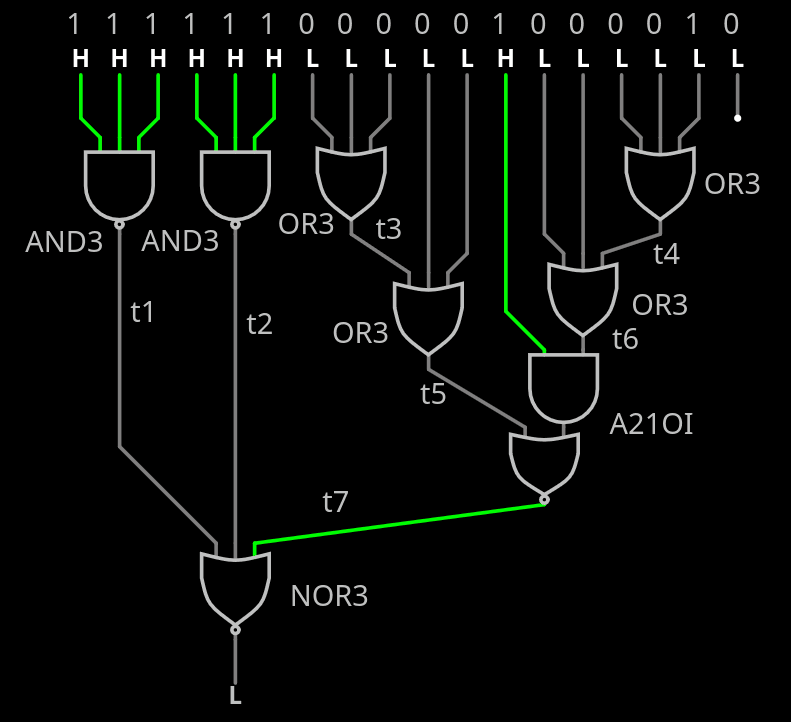
    The new detector is even simpler:

    Fourth time should be a charm, now.

    .

    Only drawback : the "worst case Fibonacci" count for an error going from MSB6 to MSB0 (6 bits, or 64×) would be 11 cycles. Counting the other segments, we get to 13. Another constant with fewer set MSB (only 3 or 4) would be a bit faster.

    It's a compromise between avalanche speed and code coverage. 111100001000100010 and 111000100010000010 would be interesting candidates as well, maybe we'll have to compare them.

  • gPEAC circuit correction

    Yann Guidon / YGDES11/12/2025 at 06:09 0 comments

    The last log 101. gPEAC: the circuit has a little flaw...

    Test.

    Test early.

    Test often.

    Some tests have reminded the importance of the carry and the updated algorithm is

    Phase0:    accumulation
      X[18:0] := Msg[17:0] + Y[17:0] + X[18]
      Y[18:0] :=   X[17:0] + Y[17:0] + Y[18]     
    
    Phase1:    modulo
      t[18:0] := X[18:0] + Cst
      u[18:0] := Y[18:0] + Cst                
    
      X[18]:=t[18]
      if t[18]==1, X[17:0]=t[17:0]
      Y[18]:=u[18]
      if u[18]==1, Y[17:0]=u[17:0]
    

    so the carry still exists as the MSB of X and Y, which is always written and selectively used, depending on the phase.

    Thus the requirement/format for the adder is : 19 bits with carry input (still no carry out, it's the MSB).

    The diagram is updated:

    Fortunately, the implementation has only been in high level so far, indeed to verify the long-term behaviour. Without this carry, the cycles are very short.

    .

    Another big problem :

    The system loops after 32.315.302.423 iterations only !

    The modulus is maximal but not perfect !

  • gPEAC: the circuit

    Yann Guidon / YGDES11/10/2025 at 08:08 0 comments

    Looking back at the main diagram of log 6. Double parity, there are two main big modifications to apply:

    1. Use the non-binary modulus: this is a critical requirement.
    2. Use a single adding circuit: this is a choice, a trade-off, to be examined, in the hope to reduce both silicon surface and power consumption. But it could also increase the complexity.

    .

    Let's go back to the binary version of the encoder, in PEAC_LineScrambler.png

    So let's start with the Two-Adder version.

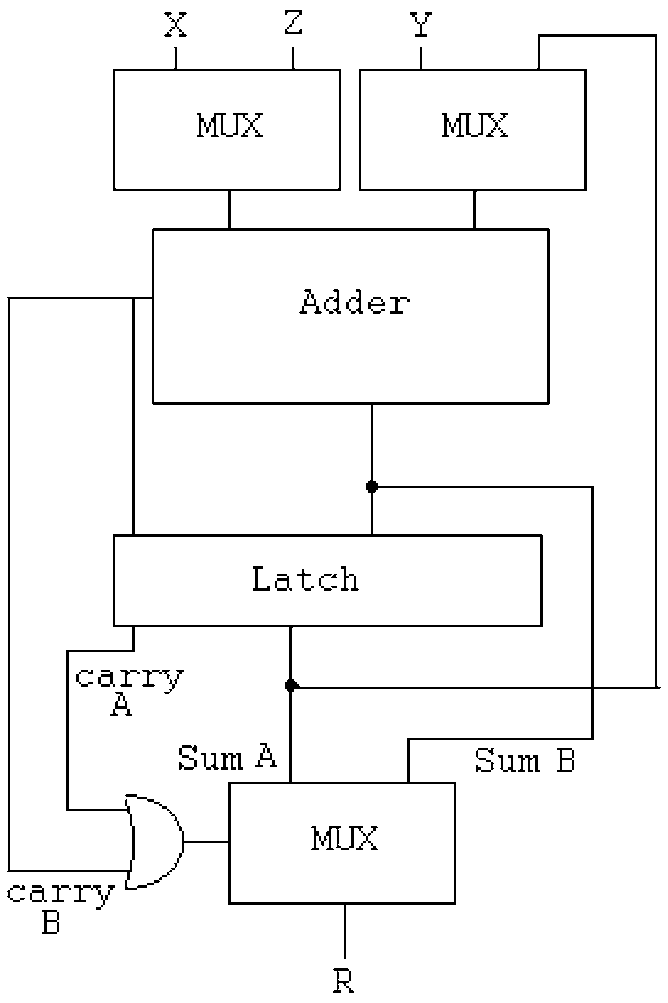
    • The loopback of the carry is replaced by the added constant, in a second cycle. But the register remains because its value is required in the second cycle.
    • there is no prefix/parity either, it's implemented by the MSB of the adder.

    .

    For the scrambler, the algorithm becomes:

    1. Sum:
      Y1 = D:SumX = Message + X0   \_ in parallel
      X1 = C:SumY =      Y0 + X0   /
    2. Correction:
      IF D==1 then Y1 = SumX = Y1+ Cst
      IF C==1 then X1 = SumY = X1+ Cst.

    It's messy. And I would like to avoid adding registers or muxes, though it's blatantly required and I can't accept that yet.

    Anyway there is no additional register, X and Y can remain as they are, however I identify 3 MUX:

    • MX1 = X ? CST (shared by SumX and SumY)
    • MX2 = Message ? Y (SumX)
    • MX3 = Y ? X  (SumY)

    However SumY always depends on X at one input and it's not a problem if the Cst is applied in other places, as it reduces the number of complex Muxes.

    • SumX = ( Msg ? Y ) + ( X ? Cst ) 
    • SumY = X + ( Y ? Cst  )

    Note: due to commutativity, there are 4 combinations for SumX:

    1. ( Msg ? Y ) + ( X ? Cst )
    2. ( Msg ? Cst ) + ( X ? Y )
    3. ( X ? Y ) + ( Msg ? Cst )
    4. ( X ? Cst ) + ( Msg ? Y )

    Which reduces to the 2 first cases.
    Routing considerations would avoid crossing or meeting X and Y so I'd rather use the first case.

    And X and Y both have their own feedback MUX in case C or D is zero.

    And it's still confusing to have SumX go to Y and SumY go to X, which I correct in the following algo (i just swap the X and Y registers):

    • X = SumX = ( Msg ? X ) + ( Y ? Cst ) 
    • Y = SumY = Y + ( X ? Cst  )

    X and Y should be 19-bit wide, so the carry/overflow is taken into account during the 2nd stage.

    This is a general overview, with a few details left out, but

    • Message_in is: b0:b7=data, b8=C/D flag, b9-16=data, b17:b18=0
    • Scrambled_out is 18-bit wide (MSB is ignored, should be 0)
    • Only one MUX is a "complete" one with 2 data inputs (the one marked X). The others use a constant so they are implemented with AND and OR gates.
    • The X and Y registers are "normal" DFF but could also be implemented with enable-input versions, if available.
    • The "enable" signal is controlled by phase=1 and MSB of the sum=0, when no overflow occurs.
    • Scrambled_out is only available when phase=0, 2 clock cycles after Message_in is provided.
    • I have managed to prevent buss crossings : X and Y do not overlap, so
      the Y half could be mirrored/swapped to reduce wire lengths. Hence the equivalent version below:

    At this point, I'm not sure a single-adder version makes sense. there would be too much muxing and control logic...

    And it would make the tests more complex.

    .

    Aaaaaaaand it's already obsolete...

View all 110 project logs

Enjoy this project?

Share

Discussions

Yann Guidon / YGDES wrote 11/23/2025 at 08:29 point

Toshiba was on the ParPop thing since at least 1983:

https://patents.google.com/patent/US4587445A/en

  Are you sure? yes | no

Yann Guidon / YGDES wrote 10/26/2025 at 02:56 point

https://connect.ed-diamond.com/gnu-linux-magazine/glmf-277/erreurs-en-rafales-multiparites-et-codes-gray-entrelaces

  Are you sure? yes | no

Yann Guidon / YGDES wrote 04/16/2025 at 14:03 point

"Not everybody can take that much fun. :-) "

  Are you sure? yes | no

Yann Guidon / YGDES wrote 04/16/2025 at 13:36 point

My approximate design parameters :

- Fclk = 100 to 130MHz (coming from "somewhere")
- 1 gate = 3 inputs max, approx 1ns (about 30% variation across voltage, process and temp variation)
- Input pins : some can do differential and dual-edge clocking, can be ganged to act as high speed comparators and create crude ADC. But their count must be kept low: 2 is nice, 3 is still OK, 4 has to be worth it.
- Output pins : can do differential and dual-edge clocking too

  Are you sure? yes | no

Yann Guidon / YGDES wrote 04/16/2025 at 05:08 point

https://www.academia.edu/5243141/A_CMOS_Transceiver_for_10_Mb_s_and_100_Mb_s_Ethernet

  Are you sure? yes | no

Yann Guidon / YGDES wrote 04/15/2025 at 11:07 point

Clock recovery can easily get incredibly complex...

https://en.wikibooks.org/wiki/Clock_and_Data_Recovery/Structures_and_types_of_CDRs/The_CDR_Phase_and_Frequency_Detector_PFD

But I can't use analog circuits here

  Are you sure? yes | no

Yann Guidon / YGDES wrote 03/26/2025 at 17:39 point

Some links from Tim for comparison :

https://ams-osram.com/de/innovation/technology/open-system-protocol

https://www.melexis.com/en/news/tech-talks/melibu

https://www.nxp.com/products/BMX6X02

https://www.analog.com/en/products/adbms6821.html

  Are you sure? yes | no

Yann Guidon / YGDES wrote 03/23/2025 at 19:30 point

20250323 !

So far we got :

- a pretty good 16-bit scrambler with a very long period, no risk of crash and parallel implementation : easier operation, lower power and

- the scrambled word has 2 additional marker bits for flagging the data vs control words, also providing a "sticky" checksum flag

- the parity/flip stage performs pop count on the 2 halves, extracting a parity flag that alters the data markers, and flips whole bytes when the number of set bits is lower than 4.

Result :

- 16 data bits are expanded to 20, which is the same +25% overhead as 100BaseT

- Far better and faster error detection, both from the scrambler and the parity/popcount levels.

- The maximum length of consecutive 0s is 10 by construction. This effectively bounds the bandwidth in a strict F-F/10 range, which is an important design parameter for the coupling transformers and the working frequency. This figure changes depending on the modulation scheme, as MLT3 divides the main frequency by 4.

- Droop management will use the popcounts from the parpop level, and insert "correction" packets when the drift exceeds a (configurable) value.

  Are you sure? yes | no

Yann Guidon / YGDES wrote 03/10/2025 at 00:35 point

https://www.iol.unh.edu/sites/default/files/testsuites/ethernet/CL25_PMD/PMD_Test_Suite_v3.5.pdf

"if more than 7 errors are observed in 3x10^11 bits (about 19,770,000 1,518-byte packets), it can be concluded that the error rate is greater than 10^-11 with less than a 5% chance of error. Note that if no errors are observed, it can be concluded that the BER is no more than 10-11 with less than a 5% chance of error."

  Are you sure? yes | no

Yann Guidon / YGDES wrote 10/29/2024 at 02:10 point

The seminal 64b/66b paper : http://www.omnisterra.com/walker/pdfs.talks/dallas.pdf

  Are you sure? yes | no

Yann Guidon / YGDES wrote 10/23/2024 at 18:03 point

at least it's something.
https://www.falstad.com/circuit/circuitjs.html?ctz=CQAgjCBMB0CsCmBaMAGELqUig7LsAHGLAGwol4AsJUAzCLCJfQsmAFADuIJkl4ZHpTRhBKdgDcGg0Wl79Z6KEwp4U65Wi3QOAc2kjBsSgrHp2+kgQJRSPa1AdaLIAJwnbNd-0hPz3VBQbSDtUPk9-EAISH3DohVdIczAcCCtguJiocLRXaFdYdSLiorAkV3ANWiTxbnTs-hi0LH5xACchZocmhqVA9g6exR6WpUKXEe7hEFoUVsj4iIJXGhCaWqiViO8IjeWaMES3X3AjvazDpP3TmoHNg6Prtb71dgAlcDBaA48wL4OwDUlNNaNB6Fp0HAXH9vjM5p9YdUIe0EatQv84fNAsU7jCfgoMZcXiVcYSjnjdpUcQEUOEiYEbESNn94fSybcaQ5nhTnsz2eBsCIzlwBRpuRjeewACaVHBJSByyrhBXy8AAOVolGlSoUOAOuCSKVW6s1IsSjKOOyZ2tQiuwjNpPiCyjAGq1NLpep1N0iYQShsdUGdzIN4C9LN16xFEbDANZws5wVCQWCwejoftlS5aZlfqg01t8umhrd6btitQXMVIarAa5dhDdoLqB80z58L4IhbPpDyoLgclHp8yeV1fYogqVvJ6gtQIwRVojAgiHnKEBsGsxEorkStFoBWdJB0riIZGwOH3Cov5R4x9PtNwlBwwmsN4wO-YAGNRULDYLKTAkBIH8kKkCs3wkGA24kAUBAXpCODsMIECApQjLhtU6EHFEAA6ADOxD4cgsD4diRSkfkmpEAQswbo6KCuLQFEpOQerCN8zAXiEpElOg+HYDxJTFOA+HiMhApoVAFaYVJhq4QRJF4cRgnFMxeAUE0HG0FxilgGCJCwIQE5BJhWAqRoKD8ZZBFCcJYCidGfCMjITluFGAT-vSrnWqIhrfCIGEnEayhSvAABmACGACuAA2AAuiAxfAuZKNoa7jrw4D+bJWUnCqIXhdF8WJcl4CpZC6UdP8AU-M6wUiEUuLZflUHOvlDWvAEL45a1WHmB8vWxuA3V-HOTBoKC4KpVCHmSdy-6DlSs5LW5vozqtqE2FszLeS5c1OOwAD2URlWgwg7uAmCMPO65KFcMxHcNp3jRdekhBVa6kO9zRPbQj1LsCDEVDA13QMUrh6l913KIwf3HVgz3ncDcAfeoEMGbw0PykkcN0IjQMMKjDGQ5jd147jdKAxdINE+jUNk+EuOUADZ0E29oPgyT33KMzD20DYOAgAAYhAaCsBUsBg7ZQllIggvICAAAi8AxRFACe7D8yAgsi2V70siACsAJIALYAA7JRFAB2n7wJrjLCxA9BkWK0uGxAQttPAACOUXwDbGtax7EDQ4E7tK1FcVq-hADCaufkl9tlbrSSINgQbh4rMf4QA8mFYV4fAcVJ8H5WMArACyEUAB74QAaod8URbodtAA

  Are you sure? yes | no

Ken Yap wrote 10/21/2024 at 22:04 point

Ethernet does not imply TCP/IP. IP is just one of the protocols that can be transported on Ethernet. Historically there were other protocol families such as Novell's IPX which could be carried simultaneously with IP. However IP is now the standard. They all use the now standardised Ethernet frame which is the data link layer.

Your project establishes a different data link layer so cannot be used with standard Ethernet hardware except the cables and the sockets. But you knew that of course.

I've toyed with the idea of using Ethernet cables and sockets for carrying power and signals over up to a few metres purely as a local hack because I have lots of cables. Mainly to counter the proliferation of wall wart power supplies. I would have to ensure those sockets are never used with normal Ethernet connections.  PoE would be a standard way to get what I want with more flexibility but more hardware complexity. But truth be told, wall warts and WiFi or Bluetooth are probably preferable to Ethernet cables all over the place.

  Are you sure? yes | no

Yann Guidon / YGDES wrote 10/21/2024 at 22:23 point

Hi @Ken Yap !

I remember IPX, programming it in ASM around 1997... and the ISA Ethernet cards using coax, the T and terminators :-D

> But you knew that of course.

I do.

> purely as a local hack

Well, in some cases, I need to go beyond the local hack.

So far, I have implemented TCP/IP boards such as #WizYasep but they are too often overkill for the clients' needs. Hence this project, where I also explore alternative novel data processing techniques.

And in many of my applications, radio links can't be selected.

  Are you sure? yes | no

Ken Yap wrote 10/21/2024 at 22:54 point

Fortunately I have only myself to entertain these days. 🙂

  Are you sure? yes | no

Yann Guidon / YGDES wrote 10/22/2024 at 12:59 point

@Ken Yap 

and Hackaday helps you :-)

  Are you sure? yes | no

Ken Yap wrote 10/22/2024 at 13:13 point

There are other entertainments awaiting when I have exhausted/tire of this one. 😊

PS: Tagging the recipient is redundant when the reply is below theirs and just generates annoying email traffic.

  Are you sure? yes | no

Yann Guidon / YGDES wrote 10/22/2024 at 13:16 point

I didn't get a notification..

Let's see if it works this time.

  Are you sure? yes | no

Ken Yap wrote 10/22/2024 at 13:22 point

You certainly generated two emails to me with your first reply. 👿

  Are you sure? yes | no

Yann Guidon / YGDES wrote 10/21/2024 at 20:44 point

https://www.ti.com/lit/an/snla266a/snla266a.pdf

https://ww1.microchip.com/downloads/en/AppNotes/AN2686-Ethernet-Compliance-Test-10BASET-100BASETX-1000BASET.pdf

https://download.tek.com/document/61W_17381_3.pdf

https://cdn.teledynelecroy.com/files/appnotes/100base-t1-ethernet.pdf

https://pdfserv.maximintegrated.com/en/an/AN1738.pdf

https://bitsavers.org/components/national/_dataBooks/1995_National_Ethernet_Databook.pdf

https://ibis.org/summits/feb19/dmitriev-zdorov.pdf

 ...

  Are you sure? yes | no

Yann Guidon / YGDES wrote 10/21/2024 at 07:15 point

https://www.falstad.com/circuit/circuitjs.html?ctz=CQAgjCBMB0CsCmBaMAGc0yRQDgCwGZZZJdsUUA2ATn3AHYRYQDGkwwAoAdxApPApoKuNGEEgUHAG7MqFAWljixaNJHD4UVcjvTzVEuBwDms+SuZkFEiRzFVwYfPMhLwKOutf7DOwuF8dXGo8EkhBYUg6WBRcEEQUaB1KFDBtKlg6XG1hXDA3BKSdQTStTOzKXDz-RKoqE0dnKE9Gl2xsG0lTCnaoNx6OyF7VBtQW73dx4dsediaJuZcWyVmncyp1djxwDZmQOq9+A531STA6CAGoI93IfjQqaAzkl50wJAdUNHxT7l5eu5xYRqe4cABOvBEUF6wOucVE5HBkNE4lhgJsdwaaJhUM08L2xwWKH4ExW7hJbjGXjcZNQ-DSmw8m12ZOODPJcXZkghdM5u15fR8XyRWz5mzA21JzDoOj+i0FjklNOkjGUqPp4jU7leomgQrgMroch+FCNpDk+iMAHsbBA0CI6oxfEwtd8ODb2AF7VoHDAXUlXBjHCB8O76F7mD6oHBAuQqHQKEpA1rziGwx07ZHHX7Y1oE0mXVAQB1QzaGJmHQ5EskE5AaFRcLB8Jh-cl44m+IX1AxQ-gM2gAGKZhCIBywIo6l7vRAMZAgAAi8AANgBDACeHD77hAQ4CgfYaDnAEkALYAB3gABMVwA7ADG8E3GZ3EFoX2SUEn8QgA7B8AAjgArvA94bludwvkW3zfguADCAA6ADOADyABmqGIfAAAuHBAA

  Are you sure? yes | no

Yann Guidon / YGDES wrote 10/21/2024 at 05:35 point

https://www.falstad.com/circuit/circuitjs.html?ctz=CQAgjCBMB0CsCmBaMAGK0wA4DMrZgBYsA2SFTA48AdhFhAOzqTDACgB3OggqSX2MTSR+IFGwBuDTMNGwefXsPApVa1eGhUwWsWLhsA5tNm9KvEUrFswxAJzhbmKIMcoLrtCmhrs9CN7qdtTBYNTu4dTYKIQQiIExuHaYItRgkILEBJBRIIiYGLj4pHbYWek4SGT6dnZGjsTOOZANTZjOXvWNTa7dUO164sas7i7aqBYDnVysjWOtUNQt4jNO4HYt6bbry5wgtS2WKuSK1mEQfUcHp2h20Haw6k9qYEgOqGjYu1zXGdqqPSoKxAl1EWVM1gATiCCMIBuCbsc2NDBBCEUc0GBYF1Yf1nAjolZgR9ASpXM1rDMUOSlm4PEC9iTTngqGQOozqayTiMLKJxNCWVBuZzFsskQLINswBtwJLWZ4GOFVIy1n9Zds1eIAPZ6AIMFC1Oj6PVi7BsHXpcB6WGGmD0QL2qCykBmi3OPU2hx2-TUvSbZyukDu60Ghz2nyqaWwXAZP1Bl3mkC0D2hn1qaglbB2AjR9LhoIZwSx5S0M3Yd1oABieoQiDDEeez1eiFoyBAABF4AAbACGAE82OWVCBq1bYyM8hAAJIAWwADvAACY9gB2AGN4IPg6OmB91MdnpOR5D4ABHACu8HXA6AA only one transfo, then.

  Are you sure? yes | no

Does this project spark your interest?

Become a member to follow this project and never miss any updates