Close
0%
0%

OMNI 4 - a Kaypro 2x Logic Analyzer

A while back I acquired a rare logic-analyzer, whose lone system-diskette needed backing-up.
Now this page is all things OMNI 4

Public Chat
Similar projects worth following
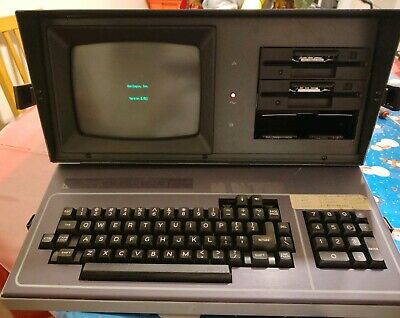
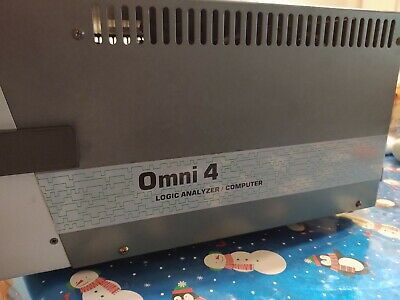
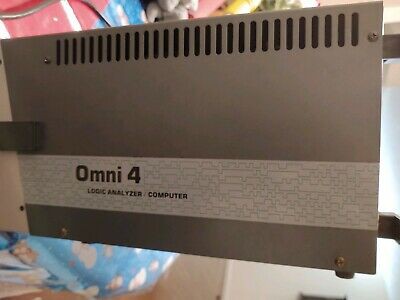
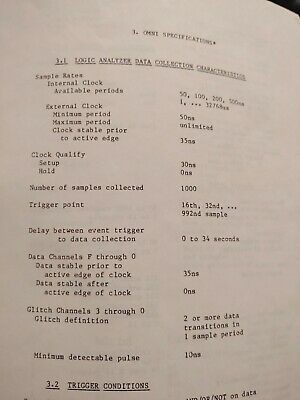
This KayPro-based "Omni4" logic-analyzer is pretty impressive, for its time... And still certainly usable/useful. 20MS/s on 16+ channels...
30 years old, and it booted up right away, despite having its diskette clamped in its heads for probably decades.
I can't find much on the ol' interwebs about this machine, so it's plausible this is amongst only a few remaining system-disks on the planet!
But copying this aging diskette turned into quite a feat. Many Months of work. Check out the old logs.

Here be other things OMNI 4, as well!

FLOPPY DISK IMAGE HAS BEEN SUCCESSFULLY EXTRACTED.

and this project-page has since become about many things OMNI 4.

Check out the old logs for floppy-disk extraction endeavors.

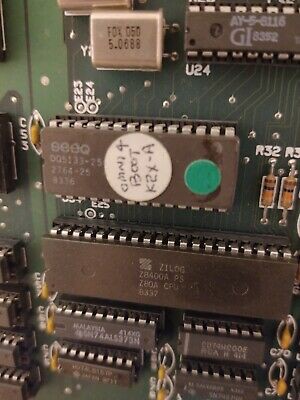
Newer logs are mostly @ziggurat29's amazing work looking into the boot and character ROMs, and even some explanation of the initial/low-level boot process/hardware!

---------

Based on the limited info I can find on the web...
(see a great article, here).

It would seem I've come across a system which may be one of only a few remaining in existence... or at least one of only a few that anyone's bothered to mention on the ol' interwebs.

And I've only got the one floppy disk containing the software for its unique hardware...


And thus beginneth my endeavor into learning a bunch about floppy-disks, drives, and more.

What I thought was going to be a one-night project with a floppy-disk imaging-utility like ImageDisk turned into several months of work, extracting as many sectors as possible via many different methods, including several scripts and a pretty large program I've written myself. Has turned into my learning about MFM-encoding, CRC-checking, Gap-lengths, and countless other factors of floppy-disks, some eccentricities and limitations of various floppy-disk-controller-chips, and more.

----------

So, what's the world-changing-ness of this project...? Well, as it stands, this little piece of history isn't too-well-documented... and if its lone floppy-disk fails before I can make a copy, the entire system could be lost to "bit-rot," plausibly leading its kind to extinction!

Don't want to see that happen!

And, otherwise, even if it's not so unique, at least it'll still be functional, keeping a chunk of metal from the e-waste bin and, with the right owner, giving this system a few more years of usefulness. 20MS/s is still plenty for many needs!

(Heck, most of it is based on well-documented and easily-sourced chips... it could very-well outlast the majority of systems in use today, 30 years after its birth).
OMNI4FIN.IMD

DISK IMAGE Use Dave Dunfield's imd117. Notes about special settings are at the top of this file (viewable via 'edit'). E.G. R/W gap=20, Format Gap=23. Some drives and/or PC FDC chips may not be able to handle these tight constraints they used to fit an extra sector on each track. Aside: The OMNI4's floppy drives CAN be replaced with 1.44MB 3.5inch drives(!). Block the 1.44MB hole on the disks with tape. And don't forget to change Drive-Select jumpers. 3.5in disks will only use half the available tracks (first 40 of 80, 400KB of 800KB (unformatted)) but do NOT choose DoubleStep!

imd - 353.86 kB - 01/09/2026 at 03:50

Download

Omni4 Article-Broadcast Engineering Nov1986.pdf

Adobe Portable Document Format - 17.47 MB - 10/16/2022 at 07:58

Preview

2020-01-27 - Organized OCRed 150PPI Compressed.pdf

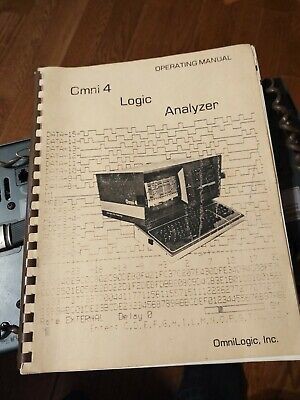
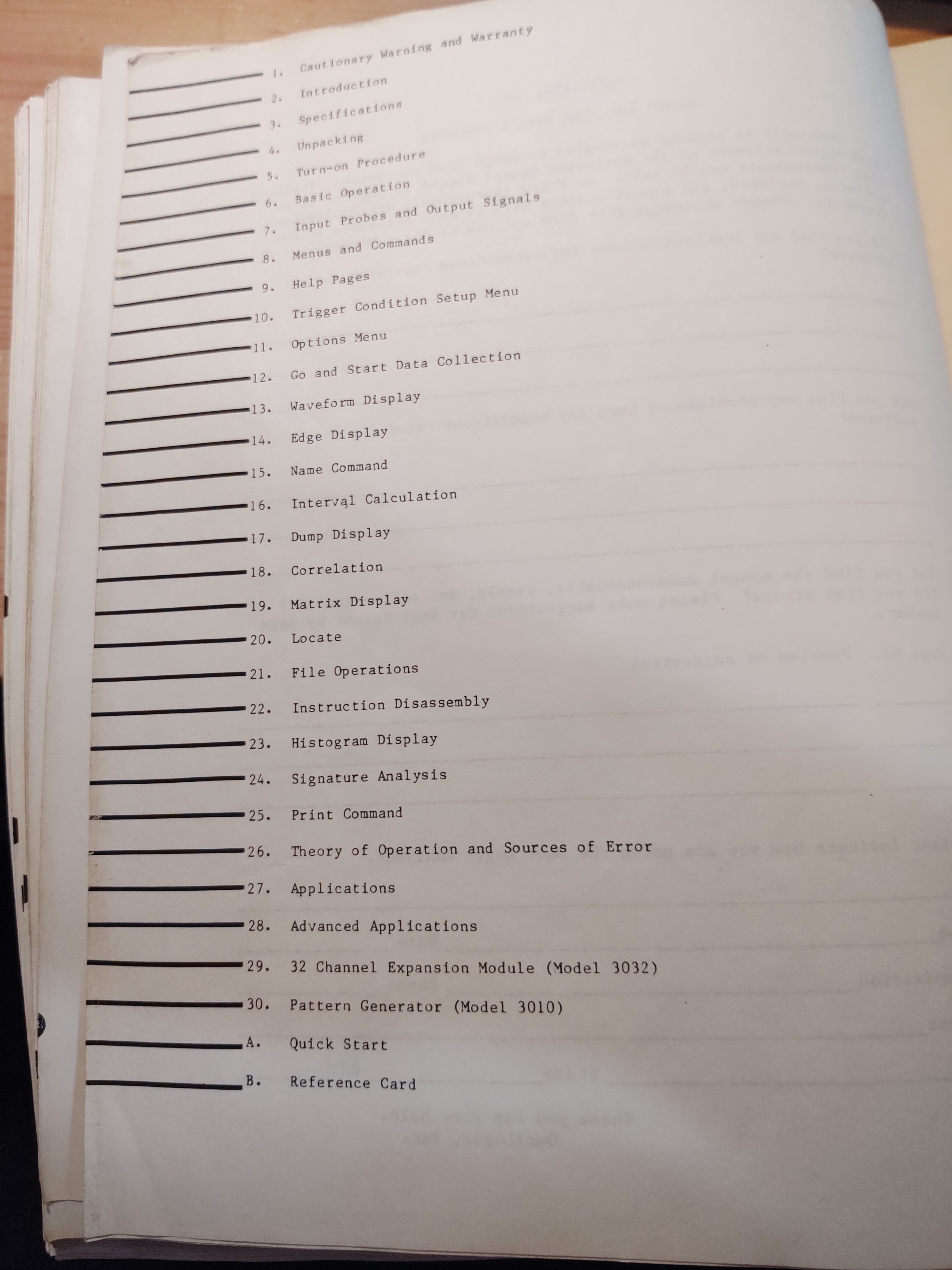
OMNI4 Manual! A sincere Thank You to Dominic for scanning this! My OCR technique leaves much to be desired, unfortunately. If you know of better or want the original-quality scans, feel free to contact me.

Adobe Portable Document Format - 43.69 MB - 01/29/2020 at 06:49

Preview

4625381579779084353.pdf

Kaypro Technical Manual, Dec. 1984, 1484-D For all Kaypro models. There's another in these files as well [TODO compare] Thankya @Dr. Cockroach, who also notes: "I see that 2X is double-density and double sided 390K and will also read/write Osbourne disks....if that means anything helpful :-)"

Adobe Portable Document Format - 4.30 MB - 01/25/2020 at 00:42

Preview

TEAC-FD235HF-A291--booleans.pdf

Floppy drive manual... this drive is *not* from the Omni4, but this manual has extensive data regarding the boolean-logic implemented in drives' circuitry regarding I/O. E.g. /STEP is ignored if /WG is active.

Adobe Portable Document Format - 481.84 kB - 11/15/2017 at 11:37

Preview

View all 14 files

  • 100 × blood
  • 1000 × sweat
  • 10 × tears
  • 400 × hours

  • Logic Analyzing with the OMNI4 - Part 2

    Eric Hertz3 days ago 0 comments

    It took most of yesterday to get the Hyperthreaded Pentium 4 machine up and running and loaded with the tools to write a new OMNI4 boot disk... And I had to wait until today to actually try it...

    But it worked!

    I now have several copies, and I tried a couple different interleaves in case I feel up to running speed tests.

    But, it works!

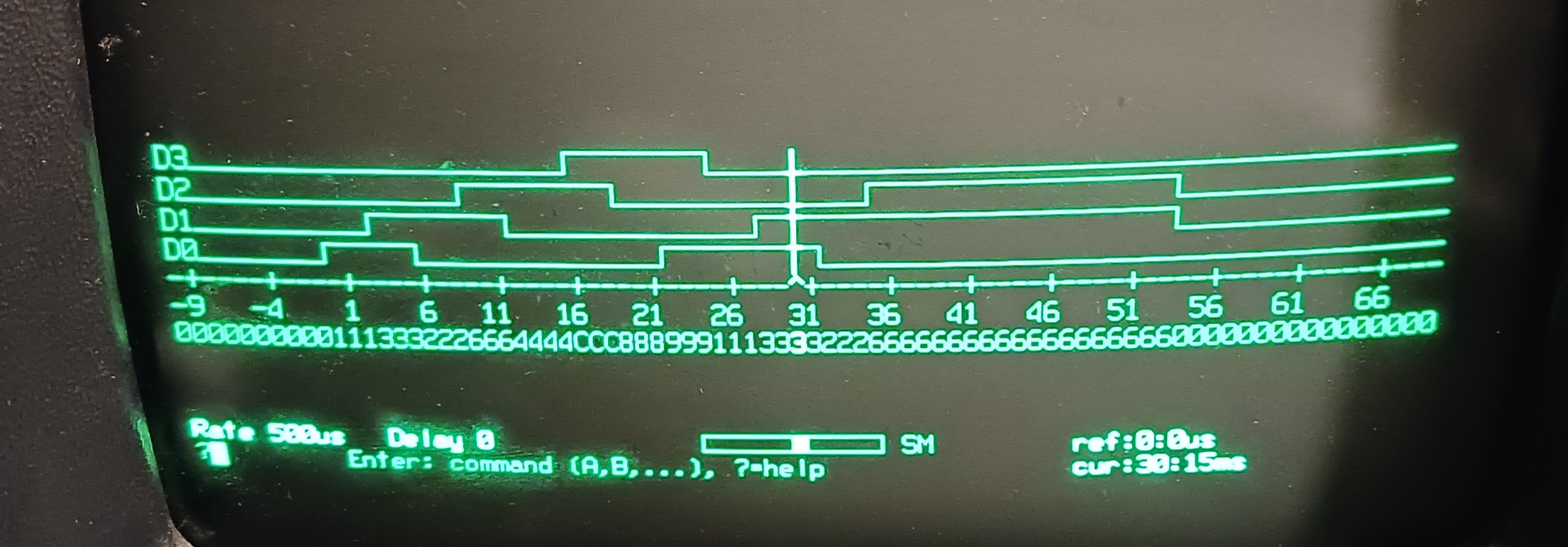
    Here is a plotter's horizontal stepper-motor moving one character (space) to the right...

    Analysis here:

    https://hackaday.io/project/204767-m-740-reverse-engineering-and-hacking-adventures/log/245582-brief-stepper-analysis

  • Logic Analyzing with the OMNI4 - Part 1

    Eric Hertz5 days ago 0 comments

    Nearly a decade(?!) later...

    I have a use for this machine, as-designed!

    #M-740 Reverse-Engineering And Hacking Adventures has me wondering about how that machine's two MELPS-740 (6502-derivative) microcontrollers communicate (and why!)...

    So I thought I'd dig out the ol' Omni4, which was made in the same year.

    It took a tiny bit of effort to get the Omni4 booted, mostly consisting of acknowledging that my A-drive is flakey. Swapping it out with B did the trick, and I started reading the online help to figure out a triggering scheme.

    I ran some really simple tests, just toggling a pin between its internal pull-up and ground... Seemed to work great!

    Then I read [most of] the manual, which is thorough, and was so-generously scanned by a fellow I met through here years ago. (mine didn't have a manual).

    Interestingly, the manual mentions at least twice that the disk should *not* be inserted during power-up, and *should* be inserted when the drive light is on. The claim is that CP/M is notorious for creating bad sectors if the disk is in during power-up/down.

    As @ziggurat29 pointed out, this is probably more about the drive-electronics and electrical glitches than about CP/M, but either way, the Omni4 manual makes a big point of it twice.

    I certainly had never worried about it before...

    All those years ago when I backed-up its disk, I'm pretty certain I treated the machine more like I'd always treated a PC, when intending to boot from floppy, and put it in *before* power-up.

    Aside from tgat, as surely I mentioned in the early log-entries here, when I dug the OMNI4 outta storage that first time, after numerous moves, I discovered its disk had been clamped in the read/write heads for easily the decade I'd had it, and possibly most of the decade it went unused before it was given to me... And... It booted as soon as I powered it up. And... Of course I went through several power-cycles at that time with the disk in...

    Maybe that's part of the reason I had such difficulty extracting the sectors... Maybe a power-glitch toggled an MFM-encoded bit, somewhere...

    So weird how that went... I tried *numerous* methods to try to recover the data... Oh the months... only eventually to essentially give-up and just run a script to repeatedly read each sector as many times as it took to get a valid checksum. I *really* did *not* expect that to work, but it did. Sheesh.

    So, I suppose, maybe, in the realm of MFM-encoding, it's plausible such a power/write-glitch could've occurred *anywhere(s)* on the disk surface... including, plausibly, somewhere *mid*-"bit".

    What would that mean, then? Well, *plausibly* since there's a clocking-reference at the beginning of each sector, and no guarantee of a clock alongside every "bit" thereafter, and thus a PLL is necessary to keep that clock ticking during the remaining "bits"... it's *plausible* that every time a sector is read it might actually *sample* the mfm-encoding (flux-transitions) at very slightly different timings... And maybe after a hundred tries it just happened to sample *past* or *before* the "glitch*...

    I think I can see how it's feasible, anyhow. Especially with glitches that might occur in one bit-level vs the other... because, as I recall (was it bit='0'?) the *data* encoding is officially something like <flux-change, no-flux-change> but *also* is sometimes encoded as something like <no-flux-change, no-flux-change>, wherein the lesser-common encoding is especially used during the PLL-clock synchronization pulses *before* the data...

    Hmmm...

    So, I guess the point is that a single flux-transition might get mangled (or inserted?) in a sector, and it *might* be possible to read the data correctly, on random-ish occasion.

    That *could* explain why the "brute-force" "just keep trying" approach eventually worked. Maybe... Heh!

    Whoa, sidetrack.

    Anyhow,

    Yesterday I was stoked to see something, so hooked up the probes (for my first time?) to some circuitry... and... "bad sector."

    Oddly, *after* I started being cautious...

    Read more »

  • Random Related Notes-To-Self

    Eric Hertz11/04/2024 at 17:26 0 comments

    Maybe one a deez dayz I'll wisen-up and throw a single "log entry" like this into my projects, early-on, and link it (singular!) in the project-description, or something, so it's easy for me to find, but doesn't flood the logs with a bunch of tiny notes-to-self... Especially annoying, because such things often pop-up months or years after I last worked on the project, and often the last log was worthy of being recognizable as the last directly-related to progress. I dunno.

    Anyhow: 

    Notes-to-self:

    avr-libc: util/crc16.h

    *looks like* some decent code and references regarding the CRC used on floppies. 

    (Which, for all who aren't in the know, was a deep rabbithole the OMNI4 led me into, that resulted in the discovery that many *respected* references on the matter turned out to implement it *very differently* than they *explained* it. [schematic diagrams using shift-registers did *not* match the code implementations]. And, the further discovery that that disconnect seems to exist in MANY references on LFSRs, in general... which may very well be why I had so much trouble implementing one in my capstone class ~20 years ago. BUT, while working on the OMNI4, I finally noticed that disconnect in numerous resources, and agonizingly convinced one to correct it... heh. So here are some more direct references I might one-day compare my findings to.)

  • Hack Idea...

    Eric Hertz10/15/2024 at 00:16 0 comments

    While I'm very *pro* keeping this thing in original form... I haven't really found much use for it. (Mostly, maybe, due to so many project-ideas, and "real life," whatever that is).

    ...

    Weird idea... first some background...

    This interesting article came up about an electronics-related archaeological endeavor...

    https://hackaday.com/2024/10/14/solving-a-retrocomputing-mystery-with-an-album-cover-greengate-ds3/#more-727779

    (and Part 2: https://hackaday.com/2024/10/14/the-greengate-ds3-part-2-putting-a-retro-sampler-to-use/ )

    ...

    Following Adam Fabio's rendition of the story, I was running through the ideas of what the mystery-chip could be, but didn't quite get there on my own... OF Course! A DMA controller! How else would a system of that vintage keep up with the timing demands of sampled audio?

    Which led me to the observation that... Heh, that was one of the big-learns from my [our] archaeological endeavor with this system, the Omni4... DMA controllers running the bus and RAM far faster than the Z80 CPU could... at a time when, frankly, it was darn-near shocking to look back on and believe such speeds were possible. 20MSPS!

    ...

    For a brief moment I considered the possibility the Omni4's logic-analyzer add-on card (being an otherwise stock Kaypro machine) might just be capable of doing for the Kaypro what the card in the article did for the AppleII... Heh!

    This is my brain, and why I have so many project-ideas and actually get to doing so comparatively-few.

    I'm no musician, anyhow... But I know a thing or two (built most my career around) MIDI, so I suppose adding a keyboard would be a snap in comparison to writing the software...

    Heh. The original software-architect for the AppleII product was, apparently, pleased to be approached about his long-forgotten masterpiece... Heartwarming.

    Wonder if he'd cough-up sourcecode. Heh! 

    6502 assembly, maybe? What a friggin ridiculous undertaking this would be... especially for a long-forgotten, if ever even recognized, board that only seems to exist in two machines in the world, OTOH... OTOH...

    ...

    The "Heartwarming" aspect of this article is really what gets me. There's no particular reason to go down a path like they did. Nearly any keyboard can be connected to nearly any computer these days, and loaded-up with one of probably dozens of softwares to acheive the same as this setup, and probably far more.

    OTOH, these folk found the time and cause to remember some other folks' long-forgotten hard work... And part of my early draw to electronics and software is its duplicatability, specifically in the interest of its longevity. 

    Some folk got together long ago and created their "baby"... It wasn't the best of the best, by any means. Sure, the Fairlight won that competition hands-down. But, here, these folk, complete strangers to the originators, have gone out of their way to make sure that forgotten baby has offspring... Beautiful tale.

    ...

    I have no idea how that fits with the Kaypro/Omni4 idea, except in that plausibly it wouldn't be difficult to reproduce that card, similarly. But, well, 20MSPS logic analyzers sized to fit 5.25in floppies aren't particularly desireable nor useful, even to the hardcorest test-equipment collectors... But maybe it's just a matter of software and a tiny add-on (for output) to turn it into something more... an alternate timeline where Kaypros were competitive with AppleII's competitiveness with the Fairlight. Heh!

    But, see, it could be more than that... Card-interfaces back then were quite simple... Really not much more than tapping off the CPUs' memory-bus... So, I mean... It wouldn't be implausible to use either of these cards in *any* 8-bitter system (even, say, an AVR)... with some software-generalizing and new plug-ins...

    OK, yeah, a bit carried-away. But, not implausible. And, for an hour or so, there, I was pretty excited about the possibilities. Enough to start writing about it, anyhow... with two friggin' thumbs. Heh!

  • This would be so wrong...

    Eric Hertz12/04/2021 at 21:32 0 comments

    ...but yahknow I love hacking things together that were never meant to work together...

    No! NOT with the Omni4, it's already unique... but another Kaypro, or similar style/era luggable maybe... dual-head!

    dunno what it'd be useful for, and would prb require a custom add-on vidcard with custom supporting software... ok, it's kinda ridiculous.

  • A Manual!

    Eric Hertz01/29/2020 at 07:00 2 comments

    Dominic--who happens to be selling the only other OMNI4 I'm aware of in existence--very kindly scanned and sent me the user manual [possibly the only in existence] for posterity! 

    A copy is in the Files section.

    BTW, Dominic's been quite awesome taking the time to do this and more. If you're intrigued by the OMNI 4, consider purchasing it from him at:

    https://www.ebay.com/itm/Vintage-KayPro-2x-OMNI-logic-analyzer-computer-w-manual-cables-and-case-/283740420168?pageci=60b866f1-af76-4464-bc0a-a87cad5211c6

  • More

    Eric Hertz01/25/2020 at 01:02 1 comment

    Very difficult to edit a log full of pictures, they seem to randomly disappear.

    Here's a couple more photos from the seller of the other unit [see last log] who has been very considerate in this venture. Muchas Gracias, Dominic!

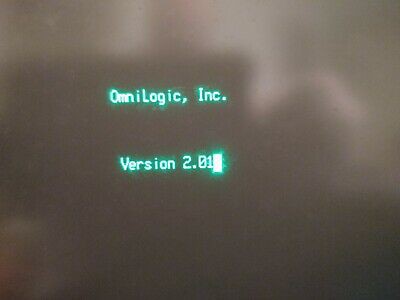
    Check out my screenshot [from an old log] and compare to above, 1984, 1987!

    "OmniLogic INC was located at 350 Sunset Blvd. N. ,Renton, WA. 98055"

    Mmmmhmmmm, just miles away from where I acquired it. Maybe mine was in fact a prototype, or pieced together from spare/unsellable parts, or something.

    TODOs: There's some great info in these photos from the manual, put it in a log!

    E.G. some comparison to the OMNI II? Not quite grasping what it's saying, the disks are compatible? Gonna have to dig deeper.

    E.G.2. A listing of the files and their purpose


  • Another Exists!

    Eric Hertz01/23/2020 at 09:25 0 comments

    These photos are of another unit found recently on ebay. [Photos used with permission]

    https://www.ebay.com/itm/Vintage-KayPro-2x-OMNI-logic-analyzer-computer-w-manual-cables-and-case-/283740420168?pageci=60b866f1-af76-4464-bc0a-a87cad5211c6

    If you decide to purchase this unit, please keep in touch, and consider joining the 'team' here to contribute!

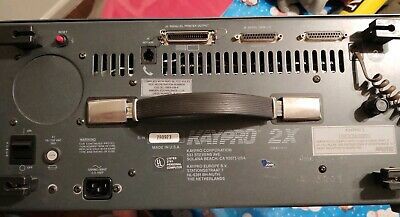
    This unit differs from mine in at least one notable way; mine doesn't say anywhere on it that it's a Kaypro 2x. @ziggurat29 had to figure this out by looking up Kaypro motherboards!

    [Also, an odd note, apparently when using 'cpmtools', one must select 'kpiv', even though the Kaypro IV is an entirely different beast(?)]

    [TODO: take similar shots of mine for side-by-side.]

    This appears to have the drop-down door type latch floppy drives, whereas mine has the rotating lever-latch.

    A manual!

    "Kaypro 2x" heh, that'd've been handy

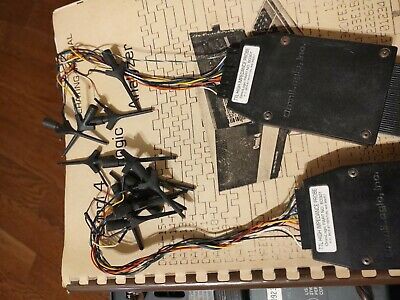
    Hmmm, my pods are merely heatshrunk, and their cables merely ribbon cables. [And, crosstalk/interference was an issue]. Seems even more plausible, now, mine might've been a prototype?

    A carrying case!

  • DRAM Refresh....

    Eric Hertz11/07/2017 at 08:28 4 comments

    UPDATE: Whoa Whoa Whoa..... (at the bottom).

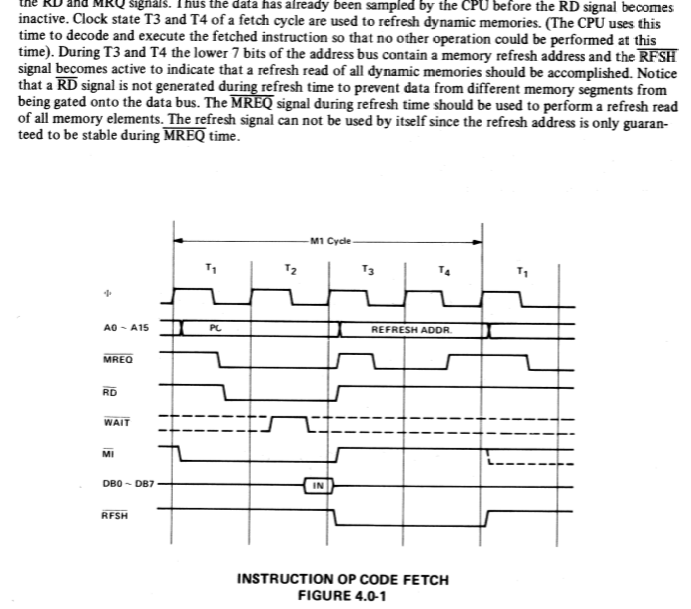
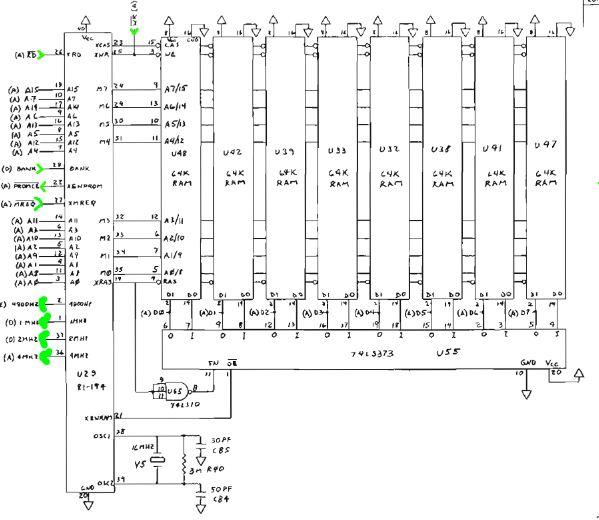
    So, the question, earlier, came up regarding how the DRAM gets refreshed, if the /REFRESH pin is N/C (which it appears to be, according to the schematic).


    and dammit if I didn't have a long write-up on the matter, and lost everything after this point. So, I guess I'll get to the point.

    There's really no *need* for the /RFSH signal. At least with typical DRAMs. Basically, a row in the DRAM is refreshed whenever a row is accessed. And for a typical Read/Write operation, the row is accessed first, then the column, then the Read/Write signal is sent. So, the row gets refreshed with every read/write access.

    So, why not treat *every* address placed on the address-bus, accompanied by /MREQ, as a Row AND Col access, as though for a read/write? And... now I'm pretty sure that's what happens.

    Simple.
    And I'm betting the custom chip doesn't contain any specialized logic regarding refresh.

    ----------

    There's still the issues of BANK and /PROMCS, and how those are related to the DRAM... My guess, again, is that *every* address-access on the Z80's address-bus, accompanied by /MREQ, accesses a memory-location in the DRAM (even, for instance, when the ROM is being read).

    BANK is controlled by a bit on the "system port" register... That, as we understand, chooses whether to do memory-accesses from the ROM or the RAM. So, e.g. during boot, BANK directs it to the ROM, then after boot, its directed to the RAM where the OS is stored, etc. (There's some debate as to whether the "BIOS" in the ROM is accessible to applications once the bank has been switched to RAM... E.G. if there could be, say, routines in the BIOS for displaying characters on the screen, could that be called from a user-application, switching into the ROM for execution, then back into the RAM for the next portion of the user-application? I'm sure there are ways, but they may not be pretty... e.g. storing *pieces* of the same code in both ROM and RAM, at the same locations... I'm sure I can find out with further analysis of Ziggurat's ROM disassembly).

    So, obviously, when BANK is set to ROM, /PROMCS gets activated with /MREQ, but /XENRAM does not. But, then, when the ROM is executing (during boot), the RAM still needs to be refreshed... so its still feeding *every* address-access to the row/col system... Which is fine for /RD, since /XENRAM is disabled and therefore the data in the DRAM is not written to the data-bus...

    But what about Write...? /WR is not gated through the custom chip, it goes *straight* to the DRAM!

    Ah hah!

    Write... Never Happens to the Read ONLY Memory.

    OK-then...

    Now this leads me to the question of how the ROM can access RAM, for storing variables, etc.

    In what I've seen of Ziggurat29's disassembly, it seems the stack-pointer is set-up in a high-address, e.g. 0xff00... and it seems most other variables are stored up there, as well...

    So, then, BANK only switches between ROM and RAM in the *lower* addresses, and always accesses RAM in the higher ones... simple enough.

    And, again, by treating the RAM as though it's being accessed even when the ROM is, but gating the RAM's /RD signal (/XENRAM), it still gets refreshed.

    This custom chip is starting to seem quite simple, really... a few gates.

    (As Ziggurat29 pointed out a while-back, the 2x motherboard uses this custom chip, but the earlier motherboards are similar in design but use discrete logic instead... I've been meaning to look at those, but haven't yet. All these ramblings are from the perspective of treating it like a black-box... I guess it's kinda like doing math homework where the answers are in the back of the book... should I go look?)

    -----------

    Whoa Whoa Whoa!!!

    that /WR signal is *directly* connected to the DRAM chips! And they don't have Chip-Selects! That's fine for ROM... but...

    What the heck happens during an I/O write!?

    ... "/CAS is used as a chip select activating the column decoder and the input and output buffers."

    So, maybe I'm mistaken in...

    Read more »

  • 'round the web...

    Eric Hertz11/06/2017 at 12:24 2 comments

    1) An image-search for '"Omni 4" "Logic Analyzer"' results in many hits from this project-page... pretty cool. OTOH, it's quite strange, saying that many of the images are "4-5 days ago" that were actually several months ago. (is it 4-5 days ago that Google crawled on 'em?)

    2) A resulting-image doesn't show anything related to the OMNI4... so I clicked through to the page to see what Google thought made it relevant... Apparently MAME now comes with the OMNI4 ROM (?!)

    http://www.filehorse.com/download-mame-32/change-log/

    "October, 26th 2017" ... "Changelog" ...

    "What's new in this version:" ... "New clones marked as NOT_WORKING:" ... "- Omni 4 Logic Analyzer [rfka01]"

    hmmm....

    A bit more research...

    https://git.redump.net/mame/commit/?id=68a53889a02c21f9b0c6f58c613faf4eaea8a973

    Added as a 'diff' patch 10-15-2017.downloads/mame/mame-0191/

    Cool! Glad to see it won't get lost to bit-rot. Is this your doing @Ziggurat29?

    ...ah... the ROM's not included with MAME's source-code... so I guess it still has to be downloaded from somewhere.

View all 46 project logs

Enjoy this project?

Share

Discussions

Ken Yap wrote 01/22/2020 at 05:32 point

I used to have a DOS program that could read many flavours of CP/M diskettes including the Kaypro luggable by programming the 965 appropriately. That was almost 30 years ago I think. Might still be in some DOS shareware archive. Edit: I think it's 22disk.

As for the refresh, does this machine use a Z80? You know that it implements hidden refresh right?

  Are you sure? yes | no

Eric Hertz wrote 01/22/2020 at 05:44 point

believe me, I tried every disk imaging utility I could find, and several different drives. Hundreds of sectors were unreadable, feel free to look through the old logs to see how it went, it's explained in great detail.

Nope, didn't know about Z80. Interesting.

  Are you sure? yes | no

Ken Yap wrote 01/22/2020 at 05:49 point

Ah the floppy is probably unusable then.

  Are you sure? yes | no

ziggurat29 wrote 09/06/2017 at 21:46 point

minor point since I was just re-reading your logs (to download some of the blurry board pics for comparison):  'denatured alcohol':  it's alcohol that has toxic stuff added, so you can't drink it.  (Otherwise it is ethanol, which you could drink, but then there'd be tax and whatnot on it).  The stuff they add is wide and varied.  We used it as kids for the alcohol lamp in our chemistry set.  You can probably use it just fine as a solvent, too.  But 'maybe', because as I said, the particular denaturant used is vendor-specific.  Usually it's methyl alcohol, though, so you'd be fine with that.

  Are you sure? yes | no

Eric Hertz wrote 09/07/2017 at 05:15 point

Stupid phone deleting responses.

Thanks! Methyl is the claim on the label. I'm no chemist, so your word is helpful.

Photos... I'll definitely be taking better photos and documenting the major chips... may be a bit since it's assembled finally...

Something specific?

  Are you sure? yes | no

ziggurat29 wrote 09/07/2017 at 14:38 point

Truly, I was trying to get a better handle on the unit's specifics in advance of attempting to disassemble the software on your disk image you so meticulously restored.

I am currently guessing this is a 'Kaypro IV'.  Kaypro's numbering was confusing; there was a '2' and a 'II' and a '4' and a 'IV', which were quite different.  E.g. the 'IV' ran a 2.5 MHz, and the '4' (release less than a year later) ran at 4 MHz.  The 'IV' and '4' had significantly different electronics designs (as I understand), but the 'IV' and the 'II' were electronically similar, apparently differing in the upgrade of the DSDD drive.
I did find a schematic to the 'II', but not the 'IV', so I'm hoping those similarities hold true.  I also found a manual for the CP/M for that unit, but not for the various 'Perfect Suite' apps that shipped with it.  And of course not the Omni4 manual (do you have that?).  (I can send you all these docs, of course, if you want them.)
Anyway, don't go out of your was to take it apart again, but it would be useful to verify some assumptions at some point, so let me know if you have plans to re-open and I can send you some more pointed questions (or I'll just formulate some anyway and send those to you for future).
Lastly, it seems there is coincidentally a guy in Oregon (I think) who also recently found one of these units, albeit the prior model (Omni2?), who alas does not have floppies or manuals.  What a weird coincidence!

  Are you sure? yes | no

Eric Hertz wrote 09/08/2017 at 00:44 point

Mr. Gung-Ho!

Alright, I'll throw more energy in trying to document this thing... I have to open it up for the latest floppy-endeavor, anyhow.

I *think* It's a Kaypro 2x (?) But I'll get on figuring that out as well.

No manuals, but the help file is full of info (except, now I recall there's a section that says "to be completed" or something... more in favor of its being a prototype?)

Ah, right... it's *difficult* to read these files without knowing the model-number/OS since they all use different methods of storing the files... I gave up at that point, managed to get a directory-listing via a linux-box I think, but not sure I ever came up with the right combination of 'mount' settings to access all the files...

Interesting about the Omni2, link?

  Are you sure? yes | no

ziggurat29 wrote 09/08/2017 at 02:07 point

Oh yes, I'm quite serious when it comes to disassembly.  It's a bizarre fetish of mine -- I don't know why, but I find it very relaxing.  Maybe it's the same thing that impels some folks to fiddle with watch mechanism.

Anyway, this is your project of course, so any looking you do is purely a bonus for me and don't derail your other plans my account.  I currently have some trouble with the disk image you placed in the 'files' section.  It's probably something I am not doing correctly in reading it -- I can read the directory, but I cannot reconstruct the files.  I sent a more detailed explanation via PM (figuring most folks would prefer my not polluting your discussion area with longer messages).

Upon revisiting the Omni2 inquiry stumbled across yesterday, I now see my memory failed me and that it was not so recent: 2013.  (But in the 34 years since the unit was current, what's 4 years?)
http://www.vcfed.org/forum/showthread.php?37166-Omni-II-Logic-Analyzer-Computer

Cheers!

  Are you sure? yes | no

ziggurat29 wrote 08/31/2017 at 23:12 point

Could your PCB mess you were dissolving with alcohol be a conformal coating?  It was popular in the day.
Pity the board picture in your mar 30 post was blurry (I know, I have the same trouble with phone cams), but I'm assuming its a Z80 board.

  Are you sure? yes | no

Eric Hertz wrote 09/01/2017 at 05:03 point

thanks for reminding me of that post... lotsa comments there regarding what that coating may be and how to go about solving the mess... not sure where I got the idea it's lacquer. Funny thing it's only on the logic analyzer board but not the motherboard.  The logic analyzer board doesn't have a processor... just a couple DMA controllers, as I recall. The motherboard is z80.

  Are you sure? yes | no

ziggurat29 wrote 09/01/2017 at 14:07 point

It seemed unusual to me that unusual that it would be used at all, but I suspected that it was just a common practice with the assembly house they used. Now that you mention it is only on one board, I'm not so sure.

Conformal coatings were typically used to control things like dielectric and to avoid ambient humidity being absorbed into dust and changing resistances (in very high impedance circuits).  It was particularly used on analog boards.  Maybe they were being defensive on the IO board design.

Anyway, if it is conformal coating, you probably can scrub away with impunity and a toothbrush, but I certainly leave that decision to you -- you don't want to break your toy!

Also, I myself have a bit of a fetish for disassembly (and in particular Z80 since that is what I cut my teeth on).  If there are any boot roms, or programs on that disk that you would like disassembled and commented, let me know.

  Are you sure? yes | no

Eric Hertz wrote 09/02/2017 at 05:22 point

wow oh wow! Disassembly of something like this could be quite something! I have no idea what I'd use it for, off hand, but that could be quite handy. If I understand properly, it uses a typical k2x bootrom, if so the application is the special part. 

Was half-tempted to bring it outta storage for something to fix up... and allegedly it only takes 65W, so could run off my inverter. Now the temptation is stronger ;)

Got me thinking... if the powder from the coating isn't a problem for functionality, it's probably best left alone, should anyone ever be interested in tracing out the circuitry... rather than risk ruining any markings on chips... then if the coating itself is blocking a marking it could be spot-cleaned... ugly, but maybe better than risking further damage.

And you probably got it... the board house probably did it... the other boards seem to be standard kaypro stuff... and otherwise the omni4 stuff is just a sheet of aluminum and a custom painted case... of course the omni4 crew wouldn't make *everything*, now that you mention it.

Kden... it's settled, I'll take the blasted thing on the road!

  Are you sure? yes | no

ziggurat29 wrote 09/06/2017 at 15:09 point

OK, well I see you did post the floppy image.  I'm not sure what format that is in, but I'll study it.  I /should/ be able to reconstruct the files from it, sector-by-sector, if I can gain an understanding of the CP/M file system (which I'm sure is documented somewhere).

Anyway, if I can do that, then I'll try some disassembly.  I'll certainly have to ask you about electrical stuff along the way, since I don't have the physical box to study.  Hmm, I should probably search for a Kaypro schematic -- that might exist somewhere, and would save some trouble in figuring out the standard stuff.

  Are you sure? yes | no

Greg Kennedy wrote 03/29/2017 at 15:44 point

Well done!

So... when are you building the Floppy Disk Emulator, to store the image on flash and serve it entirely solid-state to the machine?

  Are you sure? yes | no

Eric Hertz wrote 03/29/2017 at 23:59 point

You know I thought about it... They do already exist, though... ;)

  Are you sure? yes | no

Dr. Cockroach wrote 03/29/2017 at 08:34 point

Oh boy, Blood, Sweat and Tears. You should win something from the contest for all that effort if it was up to me :-) There must be

many older systems out there that need that kind of love and attention to keep them going, Great Job :-D

  Are you sure? yes | no

Eric Hertz wrote 03/29/2017 at 08:58 point

hahahahaha... I dunno if I've got that in me... I like the concept, it kept me going... I even thought maybe my unknown-calling was as an archaeologist. But boy was I ready for that much-needed sense of completion! but... "I wonder if..."  ;)

  Are you sure? yes | no

Dr. Cockroach wrote 03/21/2017 at 19:45 point

Hey there eric, Man you have put in a lot of work on finding those sectors, I know that I could not have stuck with it as you have :-)

  Are you sure? yes | no

AVR wrote 03/03/2017 at 12:35 point

what a sick find dude!

  Are you sure? yes | no

Eric Hertz wrote 03/03/2017 at 20:18 point

Indeed! 

It was given to me many years ago from an old boss who I think had it for many years prior without probably ever having used it. I just turned it on for the first time a few weeks ago, having figured the floppy-disk would've been long-ago corrupted to the point of unusability. Turns out the darned-thing booted right up into the program without a hitch! 

The only hitch was when I tried to make a backup of that floppy... which I've been doing for the past three weeks(!)

  Are you sure? yes | no

Dr. Cockroach wrote 03/03/2017 at 12:00 point

Man oh man, that brings a few flash backs to me. I had a KayPro II quite a few years ago and the disk system never stopped working. But yea, better get a backup made asap :-)

  Are you sure? yes | no

Eric Hertz wrote 03/03/2017 at 20:28 point

This is my first KayPro and/or CP/M endeavor... But the machine is surprisingly robust. And, surprisingly, given its age, still useful.

It's reassuring that you had a good experience with the disk-system. I've been a bit hesitant to believe floppy-disks/drives can be in any way reliable, and have been proven wrong on several occasions with this system. (Seriously, the heads were clamped on the disk while the thing had been lugged-around and stored for decades, and it booted right up!)

If it weren't for the fact this appears to be a one-of-a-kind floppy (can't find any images, or even mention of *users* on the interwebs), I'd be tempted to just use it until/if it wore out. But, yeah, probably shouldn't do that when it seems to be the only one in existence.

I think you're right, this appears to be a relabeled/modified KayPro II.

  Are you sure? yes | no

Dr. Cockroach wrote 03/03/2017 at 21:17 point

Hello again, Just my three cents but I would just keep it the way you got it. I know how it is with the cord for the keyboard, the Kaypro II was the same just not CP/M. If you ever tire of it I sure would not mind providing it a good home ;-)

  Are you sure? yes | no

Eric Hertz wrote 03/03/2017 at 22:31 point

Awesome! I'll definitely keep you in mind. And I've no doubt you'd give it a much-better home/purpose than I. I'll likely be getting back to #sdramThingZero - 133MS/s 32-bit Logic Analyzer sooner or later... once that thing's functional, I'd probably just be putting this guy back into storage. Though the thought of having a logic analyzer to work on my new logic analyzer is slightly appealing, if you can wait for a while :)

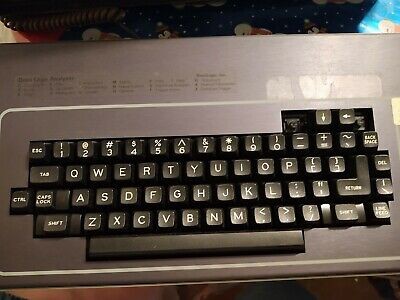
Glad you spoke-up about the keyboard. It's an annoyance, but I can imagine a modification like I'd attempt could de-value a vintage.

--------

Hah, I just remembered I have *another* logic-analyzer (peripheral) which I tried to back-up its floppy-disk a while back with errors, as well. I'll look into that one next, maybe this guy'll be available sooner than later.

  Are you sure? yes | no

Dr. Cockroach wrote 03/03/2017 at 22:54 point

Hey, that's cool beans Eric :-) Take your time but I do like the older systems. Kinda why I am building IO Lol 

  Are you sure? yes | no

Similar Projects

Does this project spark your interest?

Become a member to follow this project and never miss any updates