
 Ken Yap
-
Replacing floating point by fixed point for the AHTxx sensors
05/31/2026 at 08:35 • 0 comments![]()
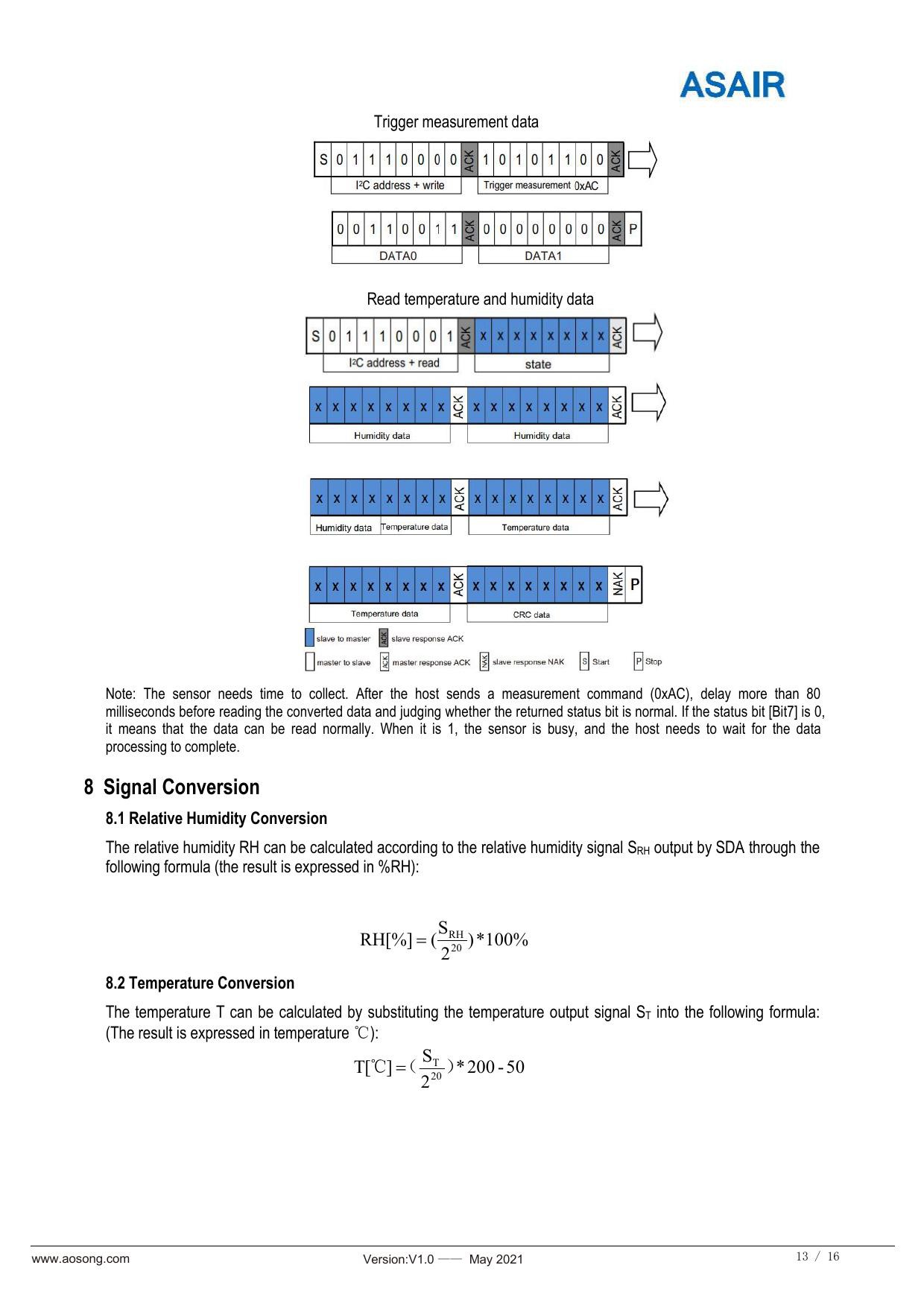
The AHTxx series of sensors, e.g. AHT20, AHT30, measure temperature and humidity. The sensor returns 20-bit values for measurements. They are to be converted to °C and %RH by the formulae given above.
All the libraries I've seen so far do the calculation in floating point. For a small MCU that doesn't have native floating point this pulls in extra library code. I wanted to see if this could be done with fixed point arithmetic.
First the humidity calculation. If we load the raw value into a 32-bit variable, multiplying by 100 will not overflow as the max value is 2^20*100. So we do this:
uint32_t l = raw * 100;
Next instead of dividing by 2^20, we divide by 2^16. This can be done by shifting right 16 bits (effectively taking the MSW of the 32-bit value).
uint16_t w = l >> 16;Now the integer part of the humidity % is in the top 12 bits and the sixteenths of % in the bottom 4 bits. We store these separately. For display we can convert the fractional part to a number between 0 and 10000 in steps of 625, and then use as many decimal digits of that as we want (the accuracy won't be as good as 1/16th %RH or °C anyway). Even a 16-entry lookup table will suffice.
hum->frac = w & 0x0F;
hum->whole = w >> 4;
A similar calculation is applied to the temperature, except that we multiply by 200. For the temperature range of this sensor this also will not overflow 32 bits. After isolating the integral part we subtract 50. Here's a catch: If the result is negative, then we must add 1 to the integral part and subtract the fractional part from 1 (actually 0b10000 since it's in sixteenths) so that both parts are non-positive.
This has been tested with an ESP8266 module (because of the 3.3V supply requirement) driven by an Arduino sketch.
-
I'd been doing resistor binning wrong
05/29/2026 at 09:58 • 0 comments![]()
I have a collection of axial resistors from long ago; I think it was a grab bag purchase. I had organised them into 12 containers for the E12 series (non-E12 values like 50k went into the closest bin). I realised I had been organising it the wrong way. When I want a value like 50k, I went looking in the 47 or 56 container, but I might be happy to accept anything from 39k to 68k.
So I reorganised them into half-decades, splitting a decade at sqrt(10) or roughly 3.12. Thus 1 to 3.3 in one bin and 3.3 to 10 in the next bin.
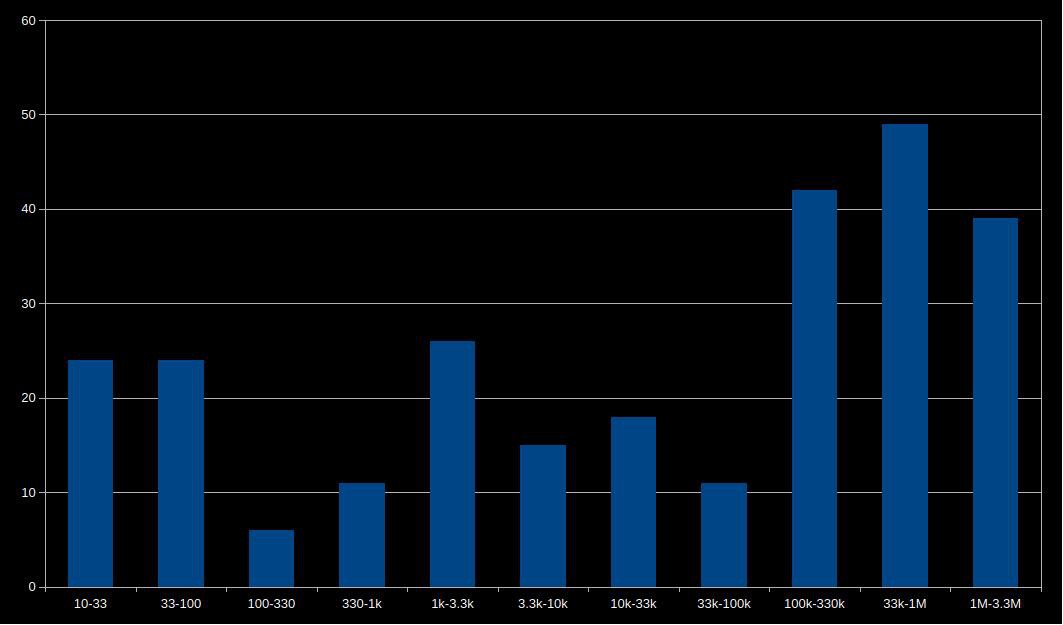
Curious as to how many I have in the bins, I weighed the containers, taring with an empty container. The results are in the chart where the vertical axis is grams, and the horizontal axis is the value in ohms. As expected my projects have depleted the middle bins. But I don't think I'll get to use up the 2.2M resistors before I move over to surface mount resistors.
-
Cheap programmable time modules
05/04/2026 at 12:41 • 2 comments![]()
These modules can be found on AliExpress for a few cents each if you buy 5 upwards.
![]()
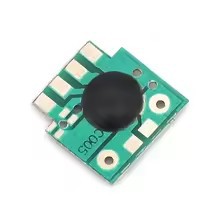
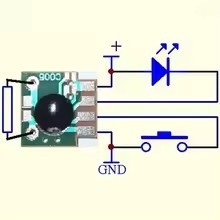
It's a 12x12 mm module with the chip under the blob, typical of other cheapies like doorbell generators. The circuit shows that a resistor "programs" the delay, between 2 seconds and 1000
secondshours. It is powered by 2V to 5V so suitable for digital logic. It's effectively a non-retriggerable monostable where a low transition on the input causes the output to go low for the programmed period. There is a reference to a selectable multiplier. I think this refers to the solder jumpers which can be used to increase the delay by 8 to the power of 0 to 3. The documentation is very scarce, there is no formula provided for calculating the resistance required. A reviewer said just as much. I'm putting a link to this on the stack in the hope that someone knows more about these.You'll need to buy $15 worth of stuff for free shipping so they could be used to top up an order to reach the threshold. I might get a few next order.
My Pages
Projects I Like & Follow
 Ian Dunn
 Alex Xia
 CanHobby.ca
 Guy Dupont
 BlackIoT SAGL
 Joren Heit
 Michael
 Just4Fun
 Michael Wessel
 Adam Wakelin
 Alan Boris
 supermarioprof
 Markus Loeffler
 Dave
Dave twodogstar
 Bohan Xu
 Wouter Minjauw
 Silica Gel
Share this profile
ShareBits


Thank you for liking and following my #Prehistory of my homemade PERSEUS computers !

Thank you for following my Sol-20 Reproduction project Ken.

Hi Ken, thanks for the like for my TD4.
As far as a CPU it is pretty useless but it makes a great demo because of the flashing LEDs.
This seems to be a Japanese trait. When I was in Japan even the vending machines had animations. The TD4 book is half electronics and half anime imagery.
I am looking a more powerful 4 bit CPU in the same style as the TD4 (but for the prototype, using an IC PROM rather than a diode PROM). Only pencil drawings on graph paper at the moment.
Regards AlanX

A CPU with 11 TTL packages is interesting because I probably have all the parts needed but pity it doesn't do much more than flash LEDs. Looking forward to seeing your design.
Hi Ken,
I had a re-look at the TD4 and I had design a Paged version (https://cdn.hackaday.io/images/1250221502460302068.png) that increased the program space to 256x8. An ALU can be mapped in RAM space (16x4) but I did not pursue that option further (I could see better options).
Also an ALU (say an 181) could be connected to the A and B registers as inputs and the output directed to the "Zero Port". That is, replace "Move A,Z+Imm" with "Move A,ALU+Imm" etc. The Page register could be used as a function register for the ALU. The ALU would need to output Zero upon reset and to return to Zero under program control. Such is the problem with 4 bits is that you need more OpCode space.
Finally you could replace the original adder with an ALU and control the function with the Page register. You would need to be careful to be able to recover the CPU from a lock state. It was at this point I decided to build a new 4 Bit CPU from scratch.
Regards AlanX
Hi Ken,
I completely forgot, I have a redesigned TD4B version of the board (based on the one shown in my project posts: https://cdn.hackaday.io/images/5564921527557781106.png) but without the RAM and tidied up. It has not been tested (one day I will assemble it) but it should work. PM me if you want one.
AlanX
Thanks @agp.cooper
I'll think start small, with a zero bit CPU, just like I started learning juggling with zero balls. TBH I haven't progressed beyond that point. 🤣
Thank you for your comment to my #PERSEUS-8 homemade 6502 computer !
Thank you for liking my #Homemade Operational Amplifier and your comment !

Hi Ken, thanks for the like!
You've got a couple of nice projects, and I like your motto. Tinkering with electronics can be meditation.
Hello Ken, thanks for liking and following my new project, the Kobold computer, https://hackaday.io/project/164897-kobold-retro-ttl-computer !
Yes, obviously like me you appreciated the cleverness of the PDP-11 instruction set where the PC being R7, load immediate becomes load indirect R7 with autoincrement.
Hi Ken, thanks for liking my #Isetta TTL computer !