 Yann Guidon / YGDES
 Dr. Cockroach
 Alex
Alex Arya
Arya Morning.Star
-
My first tape-outs
03/29/2026 at 16:50 • 0 commentsThis week I have had the chance to submit 8 designs to TinyTapeout ! Actually, 4 designs adapted to 2 nodes:
SG13G2:
https://app.tinytapeout.com/projects/3747 : https://github.com/ygdes/ttihp-HDSISO8
https://app.tinytapeout.com/projects/3758 : https://github.com/YannGuidon/miniMAC_tx
https://app.tinytapeout.com/projects/4039 : https://github.com/ygdes/ttihp-HDSISO8RS
https://app.tinytapeout.com/projects/4049 : https://github.com/YannGuidon/TinyScanChainCMOS5L:
https://app.tinytapeout.com/projects/4130 : https://github.com/YannGuidon/ttihp-HDSISO8_5L
https://app.tinytapeout.com/projects/4131 : https://github.com/YannGuidon/ttihp-HDSISO8RS_5L
https://app.tinytapeout.com/projects/4132 : https://github.com/ygdes/TinyScanChain5L
https://app.tinytapeout.com/projects/4137 : https://github.com/ygdes/miniMAC_5LThere are shift registers and experiments with the storage density, with an eye on reviving #DTAP - Debug and Test Access Port
And there are attempts to implement #miniMAC - Not an Ethernet Transceiver but they did not succeed. At least the Hammer18 circuit is working well but the gPEAC18 couldn't be ported.
But I'm indescribably thrilled and I can't thank the Tiny Tapeout team enough.
And Jeremy for sponsoring my first 2 tiles :-D
-
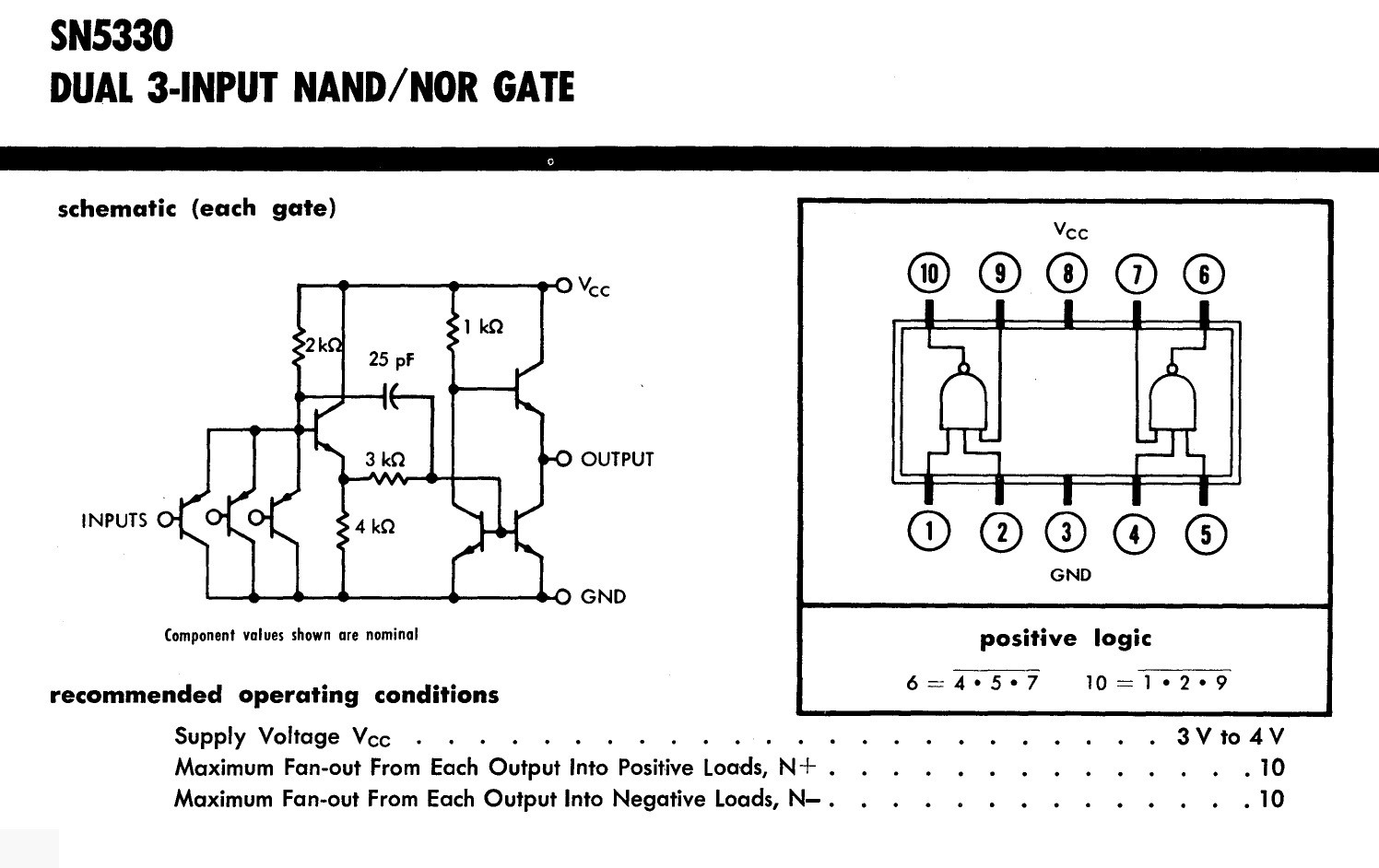
"Modified DTL" by TI
02/07/2026 at 00:59 • 3 commentsTTL is just a modification of DTL, itself derived from RTL...
In 1967 you could purchase this chip for about 11USD. Barely enough to build a dumb flip-flop.
![]()
Note that ECL would also use transistors as input buffers / impedance adapters but the amplification chain is different and DTL/mDTL/TTL saturate and have a much higher signal swing, much better noise immunity and ... longer cycle times.
The other difference with ECL is the use of complementary transistors, which make it harder to build with old transistors since they are mostly one polarity only. But it's a nice little circuit to analyse :-)
SRC: https://www.facebook.com/photo/?fbid=1419577419961171 (thanks to the author of the macro pictures)
-
Vintage bipolar analog switch
01/20/2026 at 00:52 • 1 commentIt's not exactly related to Ted Yapo's blog https://hackaday.io/project/162998-the-rise-and-fall-of-pulses/log/158851-a-toy-diode-sampler but it's close...
Inspired by Curious Marc's recent video:
I had to try a sim with Circuitjs and it works like a charm !
![]()
Why does it matter to me ?
Because I have struggled a LOT to make a DFF gate with bipolar transistors... I had found a version that looked promising for a latch but it became unstable when connected to other devices.
The insights of this pass gate could probably help solve this enigma at last.
Oh and I should get the polarities right....
And then, there is this gem : https://w140.com/tekwiki/images/9/97/Frye_s4_gate.pdf where the value is sampled at the falling edge, almost working as a DFF but with diodes.
My Projects
Projects I Contribute To
My Pages

Things I've Built
1KW LED lighting
2006: I designed and built all the electronics of a store's architectural element. 432 3W Luxeon LEDs split in 9 sectors with independent dimming with my first HTTP-based remote controller...
Lambda
LED desk lamp concept design. 2008
Drosephyia
Working as SubFlower, Igor & I built a sort of electronic plant in 2005 for an exhibition at Biche de Bere art gallery.
Projects I Like & Follow
 zpekic
 Tim Williams
 Robert
 Ryan
Ryan MatNieuw
 SHAOS
SHAOS Tim
Tim Rob Smith
 Jeroen Brinkman
 Keith
Keith Roland Brake
Share this profile
ShareBits


Bonjour,
j'ai déjà reçu votre sollicitation par message privé.
Votre projet ne correspond pas à mes capacités ou priorités et ne s'inscrit pas dans mes roadmaps.
Bonne chance
I feel so smug today.
Not having to include special formatting libraries to output debug messages in VHDL, be like
report character'val(13) & " Init=" & std_logic'image(Init)(2)

Hi Yann, thank you for following and liking my project #Isetta TTL computer ! Did you notice that you are following 1001 projects (or is that binary) ?
Hey !!!
thanks back roelh :-)
I thought it was way over 9000 ;-)

Thank you for liking, following and my #CMOS Homemade Operational Amplifier ! The offset adjustment is subtle, but ultra-high input impedance characteristics have been achieved. I am planning to conduct further operational experiments from now.
You're welcome ! I appreciate your works a lot !
Thank you for following me ! Recently, while verifying an application for calculating the position of a planet with a homemade floating-point interpreter, I found a case where the calculation stack operation was incorrect, so I updated the interpreter's code.

Hi Yann,
Merci for liking and following #MINITEL + ESP32 :))
Thank you for liking and following my #Homemade Operational Amplifier !
You're welcome !
You made me want to try this with Germanium transistors ;-)
This one looks pretty good: http://abload.de/img/je-918_documentation_9ab6k.jpg
That's a good idea! Please let me know if you get any results.

Thanks for following #But How Do It Know? 8-bit CPU Build !

Hey Yann, Thank you for the follow/like of #Starburst :-)
Thank you kindly Yann for the like/follow for #LLTP - Light Logic Transistorless Processor :-)
Like LEGO, synth design is something i'll never be able to rid my brain of.
IKR, I wake up sometimes after dreaming of stuff like this ;-)

You're welcome !
Designing crystal oscillators is a kind of dark magic so any help is welcome :-)

Hi Yann, thank you for liking and following the #Kobold K2 - RISC TTL Computer !
Hi Yann, thanks for liking and following the Kobold computer project !
Yann, thanks for re-liking #1 Square Inch TTL CPU. Did you see my new Kobold computer project ?
Bonsoir....je viens de créer une page pour mon projet: https://hackaday.io/project/205190-open-source-plfm-radar-up-to-20km-range .... Je cherche activement des collaborateurs